Expressing Food and Medical Support for Poor Countries at G7 Expansion Meeting
Establishing K-Rice Belt for Poor Countries
Expanding Emergency Rice Stockpiling System for Food Crisis Countries
Supporting Bio Workforce Training and Health Insurance System Establishment
President Yoon Suk-yeol expressed his commitment on the 20th to contribute to food aid and disease prevention for impoverished countries during the expanded session of the Group of Seven (G7) summit.
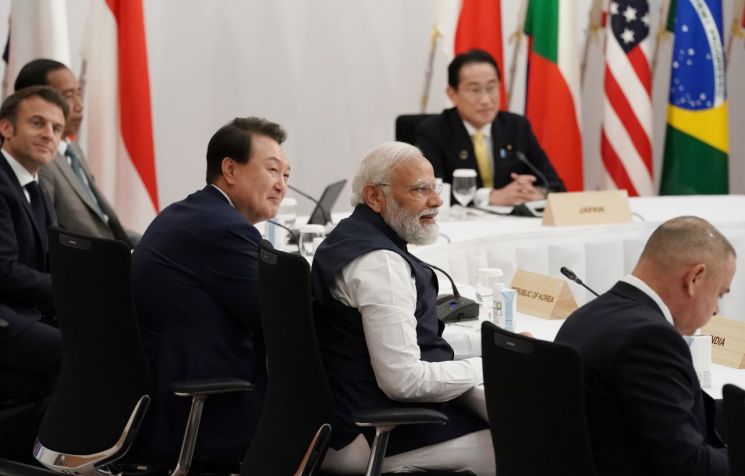
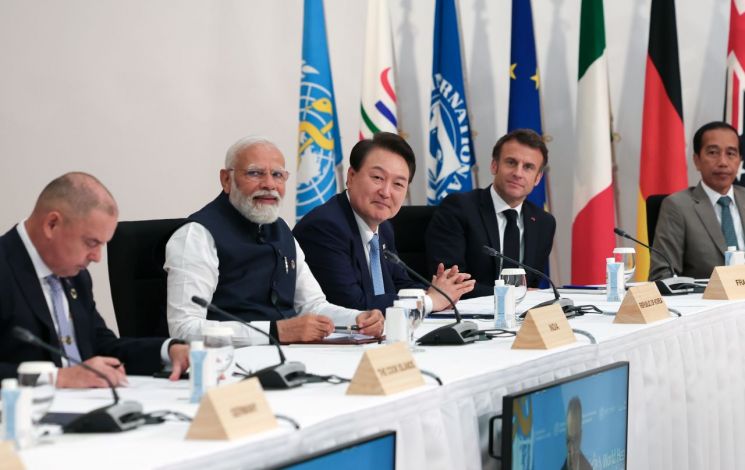
According to a briefing by Chief Secretary for Economic Affairs Choi Sang-mok at the local press center, President Yoon attended the first expanded session (Food, Health, Development, Gender) of the G7 summit held in Hiroshima that afternoon and made the remarks. President Yoon was the third speaker of the day.
President Yoon first expressed his intention to expand food aid to countries facing food crises. Since joining the United Nations World Food Programme (WFP) in 2018, South Korea has been providing 50,000 tons of rice annually to countries facing food crises such as Yemen, Ethiopia, Kenya, and Uganda. Chief Secretary Choi stated, "President Yoon announced that, taking this meeting as an opportunity, the amount will be doubled from next year to 100,000 tons annually."
He also mentioned expanding the emergency rice reserve system (APTERR) of the Association of Southeast Asian Nations (ASEAN) +3 (South Korea, China, Japan) for countries facing food crises and establishing a "K-Rice Belt" to support food aid for impoverished countries.
APTERR is a public stockpiling system started in 2013, where member countries pre-agree and stockpile rice reserves to prepare for emergencies such as food shortages and disasters, and provide emergency sales, long-term loans, or free aid during crises.
Chief Secretary Choi explained, "Although rice consumption is increasing in African countries, their self-sufficiency rate is low, leading to dependence on imports and the outflow of scarce foreign currency. The K-Rice Belt project aims to transfer South Korea’s rice self-sufficiency experience to African countries by providing rice seeds and cultivation technology." He added, "Pilot projects have started with six countries including Senegal, Gambia, Guinea, Ghana, Cameroon, and Uganda, and from next year, the cooperation will expand to more than seven countries including Kenya." While APTERR is a short-term support system, the K-Rice Belt is a mid- to long-term support project.
Support will be provided not only for food but also for disease and pandemic response. Regarding this, Chief Secretary Choi said, "President Yoon emphasized that the health gap between countries is a bigger issue than the viruses and bacteria themselves, and highlighted South Korea’s contribution to improving the health capacity of developing countries through related technologies and policy experimentation experiences."
Chief Secretary Choi also introduced, "South Korea is a WHO-designated bio workforce training hub for vaccine and biopharmaceutical production personnel from low- and middle-income countries. Since the hub designation in February last year, from June to the end of the year, a total of 552 personnel, mainly from low- and middle-income countries, received high-satisfaction training, and including online education, a total of 754 people were trained. The training facilities will continue to be expanded in the future."
President Yoon also expressed his intention to continue supporting universal health coverage (UHC) expansion and universal medical coverage in developing countries. He emphasized that South Korea’s health insurance system, introduced and rapidly established during its developing country phase, is a model case of UHC. Chief Secretary Choi explained, "President Yoon said that through the Knowledge Sharing Program (KSP) and other projects, South Korea transfers institutional design and implementation know-how to developing countries, and will continue to expand health and medical development cooperation projects implemented in eight Asian countries and five African countries through the International Health and Medical Foundation."
South Korea has pledged $24 million to the Coalition for Epidemic Preparedness Innovations (CEPI). CEPI is a public-private health organization launched in 2017 at the World Economic Forum (WEF, Davos Forum) with participation from countries including Norway and the Bill & Melinda Gates Foundation, aiming to raise funds for developing vaccines against emerging infectious diseases. The fund aims to reach $3.5 billion by 2026. South Korea’s contribution is expected to nearly triple compared to previous amounts.
Regarding this, a senior official from the presidential office explained, "South Korea, having risen from a recipient country to a global pivotal nation, is participating in expanding freedom from hunger and disease."
© The Asia Business Daily(www.asiae.co.kr). All rights reserved.