Yoon Invited by Japan to Attend G7 Summit
Growing Diplomatic Role, Check-and-Balance Dynamics Remain a Variable
President Yoon Suk-yeol's attendance at the Group of Seven (G7) summit held in Hiroshima, Japan, has drawn attention to South Korea's role on the diplomatic stage. There are also expectations that South Korea's status will change if the current G7 system is reorganized. However, considering the dynamics of the international community, there are also forces that seek to curb South Korea's expanded status, making the reality quite challenging.
President Yoon visited Japan from the 19th to the 21st as an observer country at the G7 summit. This is the fourth time a South Korean president has attended a G7 summit. During the three-day, two-night stay in Hiroshima, President Yoon will hold bilateral summit talks with the leaders of Japan, the G7 chair country, as well as Australia, the United Kingdom, Vietnam, Indonesia, and India. The Korea-Japan summit on the 21st comes just two weeks after the Seoul summit.
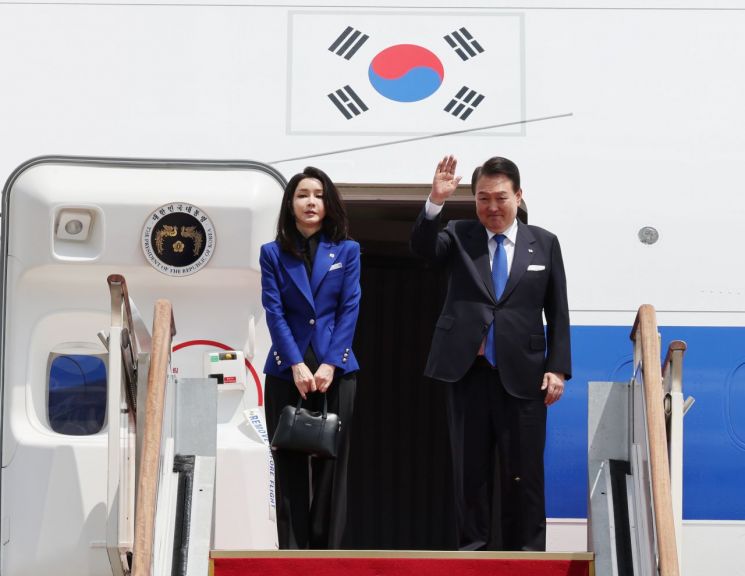 President Yoon Suk-yeol and First Lady Kim Keon-hee, attending the Group of Seven (G7) summit held in Hiroshima, Japan, are boarding Air Force One at Seongnam Seoul Airport on the 19th, greeting the farewell crowd. Photo by Yonhap News Agency
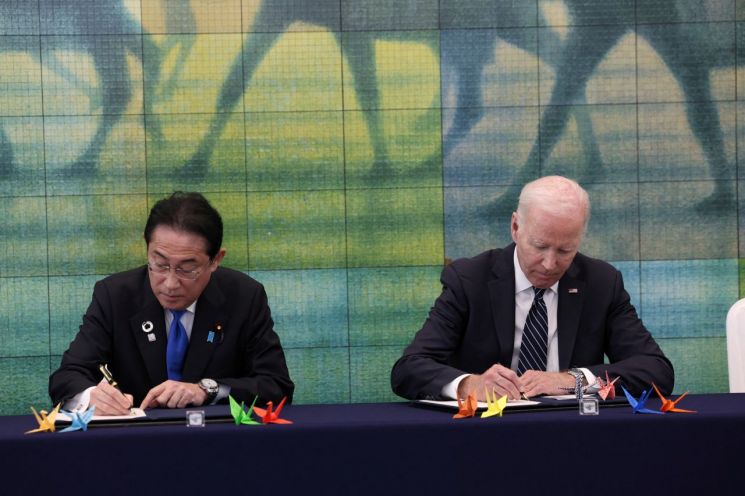
President Yoon will discuss responses to common challenges such as North Korea's nuclear and missile threats, regional supply chain instability, and the energy crisis with U.S. President Joe Biden and Japanese Prime Minister Fumio Kishida. In particular, they plan to discuss practical measures to implement the "real-time sharing of North Korean missile warning information," included in the "Phnom Penh Statement" from the trilateral summit held last November.
This summit attendance is especially significant as it was made possible by Japan's invitation amid the restoration and strengthening of Korea-Japan relations, including the resumption of "shuttle diplomacy" after 12 years. It is seen as an opportunity for South Korea's status to rise. There is also anticipation that if the G7 expands to G8 or G11, South Korea could be a key member.
However, much remains to be done. The United States has stated that there are no discussions about changing G7 membership. On the 15th (local time), Vedant Patel, Senior Deputy Spokesperson for the U.S. State Department, said in a briefing regarding the possibility of expanding to G8 including South Korea, "We are not aware of any discussions about membership changes ahead of the upcoming G7 summit," adding, "Of course, we need to see how the meeting unfolds." Japan holds a similar stance. Recently, Japanese Prime Minister Fumio Kishida told JoongAng Ilbo in an interview, "There has been no discussion about expanding membership within the G7 so far."
Nevertheless, some view South Korea's participation as an invited country as meaningful. Former People Power Party lawmaker Yoon Hee-sook said on SBS Radio's "Kim Tae-hyun's Political Show," "The most important thing is that we were invited to the G7," adding, "Being able to enter the platform that creates the order of the world's free democratic countries, the G7, is a very important hope."
Meanwhile, discussions to expand and reorganize the G7 to include South Korea and others were held during the Trump administration in 2020. Former U.S. President Donald Trump proposed transitioning to a G11 system by adding South Korea, Australia, Russia, and India. However, this was scrapped due to opposition from existing member countries.
It is known that Japan conveyed its opposition to South Korea's participation in the G7 to the U.S. government, which is analyzed to have been influenced by the Abe administration's desire to maintain Japan's status as a G7 member.
According to Kyodo News at the time, the Japanese government opposed South Korea's participation out of concern that Japan's unique status as the only G7 member in Asia could be diminished and that South Korea's voice on historical issues in the international community would become stronger.
© The Asia Business Daily(www.asiae.co.kr). All rights reserved.


















