Intelligence Agencies Conclude Investigation into 'Chinese Restaurant Espionage'
Dilemma Over Punishment Severity Amid Fears of Diplomatic Friction
As South Korean intelligence authorities have tentatively concluded that the Chinese restaurant Dongbang Myeongju (東方明珠) effectively acted as the Chinese government's 'secret police,' they have found themselves in a dilemma over the level of punishment. This is because there are no appropriate punishment regulations, and diplomatic friction with China could arise.
According to a report by the Korea Economic Daily on the 18th, intelligence authorities concluded after investigating Dongbang Myeongju, which was embroiled in a 'spy activity' controversy, that it acted as a secret police by proxy, performing consular duties and handling the repatriation of Chinese nationals within South Korea.
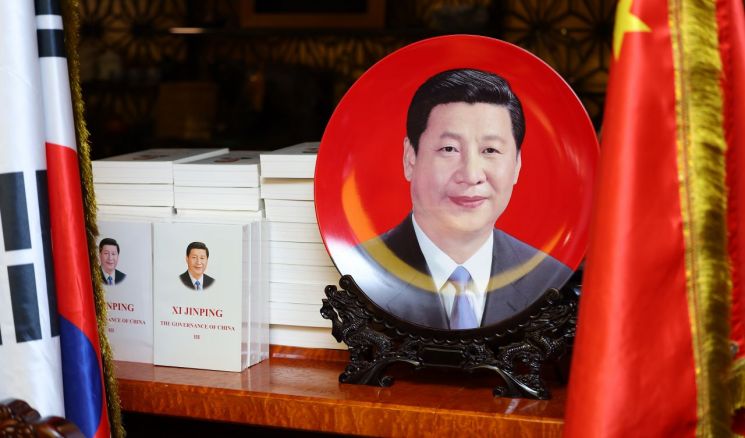 On December 31 last year, books related to Chinese President Xi Jinping were piled up in the second-floor office of a Chinese restaurant in Seoul, identified as a domestic base of a secret police station operated overseas by China.
 [Image source=Yonhap News]
The report states that intelligence authorities judged Dongbang Myeongju to have strong ties to the Chinese government, as it took charge of various events hosted by the Chinese embassy and also managed various award ceremonies targeting Chinese nationals in South Korea.
It is also known that intelligence authorities confirmed that regime-critical individuals and students were summoned to Dongbang Myeongju. In particular, the fact that it acted as an agent for repatriating Chinese nationals residing in South Korea could become a diplomatic issue, as Dongbang Myeongju likely played a role in calling regime-critical individuals back to their home country.
International human rights organizations have also pointed out that since last year, the Chinese government has been opening new types of liaison offices by employing police and students overseas. Intelligence authorities view Dongbang Myeongju as one of these offices.
There Are No Suitable Punishment Provisions to Apply Besides Criminal Law Under Current Law
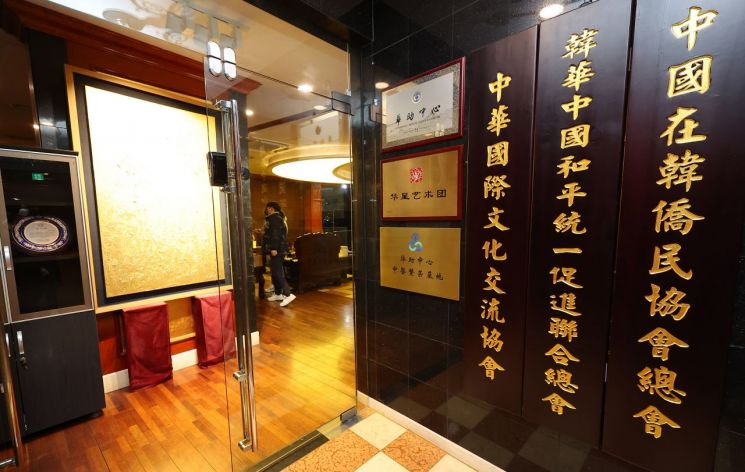 The second-floor office of the Oriental Pearl Tower, identified as a domestic base of the secret police station operated by China overseas.
 [Photo by Yonhap News]
Intelligence authorities believe that Dongbang Myeongju operated a separate 'VIP-only area' in addition to the restaurant for the general public, and that this VIP area served as a hideout for high-ranking Chinese officials.
Since prominent domestic figures also used the VIP area, there is a possibility that wiretapping or eavesdropping took place there, making the punishment of Dongbang Myeongju a matter of intense interest.
Regarding the level of punishment for Dongbang Myeongju, experts point out that establishing an office without the official consent of the South Korean government and disguising it as a private restaurant while performing consular duties by proxy carries a high risk of violating the law.
However, it is reported that intelligence authorities have forwarded all investigation-related information about Dongbang Myeongju to the police and district offices. This is interpreted as the South Korean government being caught in a 'dilemma' over the level of punishment for Dongbang Myeongju.
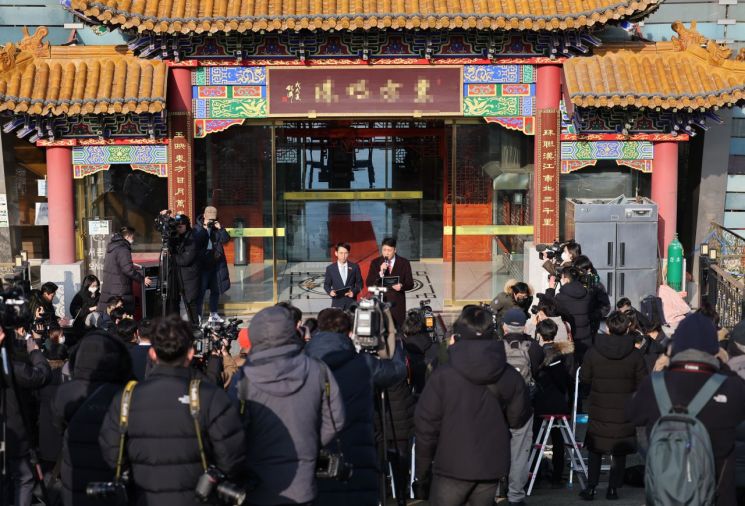 On the afternoon of December 29 last year, Wang Haegun, the manager of a Chinese restaurant in Seoul identified as a domestic base of China's "secret police station" operating overseas, held a press conference to announce his position on the allegations.
 [Image source=Yonhap News]
The South Korean government’s reluctance to directly raise the secret police issue with the Chinese government is related to the current legal system. Even if Dongbang Myeongju’s secret police activities are factual, there are no suitable punishment provisions to apply besides criminal law under current law. The current counterintelligence regulations are set by presidential decree and do not include separate punishment provisions. Furthermore, espionage activities defined under the espionage crime are limited to 'enemy states (North Korea)'.
If the punishment level is increased, China may retaliate, potentially escalating the issue into a diplomatic problem. The practical benefits of punishing Dongbang Myeongju are not significant, whereas the damage caused by a deterioration in South Korea-China relations could be substantial.
The Seoul Songpa Police Station, which took over the case, sent Wang Haijun to the prosecution in March on charges of violating the Food Sanitation Act and the Outdoor Advertising Act. It is also known that Songpa District and the National Tax Service are jointly reviewing Wang Haijun’s tax evasion allegations. This has led to evaluations that the approach taken is more of a warning punishment rather than direct punishment for 'spy activities.'
© The Asia Business Daily(www.asiae.co.kr). All rights reserved.



















