President Yoon Departs for 3-Day Trip to Hiroshima, Japan to Attend G7
South Korea-Japan Leaders Meet After 2 Weeks, Confirm Commitment to Security, Economic, and Cultural Cooperation
Likely South Korea-US-Japan Summit... Possibility of Expanding 'Washington Declaration'
President Yoon Suk-yeol will depart on the 19th to attend the Group of Seven (G7) summit held in Hiroshima, Japan. Although invited as a guest country, he is scheduled to hold official meetings and bilateral summits with Japan, the United Kingdom, Australia, Vietnam, India, and Indonesia over a 2-night, 3-day period from the 19th to the 21st.
The key point to watch is the trilateral summit among South Korea, the United States, and Japan expected to take place during the G7. President Yoon and U.S. President Joe Biden will meet again in less than a month, marking the third trilateral summit since the Yoon administration began. At this meeting, they are expected to review the progress of cooperation on North Korea’s nuclear and missile threats following the Phnom Penh joint statement and discuss collaboration on supply chains and climate change.
In particular, there is cautious speculation about the possible expansion of the “Washington Declaration,” which includes the U.S.’s practical extended deterrence and the establishment of a high-level nuclear consultation group (NCG) between South Korea and the U.S. President Yoon mentioned at this month’s South Korea-Japan summit that “the Washington Declaration is, for now, an agreement based on the bilateral relationship between South Korea and the U.S.,” but “Japan’s participation is not excluded.” This means that since the Washington Declaration between South Korea and the U.S. is not finalized and requires ongoing discussion, joint planning, and implementation, cooperation with Japan is possible at any time.
Moreover, the U.S. and Japanese leaders held a one-hour summit the day before, confirming their intention to closely cooperate on security challenges posed by North Korea and China. Considering that Japanese Prime Minister Fumio Kishida said he would further advance South Korea-Japan relations and President Biden welcomed this, it is expected that more developed outcomes will emerge following the Phnom Penh joint statement.
The G7 is scheduled to exchange views on the situation in Ukraine, nuclear disarmament, and non-proliferation issues during the summit and announce the results in a joint statement. It is also of interest whether President Yoon will reiterate the South Korean government’s position. Since President Yoon has repeatedly emphasized a “rules-based international order,” direct remarks targeting Russia and China may be made. The G7 is known to express its determination to oppose changes to the status quo by force and to uphold a rules-based international order in response to Russia’s invasion of Ukraine and China’s implied use of force against Taiwan.
This is the fourth time a South Korean president has been invited to and attended a G7 summit. President Yoon is expected to speak on global agendas such as food, security, climate, and energy development at this expanded G7 meeting. There is also a possibility of discussions on the key themes of “rules-based international order” and “engagement policies for emerging developing countries.”
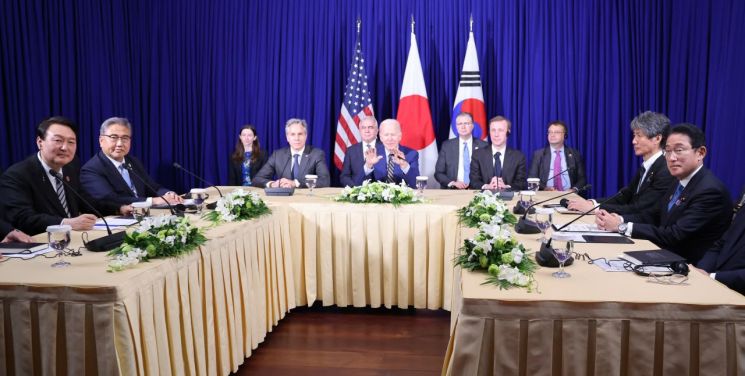
The South Korea-Japan leaders will sit at the table again after just two weeks. Following President Yoon’s visit to Japan in March and Prime Minister Kishida’s reciprocal visit this month, this will be the third meeting this year. Rather than introducing new agendas, it is expected to be an occasion to subdivide the previously discussed topics of security, economy, and cultural cooperation or to reaffirm the two countries’ willingness to cooperate.
President Yoon and Prime Minister Kishida are reported to jointly pay respects at the “Memorial Monument for Korean Atomic Bomb Victims” in the Hiroshima Peace Memorial Park, which may bring a new message regarding historical issues between South Korea and Japan. This monument commemorates Koreans who were victims of the atomic bomb dropped by the U.S. military on Hiroshima on August 6, 1945, to hasten the end of World War II. These individuals suffered during the forced mobilization under Japanese colonial rule. The last sitting Japanese prime minister to visit this monument was Keizo Obuchi in August 1999, who attended an event at the Peace Memorial Park and then visited the monument.
Additionally, President Yoon will hold bilateral summits in Hiroshima with leaders from Vietnam, Australia, India, Indonesia, and the United Kingdom. On the first day, the 19th, he will meet with Australian Prime Minister Anthony Albanese and Vietnamese Prime Minister Pham Minh Chinh. On the second day, the 20th, he will hold bilateral talks with Indian Prime Minister Narendra Modi, Indonesian President Joko Widodo, and British Prime Minister Rishi Sunak. However, due to the G7 summit schedule, additional bilateral meetings may be added or existing ones canceled. The presidential office stated, “Due to the nature of multilateral meetings, even confirmed bilateral schedules may be suddenly adjusted.”
© The Asia Business Daily(www.asiae.co.kr). All rights reserved.

















