President Xi Jinping Emphasizes "Community of Shared Future"
"Demonstrates Central Asia's Importance on Diplomatic Agenda"
The multilateral summit between China and the five Central Asian countries opened on the 18th in Xi'an, Shaanxi Province, the starting point of the Silk Road. Ahead of the major Group of Seven (G7) summit held in Japan, China is proudly gathering its allies and demonstrating its strength.
According to the Chinese Ministry of Foreign Affairs and local media, China held a two-day multilateral meeting from the 18th to the 19th with the leaders of Kazakhstan, Uzbekistan, Kyrgyzstan, Tajikistan, and Turkmenistan. This meeting is the first face-to-face multilateral summit in 30 years since China established diplomatic relations with the Central Asian countries in the early 1990s. Chinese President Xi Jinping, together with his wife Peng Liyuan, hosted a large-scale welcoming ceremony for the leaders and first ladies of the five Central Asian countries at the folk theme park "Datang Furongyuan," built on the site of the imperial gardens of the Sui and Tang dynasties in Xi'an on the opening day of the summit.
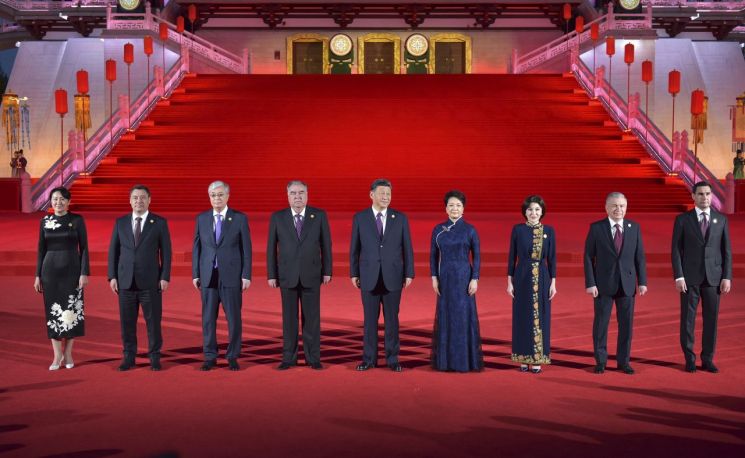
In his welcoming speech, President Xi emphasized cooperation and friendship, calling the five Central Asian countries a "community of shared destiny." He stated, "No matter how the international situation changes, China and the Central Asian countries will consistently respect each other, maintain friendship, and uphold win-win cooperation," adding, "The bilateral relations have developed historically from good neighbors to strategic partners and ultimately to a community of shared destiny." He further stressed, "We sincerely welcome the Central Asian countries to board the express train of China's rapid development and create a better future together."
Notably, this year marks the 10th anniversary of the Belt and Road Initiative (BRI), led by President Xi, which connects China, Central Asia, and Europe via land and sea Silk Roads. China appears to be focusing on strengthening cooperation with the Central Asian countries that serve as a link to Europe. Holding the meeting in Xi'an instead of the capital Beijing aligns with this context.
The joint statement released after a series of bilateral talks with the five leaders the previous day also expressed a commitment to jointly building the Belt and Road. Additionally, it addressed mutual support for China's long-emphasized "core interests," including sovereignty and territorial integrity, as well as enhancing cooperation such as expanding agricultural product imports. On the 19th, at the main session attended by the six leaders, President Xi is expected to deliver a keynote speech outlining the vision for building a China-Central Asia community of shared destiny.
China's Global Times cited Wang Xiaoqian, a researcher at the Chinese Academy of Social Sciences, comparing this meeting to the G7 summit. Wang said, "The United States and its allies are prepared to increase pressure on China at the G7 summit," and reported, "While the G7 focuses on discussions about dominating the world order and monopolizing the international economy, China and the Central Asian countries, all developing nations, are striving to build a fair and reasonable world order."
Researcher Wang explained, "China holding its first major diplomatic event of the year targeting Central Asian countries shows the growing importance of these countries in China's diplomatic agenda," adding, "These countries are China's strategic rear to cope with risks." He also emphasized, "Even when the United States rallies its allies against China, China needs a stable Central Asia," and stressed, "The security of this region has a tremendous impact on China's northwest region."
© The Asia Business Daily(www.asiae.co.kr). All rights reserved.
![Clutching a Stolen Dior Bag, Saying "I Hate Being Poor but Real"... The Grotesque Con of a "Human Knockoff" [Slate]](https://cwcontent.asiae.co.kr/asiaresize/183/2026021902243444107_1771435474.jpg)
















