Debt Ratio Records 299%... Financial Stability Improved After Split
"Increase in Non-Residential Sector Sales... Establishing Long-Term Growth Momentum"
Kolon Global has achieved an improvement in its financial structure following a spin-off. This is attributed to the significant reduction of its debt ratio to the 200% range after deciding to split its construction and automotive divisions at the beginning of the year, thereby enhancing financial stability.
According to the Financial Supervisory Service's electronic disclosure system on the 18th, Kolon Global's consolidated debt ratio for the first quarter of this year was recorded at 299%. This marks a decrease of more than 104 percentage points compared to the same period last year (317%) and the end of last year before the split (403%).
The improvement in the financial structure is largely attributed to the dispersion of investment risks in Kolon Global's imported car division. Typically, for imported cars, an increase in accounts payable due to purchases on credit from suppliers leads to a rise in the debt ratio. However, factors such as unsettled amounts classified as borrowings under accounts payable have been resolved.
In fact, Kolon Global's accounts payable for the first quarter of this year stood at KRW 273.354 billion, down 9.46% from KRW 301.923 billion at the end of last year, and accrued expenses decreased by 42.82% to KRW 33.259 billion. During the same period, total accounts payable and other liabilities, including long-term payables, fell 35.4% from KRW 699.8 billion to KRW 451.9 billion, and total liabilities decreased by 24% to KRW 1.723 trillion.
Although the net debt ratio increased to 72% in the first quarter of this year from 67% in the same period last year due to borrowings for operating funds, Kolon Global's cash and cash equivalents (including deposits at financial institutions) rose by 20.5% compared to the end of last year and by 37.5% year-on-year to KRW 218.791 billion. Despite a decline in sales and operating profit caused by worsening cost ratios due to rising raw material prices and reduced profitability in the housing and construction sectors, liquidity has been strengthened and financial soundness improved.
Kolon Global is also recognized for expanding a stable sales base by successfully diversifying its portfolio in the non-residential sector. In the first quarter, Kolon Global recorded new orders worth KRW 469.7 billion, including Samsung Electronics' Pyeongtaek office building (Phase 1, KRW 45 billion), Daewoong Pharmaceutical's Nabota factory (approximately KRW 52.9 billion), and Daewoong Bio factory (KRW 61.8 billion). Sales in the non-residential sector, such as private construction, increased, raising expectations for stable future performance.
Moreover, the balance of high-profit joint development projects increased from KRW 1 trillion in 2021 and KRW 1.2 trillion last year to KRW 1.4 trillion in the first quarter of this year. Orders in the non-residential sector this year are planned to reach KRW 2.3 trillion, double the KRW 1.1 trillion recorded last year.
Performance improvements were also seen in the trading and Sporex divisions. Kolon Global's trading division improved results due to strong sales of the new robot vacuum cleaner (Dreamie) and domestic steel demand. The trading division's sales decreased by 7.5% year-on-year to KRW 99.1 billion, while operating profit doubled to KRW 2.8 billion. Sporex recorded a 46.6% increase in sales to KRW 12.9 billion and a 44.4% increase in operating profit to KRW 1.3 billion, driven by the normalization post-COVID-19 and new branch openings.
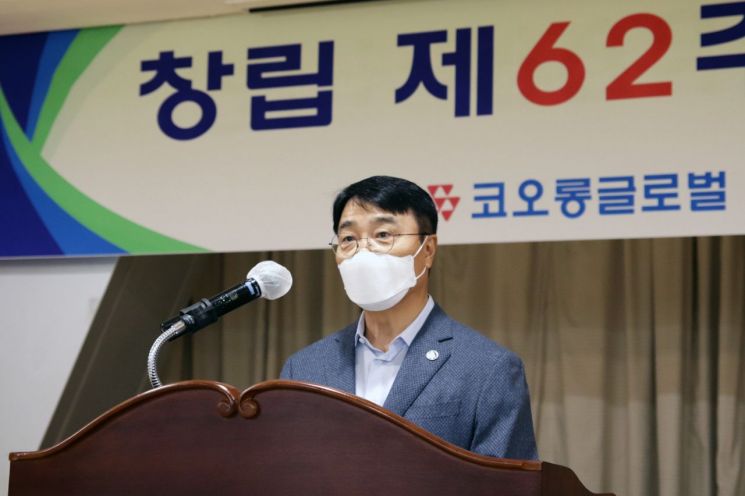 Kim Jong-il, CEO of Kolon Global, during the anniversary ceremony at the founding anniversary event.
 [Photo by Kolon Global]
Kim Jeong-il, CEO of Kolon Global, is credited with the success of the company's 'structural reform.' In his New Year's address this year, Kim emphasized the need to diversify the business structure, which had been concentrated in the housing sector, and to establish it as a major pillar of the business. He stressed the importance of creating a mid- to long-term stable portfolio based on this.
Kolon Global is expanding its ‘Haneulchae’ brand mainly in key areas of Seoul while also broadening its land and offshore wind power businesses and pursuing portfolio diversification in areas such as water treatment, waste management, and OSC (modular construction) projects.
By securing major projects, Kolon Global joined the KRW 1 trillion urban redevelopment order club last year. Starting with the third phase of the mixed-use residential and commercial joint development project in Seonhwa-dong, Daejeon, early last year, the company won orders in various fields, including the railway technical bidding for the Yeoju-Wonju Section 2 project. It also secured brand towns in 1-6 districts of Beon-dong, Gangbuk-gu, Seoul, under the single ‘Haneulchae’ brand, as well as the Changwon Towol remodeling project.
Additionally, Kolon Global is expanding into offshore wind power and repowering sectors. In September last year, it obtained approval from the Ministry of Trade, Industry and Energy for the 400MW ‘Wando Jangbogo Offshore Wind Power Project.’ Kolon Global is also strengthening its identity as a renewable energy company through eco-friendly technologies such as water treatment. Recently, it has signed related MOUs for major overseas projects including Saudi Arabia’s NEOM City and Indonesia’s capital relocation, actively advancing its overseas business.
A Kolon Global official stated, "Although profitability in the construction sector has somewhat declined due to continuous raw material price increases, sales in the non-residential sector have increased, building momentum for long-term growth." He added, "From this year, risks related to unsold housing and project financing (PF) have significantly decreased, and sustainable growth is expected based on portfolio diversification in the non-residential sector."
© The Asia Business Daily(www.asiae.co.kr). All rights reserved.
![Clutching a Stolen Dior Bag, Saying "I Hate Being Poor but Real"... The Grotesque Con of a "Human Knockoff" [Slate]](https://cwcontent.asiae.co.kr/asiaresize/183/2026021902243444107_1771435474.jpg)












