English Professor's Claim "It's Safe to Drink Contaminated Water" Sparks Controversy
Seoul National University Professor Warns "Scientists Are Not Doctors"
Amid controversy over a British professor, a world-renowned expert in the field of radiation, claiming that the contaminated water from the Fukushima Daiichi Nuclear Power Plant in Japan is safe, Professor Seokyun Ryeol, Emeritus Professor of Nuclear Engineering at Seoul National University, has refuted this claim. Professor Seo warned that while tritium is indeed expelled from the body, once it enters the body, it can interact with the blood.
On the 17th, Professor Seo rebutted the remarks of Professor Wade Allison, Emeritus Professor at the University of Oxford, UK, on YTN Radio's 'News King Park Ji-hoon.' Professor Allison has consistently argued that the risks of radiation and nuclear power are exaggerated and is known as an authority in the field of radiation nuclear physics.
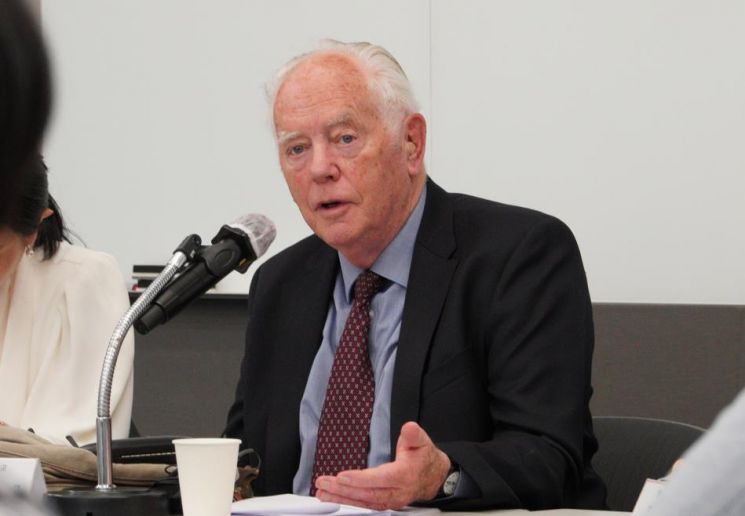 Wade Allison, Honorary Professor at the University of Oxford, UK, is speaking at a press conference held on the 15th at the HJ Business Center in Jongno-gu, Seoul, on the topic of "Effects of Low-Dose Radiation and the Fukushima Contaminated Water Controversy - Science Swallowed by Fear." Photo by Korea Atomic Energy Research Institute, provided by Yonhap News.
On the 15th, at a press conference hosted by the Korea Atomic Energy Research Institute and the Korean Nuclear Society under the theme "Low-dose Radiation Effects and the Fukushima Contaminated Water Controversy - Science Swallowed by Fear," Professor Wade Allison stated, "If I had 1 liter of water treated by the Advanced Liquid Processing System (ALPS) from Fukushima in front of me, I would drink it."
Regarding concerns that there is no research on the long-term effects of low-dose radiation emitted by tritium, which is not filtered out by the ALPS, and thus it cannot be considered safe, he said, "Tritium is a form of hydrogen and is washed out with water, so the time it stays in the body is about 12 to 14 days," adding, "It does not accumulate in the body, so there is no effect through the food chain."
However, Professor Seo countered this claim by saying, "That is what textbooks say," but argued that the situation changes once tritium enters the body. He explained, "The body is more than 60% water. Tritium is also water, so they mix together," and added, "When it binds to living organisms, especially attaching to blood cells like white blood cells, it emits a weak electric charge. Although weak as radiation, it is strong enough to sever cells."
He continued, "Chromosomes are connected by a double helix, and this can be sufficiently broken," and said, "While it is excreted, tritium does not remain quietly for 12 days. Scientists are not medical doctors."
Leukemia and Radiation Exposure from Eating Fukushima Agricultural and Marine Products... Concerns over 'Contaminated Water' Persist
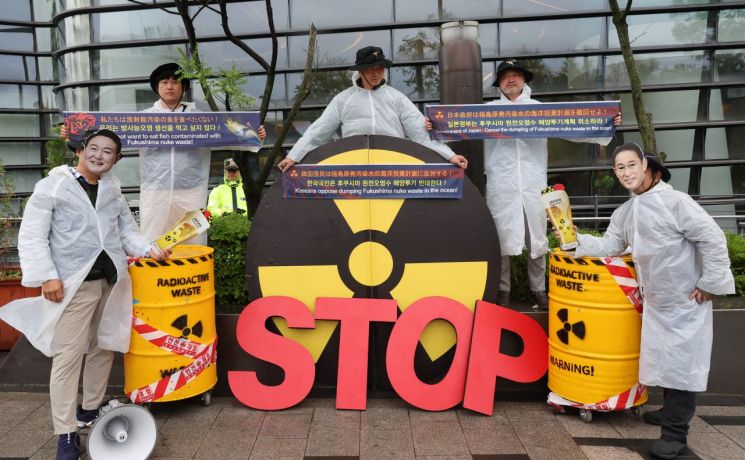 Members of the civic group Environmental Health Citizens' Center held a press conference and performed a demonstration on the 6th to oppose the discharge of contaminated water from the Fukushima nuclear power plant into the ocean. Photo by Yonhap News
Professor Allison's statement about drinking Fukushima contaminated water to emphasize its safety revived memories of the Japanese government's past "Eat to Support" campaign. One month after the nuclear accident in April 2011, the Japanese government launched a reconstruction campaign under the slogan "Eat to Support," encouraging consumption of agricultural products produced locally in Fukushima. However, fears about Fukushima agricultural and marine products grew when it was revealed that some Japanese celebrities who ate these products developed diseases such as leukemia and cancer.
In November 2011, Hiroto Abe (23), who lived in Fukushima, died of acute leukemia after eating fish he personally caught and local agricultural products to promote Fukushima's agricultural and marine products. In March 2012, Tatsuya Yamaguchi of the Japanese male idol group TOKIO, who had been eating local agricultural and marine products to support Fukushima, was publicly revealed through a broadcast to have been internally exposed to Cesium-137.
Meanwhile, there are expectations that Japan will begin discharging contaminated water around this summer if the International Atomic Energy Agency (IAEA) concludes in its final report that there are "no problems" related to the discharge of contaminated water.
Earlier this month, the IAEA stated in an interim report that the verification results of the contaminated water showed "no problems," making it highly likely that the final report will also conclude "no problems." The Japanese government plans to treat and dilute 120 tons of contaminated water daily from the Fukushima nuclear power plant and discharge it over 30 years.
© The Asia Business Daily(www.asiae.co.kr). All rights reserved.


















