Focus on Legacy Semiconductor Production
Some Companies Enter Restructuring
Senior Chinese Official Emphasizes 'Supply Chain' Through Diplomacy
China, which has been under U.S. restrictions related to the semiconductor industry, has increased its semiconductor production for the first time in 16 months. Imports of semiconductors from South Korea and Taiwan showed a significant decline.
According to the announcement by China's National Bureau of Statistics on the 16th, China's integrated circuit (IC, semiconductor chip) production last month reached 28.1 billion units, up 3.8% year-on-year. The National Bureau of Statistics surveyed production from companies with annual sales of over 20 million yuan (approximately 3.8 billion KRW). This increase in production is the first in 16 months since January last year. Production decreased by 17% year-on-year in January-February and by about 3% in March this year. Last year, production fell by 9.8% compared to 2021.
According to the Hong Kong South China Morning Post (SCMP), this increase in production occurred amid a significant reduction in semiconductor imports from South Korea and Taiwan. According to China's General Administration of Customs, total semiconductor imports in China from January to April this year were 146.8 billion units, down 21% year-on-year.
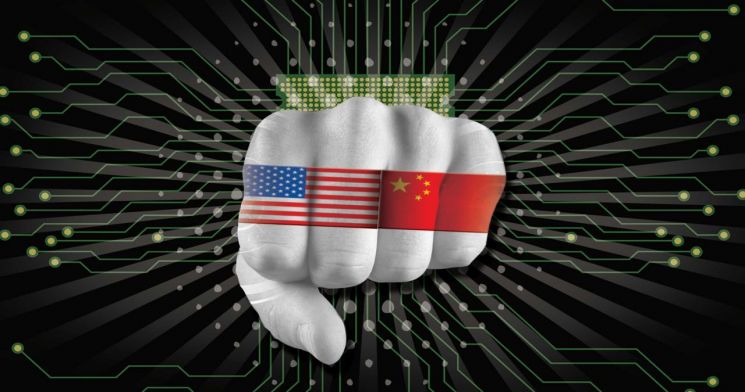
As the U.S. moves to tighten restrictions on China's access to advanced semiconductor technology and equipment, China is reportedly producing more legacy semiconductors to meet domestic demand from automobile manufacturers and home appliance companies, SCMP reported. Meanwhile, shipments of microcomputers in April fell 19.9% year-on-year to 25.4 million units, and smartphone production decreased by 5.9% to 86.5 million units.
Local governments in China are providing substantial subsidies to semiconductor-related companies. According to industry sources, subsidies paid to 190 listed semiconductor companies nationwide last year amounted to 12.1 billion yuan (approximately 2.32 trillion KRW).
However, related companies are suffering from market uncertainties and other impacts. Chinese smartphone manufacturer Oppo closed its semiconductor design subsidiary ZEKU on the 12th, laying off 3,000 engineers?the largest scale in the industry?causing controversy. At the time, Oppo explained the background by citing "significant uncertainties in the global economy and smartphone market." ZEKU is also known as the company where some employees from HiSilicon, Huawei's semiconductor design subsidiary that was subject to U.S. sanctions, moved to.
Meanwhile, senior Chinese officials are actively persuading the Netherlands, which has joined the U.S. in controlling exports of advanced semiconductor equipment, emphasizing the "supply chain." According to China's state-run CCTV, on the 16th, Chinese Premier Li Qiang said in a phone call with Dutch Prime Minister Mark Rutte, "We hope the Netherlands will adhere to the spirit of contracts, market principles, and global trade rules, and safeguard the joint interests of companies from both countries as well as the smooth flow of the global industrial and supply chains."
Earlier, Chinese Vice Premier Han Zheng also emphasized during a meeting with Prime Minister Rutte in The Hague from the 10th to 12th (local time) that "In recent years, both sides have cooperated based on mutual respect and trust to respond to challenges, jointly secured the stability of global industrial and supply chains, and contributed to the economies of both countries and the world."
© The Asia Business Daily(www.asiae.co.kr). All rights reserved.

















