G7 Finance Ministers' Meeting Focuses on Default Risk Concerns
The so-called ‘X-day,’ when the U.S. federal government’s cash runs out, is approaching, prompting a series of warnings from the international community. At the G7 Finance Ministers' meeting held from the 11th to the 13th in Niigata, Japan, finance chiefs from various countries sharply criticized the ongoing U.S. debt ceiling negotiations. This is because if the balance is depleted without any action on the debt that has reached the statutory limit, making it impossible to fulfill payment obligations, it could deliver an unpredictable shock to the global economy.
On the 15th (local time), The Wall Street Journal (WSJ) reported, "The global economy, already grappling with inflation and aggressive tightening since last year, now faces the added risk of a default due to difficulties in debt ceiling negotiations," adding, "It is expected that world leaders will focus on discussing the deadlock in debt ceiling talks during the G7 Summit scheduled for the 19th to 21st in Hiroshima, Japan."
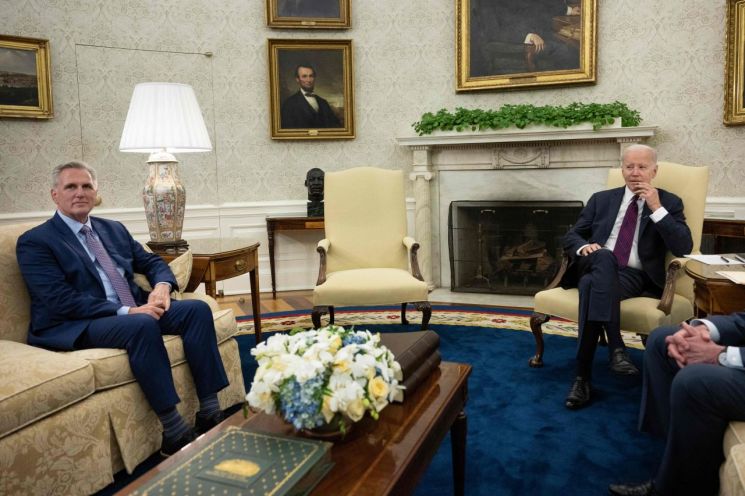
As U.S. President Joe Biden is set to depart for Japan to attend the G7 Summit, and with the U.S. Congress also recessing around Memorial Day, analysts suggest that if no significant progress is made in the meeting on the 16th, the risk of default will intensify.
Earlier, at the G7 Finance Ministers and Central Bank Governors meeting held from the 11th to 13th in Niigata, Japan, the outlook for debt ceiling negotiations was discussed. At this meeting, Japan, which holds the largest amount of U.S. Treasury securities after the U.S., expressed the most pessimistic views regarding the default crisis.
Kazuo Ueda, Governor of the Bank of Japan (BOJ), warned that "(a U.S. government default) could be difficult to resolve," and said that in the event of a default, there would be an immediate impact on the U.S. Treasury market, which amounts to $24 trillion (approximately 3,210 trillion KRW).
If U.S. Treasuries, regarded as the epitome of safe assets, fail to pay interest to bondholders on time, it is expected to cause significant global repercussions. WSJ analyzed that if U.S. Treasuries suddenly become viewed as risky assets and a massive sell-off occurs, it could trigger chaos in global financial markets and permanently undermine market investors’ preference for U.S. Treasuries.
Jeremy Hunt, the UK Chancellor of the Exchequer, described the default crisis as "a very serious threat to the global economy," stating, "If the United States, one of the largest engines of the world economy, experiences a breakdown in negotiations causing its Gross Domestic Product (GDP) to go off track, it would be absolutely devastating." Christian Lindner, Germany’s Finance Minister, also expressed concern, saying, "We have been paying particular attention to the United States recently," and added, "Considering the development of the U.S. government’s finances and its impact on the global economy, we hope a mature decision will be made."
At the heart of these concerns is the expectation that the shockwaves from a negotiation breakdown will not be temporary for global markets. According to the U.S. Treasury, since 1960, the U.S. Congress has adjusted the debt ceiling about 78 times. In 2011, due to delayed negotiations, the global credit rating agency Standard & Poor’s (S&P) downgraded the U.S. credit rating, which led to a significant drop in the U.S. stock market and took 6 to 7 months to recover.
Sri Mulyani Indrawati, Indonesia’s Finance Minister attending as a guest country, pointed out that "the recurring uncertainty related to the debt ceiling every few years is weakening global trust in the United States." She questioned, "Whether this is ultimately just a repetitive game that gets resolved or if the U.S. is beginning to learn how to break free from this recurring situation," adding, "This is not good for the United States."
Minister Mulyani also stated during a meeting with U.S. Treasury Secretary Janet Yellen that, as a measure to respond to U.S.-originated risks such as the debt ceiling, Southeast Asian regional countries plan to increase the use of their own currencies, such as the rupiah, instead of the dollar in trade.
© The Asia Business Daily(www.asiae.co.kr). All rights reserved.

![User Who Sold Erroneously Deposited Bitcoins to Repay Debt and Fund Entertainment... What Did the Supreme Court Decide in 2021? [Legal Issue Check]](https://cwcontent.asiae.co.kr/asiaresize/183/2026020910431234020_1770601391.png)