The number of nationwide applications for leasehold registration orders has exceeded 3,000 for two consecutive months. This is interpreted as due to an increase in tenants who have not been able to receive their deposits back on time, following the recent decline in jeonse prices and jeonse fraud.
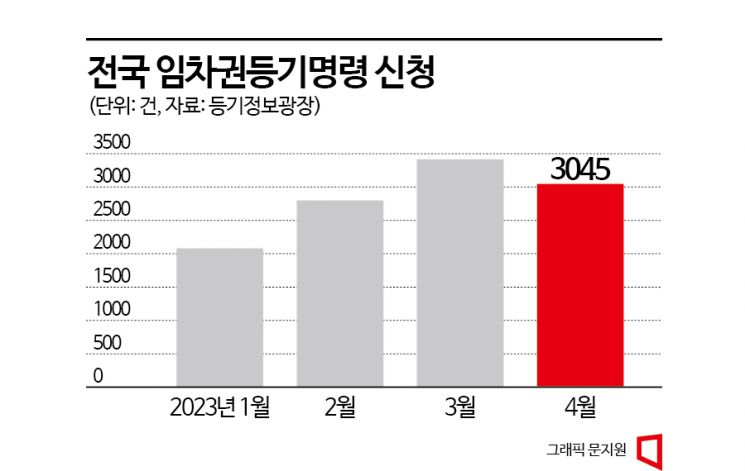
According to the Supreme Court's Registry Information Plaza on the 17th, the number of applications for leasehold registration orders on collective buildings nationwide in April recorded 3,045 cases. Although this is slightly lower than March (3,414 cases), it exceeded 3,000 for two consecutive months. This scale of applications is considered unusual. Until July last year, the monthly number of applications for leasehold registration orders on collective buildings was below 1,000. After surpassing 1,000 with 1,043 cases in August last year, it recorded 2,081 cases in January this year, and exceeded 3,000 in both March and April.
Leasehold registration is a process that specifies the existence of a leasehold on the registry even after the tenant has moved out without receiving the deposit back following the termination of the lease contract. Only after the leasehold registration is established can the tenant claim the return of the deposit from the Housing and Urban Guarantee Corporation (HUG).
By region, the majority of cases were in the metropolitan area including Seoul, Gyeonggi, and Incheon, where the issues of "empty jeonse" and reverse jeonse difficulties are spreading. In Seoul alone, 988 applications for leasehold registration were made last month. Incheon and Gyeonggi recorded 697 and 865 cases respectively.
The district with the highest number of leasehold registrations in Seoul is Gangseo-gu, which exceeded 200 cases with 256 in March and 248 in April. From January to April this year, the total number of leasehold registration applications reached 923, the highest nationwide. In Incheon, applications were evenly distributed across all areas. Namdong-gu recorded 120 applications each in March and April. During the same period, Michuhol-gu recorded 183 and 191 cases respectively.
Experts predict that applications for leasehold registration will continue to increase for the time being. This is because the lease contracts signed after the surge in jeonse prices in the second half of 2021 will expire starting from June this year. Kyunghee Yeo, Senior Researcher at Real Estate R114, said, "Contracts signed when jeonse prices were at their peak will expire between the second half of this year and early next year. If the decline in jeonse prices continues until the second half, there is concern over a crisis of deposit non-return due to reverse jeonse difficulties, so leasehold registrations are expected to continue increasing for the time being."
© The Asia Business Daily(www.asiae.co.kr). All rights reserved.