Where Are the Retail Investors Leaving the Stagnant Domestic Stock Market Heading?
Where is the safeguard against a U.S. debt default? As negotiations between the U.S. administration and Congress face difficulties, concerns among Seohak Gaemi (domestic investors investing in overseas stocks such as the U.S.) have deepened. Meanwhile, Ilhak Gaemi (domestic investors investing in Japanese stocks) are growing optimistic about the Japanese stock market, which has been buoyed by multiple positive factors. We take a closer look at these two major markets that have become the focus of investors who have left the sluggish domestic stock market.
U.S. Default Safe Havens: Gold, U.S. Treasuries, Bitcoin
On Wall Street, it is expected that if the U.S. debt ceiling negotiations are not resolved before the so-called ‘X-day’ when the federal government runs out of cash, an unprecedented disaster including a stock market crash will occur. Accordingly, it has been advised to increase the proportion of investments in safe assets.
According to a Market Live Pulse survey conducted from June 8 to 12 targeting a total of 637 institutional and individual investors, 60% of respondents predicted that the impact of this default crisis would be greater than in 2011. In 2011, delayed debt ceiling negotiations led to a downgrade of the national credit rating and the possibility of default, causing the S&P 500 index to plunge by as much as 17% at one point.
The U.S. debt ceiling negotiation is a recurring political issue every year, and considering past cases, it is likely to be resolved eventually. However, with the current situation where the Republican Party controls the House and the influence of the Freedom Caucus (a far-right group within the Republican Party) has grown, while President Joe Biden and the Democratic Party have a strong willingness to expand fiscal spending, it is expected that the two sides will find it difficult to narrow their differences in the short term. Jason Bloom, head of bond and ETF strategy at Invesco, said, "Considering the polarization in Congress due to differing views, the risk of default is higher than in the past," adding, "It seems unlikely that negotiations will be concluded by the early June deadline."
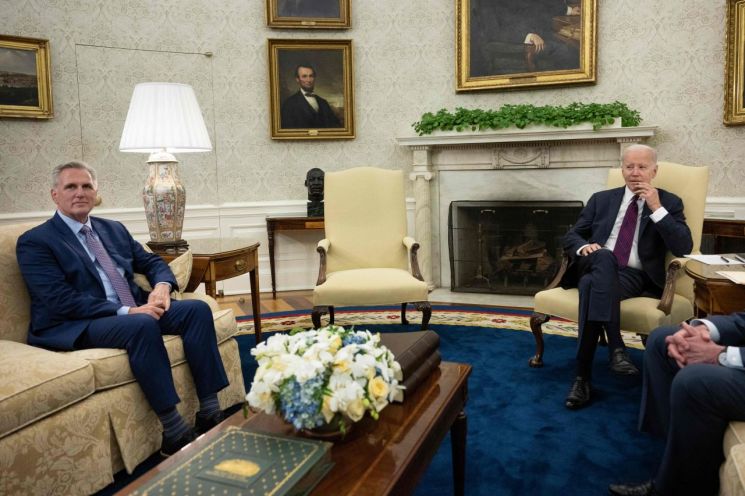 U.S. President Joe Biden is discussing the debt ceiling increase on the 9th (local time) at the White House in Washington with Kevin McCarthy, Speaker of the House from the Republican Party, and Chuck Schumer, Senate Democratic Leader.
 [Image source=AFP Yonhap News]
In this situation, Wall Street has chosen gold as a safe haven from default. About half of the respondents (51.7% of institutions and 45.7% of individuals) said they would choose gold as an alternative investment. With the halt of interest rate hikes and the possibility of a recession increasing demand for gold, it is analyzed that demand for safe assets will grow further if a default occurs. The price of gold futures traded on the New York Mercantile Exchange has been maintaining a high level above $2,000 per ounce since April.
Respondents said they would invest in U.S. Treasuries next (14% of institutions and 15.1% of individuals). Bloomberg reported, "The irony of investing in Treasuries during a default crisis stems from the 2011 experience, when after the default crisis peaked and was resolved, the price of the U.S. 30-year Treasury rallied to reach its highest level of the year." Most respondents also expect that if the default crisis is resolved this time following past patterns, the price of the U.S. 10-year Treasury will surge sharply.
The third place was taken by Bitcoin, a representative risky asset (7.8% of institutions and 11.3% of individuals). The dollar, yen, and Swiss franc ranked between fourth and sixth, trailing behind Bitcoin. This indicates that investors perceive Bitcoin as a more reliable investment destination than major national currencies traditionally considered safe assets. Following the banking crisis triggered by the collapse of Silicon Valley Bank (SVB) in the U.S., which shook the regulated financial sector, investors feeling uneasy are choosing Bitcoin, known as ‘digital gold,’ as a safe haven for investment.
Japanese Stock Market Sanctuary... Highest Level in 33 Years
While Wall Street’s preference for safe assets has increased amid the U.S. default crisis, Japan’s stock market has risen to its highest level in 33 years due to multiple positive factors. With the government also stepping in to enhance corporate value, Ilhak Gaemi’s expectations have grown even more.
The TOPIX index in Japan began its upward trend after hitting a low of 1261.70 in March 2020. On this day, the TOPIX opened at 2125.14, up 10.29 points (0.48%) from the previous trading day. It closed the previous day at 2114.85, up 18.46 points (0.88%), marking the highest close since August 1990, 33 years ago, and opened even higher than that. The Nikkei 225 index, centered on large export stocks, also surged. After hitting a low of 26,716.86 in January this year, the Nikkei 225 opened at 29,838.01, up 211.67 points (0.71%) from the previous trading day.
Last year, as the yen fell to its lowest value in 32 years, expectations arose that major listed companies would post earnings surprises, boosting the stock market. The depreciation of the yen is expected to lead export companies to record unprecedented earnings, improving investor sentiment. SMBC Nikko Securities predicted that the sales of 1,308 companies (excluding financial firms) listed on the Tokyo Stock Exchange First Section before last year’s market restructuring would increase by 14.2% to 580.3 trillion yen for the 2022 fiscal year (April 2022 to March 2023). Net profit is expected to slightly exceed the previous fiscal year’s record high of 34 trillion yen. Operating profit is estimated to increase by 4.2% to 39.1 trillion yen.
In particular, Warren Buffett, the ‘Oracle of Omaha’ and chairman of Berkshire Hathaway, revealed in an interview with Nihon Keizai Shimbun last month that he raised his stake in Japan’s five major trading companies (Mitsubishi, Mitsui, Itochu, Marubeni, Sumitomo) from the previous 6% range to 7.4%, which triggered the stock market surge. Buffett said that these five companies will constitute a large portion of his portfolio going forward and that he intends to make additional investments in other Japanese stocks. According to Bloomberg, foreign traders net purchased $22 billion worth of Japanese stocks and futures last month.
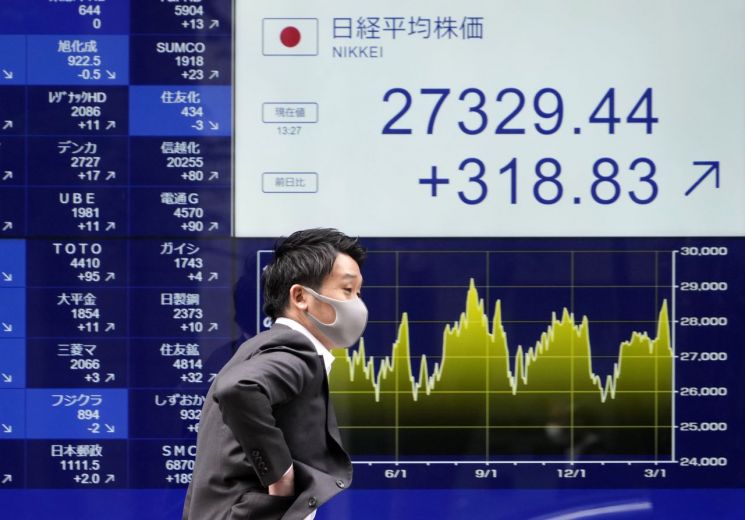 On March 17th, a citizen in Tokyo, Japan, is passing in front of a stock market electronic display board.
 [Image source=EPA Yonhap News]
Additionally, the Tokyo Stock Exchange has demanded listed companies whose stock prices are trading below book value to enhance their corporate value. In response to the securities authorities’ request, Mitsubishi Corporation decided to repurchase up to 6% of its shares for $2.2 billion, and major Japanese tech companies Hitachi and Fujitsu also announced plans for large-scale share buybacks to increase corporate value.
Investors, expecting undervalued listed companies to take further measures, have started to buy large amounts of shares in those companies. Bloomberg reported, "As investors buy shares of companies with low valuations and potential for governance improvements, stock prices are rising across sectors from steel manufacturers to airlines."
Experts expect this positive atmosphere to continue for some time. Goldman Sachs investment strategists Kazunori Datebe and Bruce Kirk stated in an investment strategy report, "We are focusing on the Japanese market, which has stronger fundamentals compared to overseas stock markets, and expect that expectations for governance improvements will further boost Japanese stock prices."
© The Asia Business Daily(www.asiae.co.kr). All rights reserved.

![User Who Sold Erroneously Deposited Bitcoins to Repay Debt and Fund Entertainment... What Did the Supreme Court Decide in 2021? [Legal Issue Check]](https://cwcontent.asiae.co.kr/asiaresize/183/2026020910431234020_1770601391.png)















