Q1 Demand Deposit Turnover Rate at 17.6 Times... Highest Since 2020
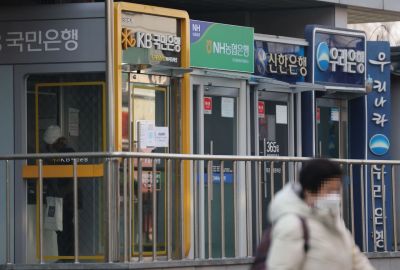
The 'money move' phenomenon is accelerating due to the decline in market interest rates. The turnover rate of demand deposits in the banking sector, which had once plummeted to the bottom last year due to the COVID-19 pandemic and tightening policies worldwide, appears to be continuing its recovery trend.
According to the Bank of Korea's Economic Statistics System on the 16th, the turnover rate of demand deposits at deposit banks in the first quarter of this year was recorded at 17.6 times per month. This is the highest level since the first quarter of 2020 (18.4 times per month), when the COVID-19 pandemic began to intensify.
The turnover rate refers to the amount of deposit payments divided by the average deposit balance. A high turnover rate indicates that companies and households frequently withdrew money deposited in banks for consumption or investment. Therefore, it is used as an indicator showing how actively funds are circulating.
The turnover rate of demand deposits at domestic deposit banks had been declining repeatedly due to various domestic and international adverse factors after recording 19.2 times in the fourth quarter of 2019. Since the impact of COVID-19, it recorded 18.4 times in the first quarter of 2020 and continued to decline, falling to a historic low of 14.3 times in the third quarter of last year due to the sharp interest rate hikes by the U.S. Federal Reserve (Fed) and the resulting asset market downturn.
However, with growing expectations for easing tightening, the rate has somewhat increased. The turnover rate of demand deposits in the fourth quarter of last year rose to 17.1 times, reaching the same level as the second quarter of 2020. In December last year, due to relatively high deposit interest rates and seasonal characteristics with high fund demand, it even recorded 19.9 times on a monthly basis.
This year, the turnover rate of demand deposits showed a decline to 17.9 times in January and 16.8 times in February but rose again to 18.2 times in March. A Bank of Korea official said, "The amount of deposit payments in the first quarter increased significantly compared to the third quarter, when the turnover rate was at its lowest," adding, "Although it has not reached the pre-COVID-19 level, it shows a trend of recovering fund demand."
The rise in the turnover rate is due to expectations of easing tightening along with the downward trend in market interest rates. For example, the interest rates on parking accounts at internet-only banks (Kakao, K, Toss Bank), which once guaranteed up to 3.0% annually, have recently fallen to around 2.00?2.60%. This is even lower than the yield of 2.95?3.60% offered by the recently popular issued note-type Cash Management Accounts (CMA).
The fixed deposit interest rates, which attracted idle funds in the market last year, are also losing relative appeal. Looking at the one-year fixed deposit interest rates (simple interest) of the four major commercial banks (KB Kookmin, Shinhan, Hana, Woori), the highest preferential interest rates range from 3.47% to 3.56%, hovering around the base rate (3.50%). In some banks, fixed deposit interest rates have even dropped to the 2% range, just before the base rate hike.
On the other hand, market funds are flowing into short-term financial products. According to the Korea Financial Investment Association, as of the 11th, the CMA balance reached 65.7 trillion won, a 13.1% increase from the beginning of the year. Although it is still difficult to say the stock market is booming, investor deposits also increased by 16.3% from the year's low to about 50.15 trillion won.
It is also interpreted that the U.S. Silicon Valley Bank (SVB) crisis in mid-March, which shook the financial market, had an impact. Hwang Se-woon, senior researcher at the Korea Capital Market Institute, said, "The expansion of the demand deposit turnover rate in March was partly influenced by funds moving to stable and profitable short-term financial products due to the SVB bankruptcy crisis," adding, "However, since the banking crisis is in a soft-landing phase and the base rate and deposit interest rates are expected to remain slightly weak for the time being, the turnover rate is expected to remain sideways."
© The Asia Business Daily(www.asiae.co.kr). All rights reserved.

















