Heatwaves Expected Amid El Ni?o Forecast After 3 Years
Summer Flood Damage Anticipated in Various Areas
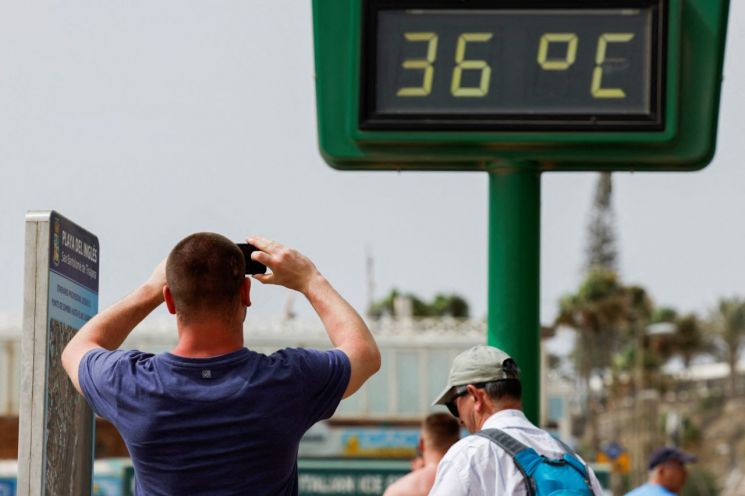
Following the United States and Europe, an early heatwave is sweeping across Asia as well, with many places near the equator, including Southeast Asia, already surpassing 40 degrees Celsius, continuing the abnormal high-temperature phenomenon.
The international meteorological community is concerned about severe weather anomalies due to the anticipated super El Nino phenomenon expected to begin after three years, warning that heavy rains during the summer could cause widespread flooding damage.
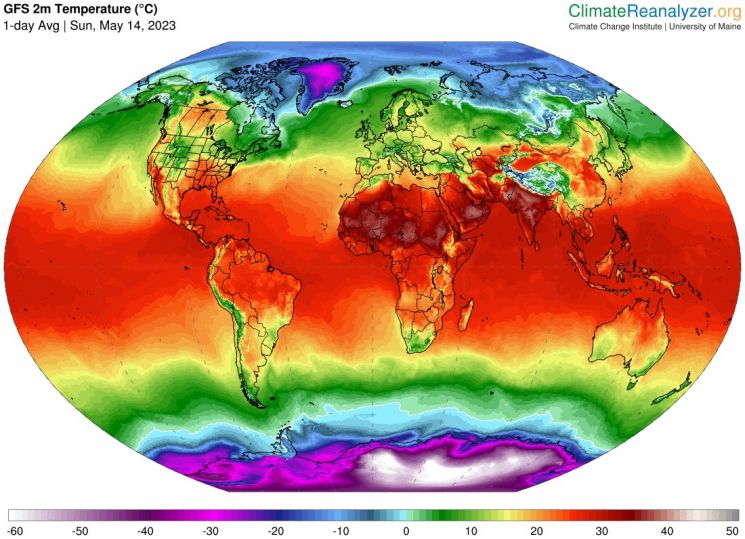 On the 14th (local time), the global temperature distribution map released by the real-time climate measurement site Climate Reanalyzer. Some areas near the equator have already exceeded 40 degrees Celsius. [Image source=Climate Reanalyzer]
Record-breaking heat in May... Heatwave starts from spring
 On the 27th of last month, a woman in Kuala Lumpur, Malaysia, covered her entire face with a cooling mask to avoid the sun and heat. Kuala Lumpur=EPA·Yonhap News
According to Singapore local media such as The Straits Times on the 14th (local time), the Singapore National Environment Agency (NEA) announced that the highest temperature reached 37 degrees Celsius on the 13th. This matches the all-time highest temperature recorded in April 1983, 40 years ago, and is the highest temperature ever recorded for May. It also exceeded the 35 degrees Celsius peak temperature forecasted earlier by the Singapore Meteorological Service this year.
Earlier, Thailand, Vietnam, Myanmar, and other regions experienced unusually early heatwaves, with frequent days exceeding 40 degrees Celsius. The Tak region in northwestern Thailand recorded a maximum temperature of 45.4 degrees Celsius on the 14th of last month, breaking Thailand's all-time highest temperature record. The perceived temperatures across various parts of Thailand soared well above 50 degrees Celsius. Vietnam also broke its all-time highest temperature record earlier this month, reaching 44.1 degrees Celsius. Myanmar recorded a regional highest temperature of 43 degrees Celsius in the south-central area at the end of last month, marking the highest in 58 years.
Not only Southeast Asia but the entire world is suffering from early heatwaves. According to The New York Times (NYT), record-breaking heat continued along the Pacific Northwest coast of the United States. In Seattle, Washington, four locations set new all-time high temperature records on that day. Among them, the Quilayut area reached 32 degrees Celsius, far surpassing the previous record of 26.7 degrees Celsius set on the same day in 1975. Portland, Oregon, recorded a daytime high of 33.9 degrees Celsius the day before, exceeding the all-time high of 33.3 degrees Celsius set in 1973.
Southern Europe, where the scorching heat began last month, is also facing drought conditions. In Spain, as the early heatwave intensified with the hottest and driest weather ever recorded last month, the cabinet approved a drought emergency measure worth 2 billion euros (approximately 2.91 trillion KRW) on the 11th. Neighboring Portugal, as well as Morocco and Algeria across the Mediterranean in North Africa, also broke their all-time highest temperature records last month.
Super El Nino hasn't even arrived yet... Concerns over frequent weather anomalies
According to Fox News in the United States, the National Oceanic and Atmospheric Administration (NOAA) has raised the probability of El Nino occurring between late summer and autumn this year to over 90%, warning that weather anomalies will continue worldwide.
Climate scientists also view the recent abnormal high temperatures as a result of the climate crisis caused by global warming. The World Weather Attribution (WWA), a multinational climate research organization, recently evaluated the impact of global warming on recent heatwaves in Spain, Portugal, Morocco, and Algeria, concluding that the likelihood of heatwaves has increased at least 100 times compared to pre-industrial times.
Damage caused by high temperatures is occurring even before El Nino fully begins, raising concerns that if El Nino starts in the second half of this year after three years, extreme weather anomalies will become more frequent. Climate scientist Zack Hausfather warned in an interview with Axios, "Due to El Nino, 2024 is increasingly likely to become the hottest year on record."
Meanwhile, El Nino refers to a phenomenon where sea surface temperatures in the tropical eastern and central Pacific Ocean remain higher than usual for several months. La Nina is the opposite phenomenon, where sea surface temperatures decrease. La Nina has been observed continuously for the past three years, but El Nino is expected to reoccur this year. Typically, when El Nino is strong, East Asia, including South Korea, experiences frequent flooding damage accompanied by heavy rains.
© The Asia Business Daily(www.asiae.co.kr). All rights reserved.
![Clutching a Stolen Dior Bag, Saying "I Hate Being Poor but Real"... The Grotesque Con of a "Human Knockoff" [Slate]](https://cwcontent.asiae.co.kr/asiaresize/183/2026021902243444107_1771435474.jpg)


















