Joint Research by KAIST, Seoul National University, and Korea University
World's First Confirmation, Published in Nature on May 10
Researchers in South Korea have, for the first time, revealed that the 'junk DNA'?once considered useless and fossilized within the human genome?is involved in aging and cancer development.

KAIST announced on the 15th that a research team led by Professor Joo Young-seok from the Graduate School of Medical Science and Engineering, in collaboration with Professor Kim Min-jung from Seoul National University Hospital’s Department of Surgery and Professor Kwon Hyun-woo from Korea University College of Medicine, has elucidated the genomic destruction phenomenon in human colon epithelial cells caused by the activation of the ‘L1 jumping gene’.
Only about 1% of the human genome consists of typical protein-coding genes, while the remaining 99% of the genome has unclear functions and is thus called ‘junk DNA’ to mean ‘useless DNA.’ Among this, the L1 jumping gene, which accounts for about one-sixth of the genome, was known to have been inactivated (fossilized) during human evolution because its activation can destroy or disrupt cellular genetic information. However, the research team has, for the first time, confirmed that the activation of the L1 jumping gene is associated with aging and carcinogenesis.
This study was published online on the 10th of last month in the international journal Nature.
Activation of the L1 jumping gene in the human body is known to have driven ‘destructive innovation’ in genome sequences, thereby promoting the evolutionary process of the human species. From the perspective of individual humans, however, activation of the L1 jumping gene is disadvantageous for survival because it promotes genomic destruction and disease occurrence such as cancer. Therefore, most L1 jumping genes in modern humans were considered to be inactivated (fossilized).
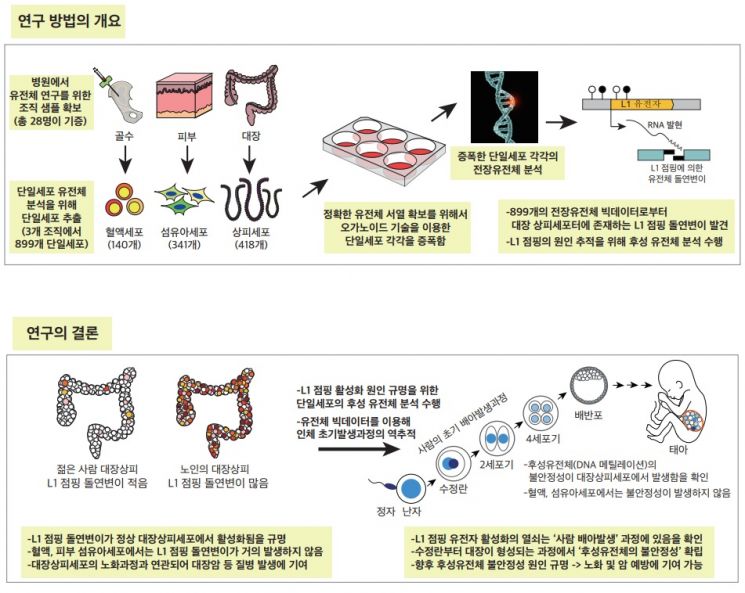
Contrary to this common belief, the study clearly demonstrated that some L1 jumping genes can still be activated in specific tissues and that they frequently generate genomic mutations during the aging process. This provides a new perspective on understanding cellular aging and cancer development.
The research team analyzed whole-genome sequencing data of a total of 899 single cells obtained from the skin (fibroblasts), blood, and colon epithelial tissues of 28 individuals using bioinformatics techniques. The frequency of mutations caused by the L1 jumping gene varied significantly depending on the cell type and was mainly found in aged colon epithelial cells. The team confirmed that genomic mutations in colon epithelial cells caused by the activation of the L1 jumping gene occur continuously from the embryonic developmental stage before birth throughout a person’s lifetime. According to the study, colon epithelial cells of a 40-year-old individual typically carry one or more mutations caused by the L1 jumping gene.
To trace the activation mechanism of the L1 jumping gene, the researchers examined not only DNA but also epigenomic (DNA methylation) sequences. Cells with activated L1 jumping genes exhibited epigenomic instability, revealing that changes in the epigenome act as a switch regulating the activation of the L1 jumping gene. By tracking the embryonic development of cells, the study suggested that most of this epigenomic instability is formed during early embryonic development.
Professor Joo stated, "This is a representative study that confirmed life phenomena caused by the L1 jumping gene, which had been difficult to elucidate until now, through extensive application of whole-genome sequencing and bioinformatics. This research shows that DNA mutations are not exclusive to cells with cancer or diseases but are continuously generated by the inherent instability of normal human cells during the aging process."
© The Asia Business Daily(www.asiae.co.kr). All rights reserved.


















