A joint research team from Pukyong National University, Hanyang University, and the Institute for Basic Science (IBS) has succeeded for the first time in identifying the paradoxical ‘quantum scar state,’ a stable state existing in photonic crystal quantum chaos systems.
The joint research team recently published a paper titled ‘Bloch Theorem Dictated Wave Chaos in Microcavity Crystals’ in the international optics journal Light: Science & Applications (IF: 20.26 / top 2.4% in JCR category).
The research team included Professor Heecheol Park from the Department of Physics at Pukyong National University, Professor Moonjip Park from the Department of Physics at Hanyang University, and Dr. Changhwan Lee from the Complex Systems Theory Physics Group at IBS.
In physics, it is common sense that an object with high potential energy falls to a stable position, and states are classified into two types: stable fixed points where the object is at equilibrium and does not move, and unstable fixed points where even a slight deviation breaks the force equilibrium.
However, in quantum mechanics, this common sense can be violated. Due to interference phenomena arising from particle-wave duality, it has been proposed that particles can stably reside even at unstable fixed points. This quantum state is called the ‘quantum scar state.’
If a stable quantum scar state can be realized in a complex quantum chaos system despite external disturbances, it can be widely applied in quantum technologies such as quantum sensing. Therefore, attempts to realize quantum scar states by confining photons at unstable fixed points inside microresonators have been ongoing in the physics community.
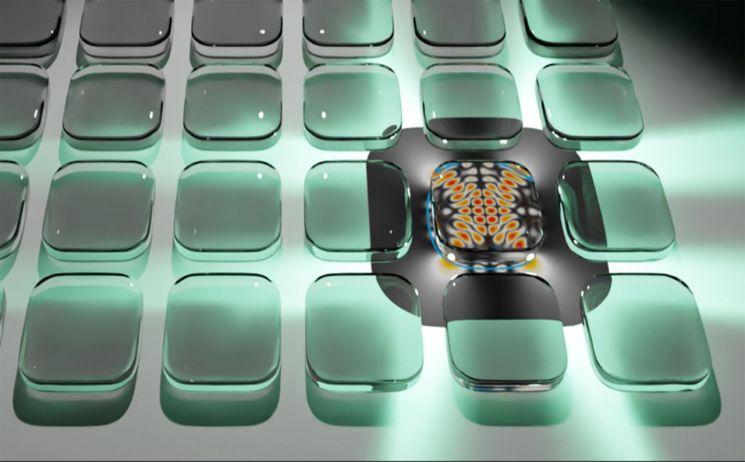
The joint research team including Pukyong National University theoretically demonstrated the existence of quantum scar states in photonic crystals where multiple resonators are arranged in a lattice structure.
The research team combined chaos and periodicity based on the insight that using photonic crystals with multiple interacting resonators can effectively control the movement of light. They proposed a new platform that can control dynamic localization in chaotic states within resonator arrays through this combination.
Until now, quantum scar states had been proposed only in single resonators, and this is the first time they have been proposed in photonic crystal structures where multiple resonators are connected.
Professor Heecheol Park said, “The fusion of quantum chaos and spatial regularity, which is the core of this research, is an effective method to control quantum chaos,” adding, “We expect this research result to become a window to observe and control quantum phenomena from the classical world and a new quantum platform widely applicable to quantum technologies.”
© The Asia Business Daily(www.asiae.co.kr). All rights reserved.

















