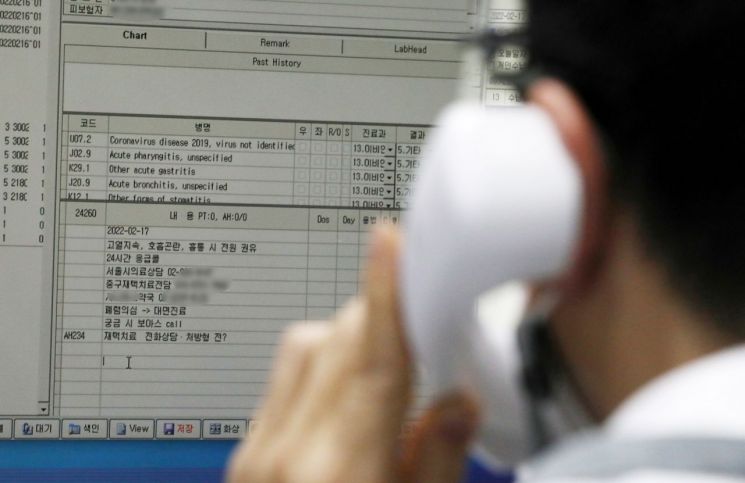
Starting next month, as non-face-to-face medical consultations transition into a pilot project format, there are calls to thoroughly analyze the temporary non-face-to-face consultation data?an inheritance from the COVID-19 pandemic?before institutionalizing the system. Meanwhile, the medical and pharmaceutical sectors argue that since the government has declared COVID-19 endemic (periodic infectious disease outbreaks), non-face-to-face consultations should, in principle, be terminated. According to the Infectious Disease Control and Prevention Act, non-face-to-face consultations are temporarily allowed when the infectious disease alert level is ‘severe,’ but with the alert level being downgraded to ‘caution’ next month, non-face-to-face consultations will become illegal starting June.
The government has announced it will conduct a pilot project to fill the legislative gap, as it is pushing for the legalization of non-face-to-face consultations in the National Assembly. However, aside from the principle of auxiliary use mainly for follow-up visits, detailed contents are still under review. Among these, usage patterns of non-face-to-face consultations vary by region, medical specialty, and age group. According to the non-face-to-face consultation status (February 2020 to September 2022) submitted by the Health Insurance Review and Assessment Service to Shin Hyun-young, a member of the National Assembly’s Health and Welfare Committee from the Democratic Party, 61% (14,453 cases) of dermatology non-face-to-face consultations were conducted at medical institutions in Seoul. In contrast, urology consultations in Seoul accounted for only 24% (36,675 cases), which was relatively low.
The age group using non-face-to-face consultations was generally highest among those in their 60s. In surgery, 60s accounted for 35%, 70s 19%, and 50s 11%, while in internal medicine, 60s were 31%, 70s 16%, and 50s 14%. In urology, those aged 50 to 70 made up 52% (78,077 cases). Conversely, dermatology saw 20- to 40-year-olds comprising 46% (10,882 cases) of the total. When divided into initial and follow-up visits, follow-up visits generally had a higher proportion. Dermatology had a relatively low follow-up rate at 74% (15,633 cases), whereas psychiatry had a very high rate of 97%.
About 80% of non-face-to-face consultations were related to COVID-19 cases. Surgery handled the most COVID patients at 79%, followed by pediatrics (78%), internal medicine (73%), psychiatry (45%), urology (30%), and dermatology (14%). Shin Hyun-young, who proposed legislation related to follow-up-centered non-face-to-face consultations, advised that “system design tailored to the characteristics of each medical field is necessary to enhance medical accessibility and ensure continuous medical service provision.”
Platform Industry: Pilot Project Matches Current Practice vs. Medical and Pharmaceutical Sectors: Pilot Project Not Acceptable
Meanwhile, the Remote Medical Industry Council (Wonsanhyeop), composed of non-face-to-face consultation platform companies, argues that the current level of non-face-to-face consultation business should be maintained. Since 99% of platform users are first-time patients, there is concern that about 30 non-face-to-face consultation platform companies could face bankruptcy. A Wonsanhyeop official stated, however, “If a consultative body including the industry is formed within the non-face-to-face consultation pilot project to start discussions together, follow-up visits can also be accepted.”
The pharmaceutical sector opposes non-face-to-face consultations altogether, citing issues such as indiscriminate misuse and misdelivery of medicines. The Korea Pharmaceutical Association held a rally on the 14th to block the non-face-to-face consultation pilot project. The medical community, which had agreed to limit non-face-to-face consultations to follow-up visits, appears to be reversing its stance after the COVID-19 endemic declaration. The Korea Medical Association (KMA) believes there is no reason to continue non-face-to-face consultations after the end of COVID-19. The Free Medical Movement Headquarters will hold a press conference on the 23rd in front of the Presidential Office in Yongsan, Seoul, calling for the suspension of non-face-to-face consultations.
All G7 Countries Allow Non-Face-to-Face Consultations
Meanwhile, according to the Medical Policy Research Institute under the KMA, all seven major countries (G7) allow non-face-to-face consultations. However, the United States, which temporarily allowed initial consultations for low-income groups, will permit only follow-up visits starting in 2025. Japan and France require a referral letter for initial consultations, and Germany and Italy allowed only follow-up visits even during the COVID-19 pandemic.
© The Asia Business Daily(www.asiae.co.kr). All rights reserved.

















