Ruling Party and Government Propose Presidential Reconsideration Request
Cabinet Meeting on the 16th... Nursing Sector Opposition Expected
Political Accountability Debate... Heightening Conflict in Health and Medical Fields
The ruling party and the government have officially recommended that President Yoon Seok-yeol exercise his veto power regarding the Nursing Act bill that passed the National Assembly plenary session, inevitably provoking strong opposition from the nursing community. If President Yoon exercises his veto, the current Nursing Act bill will effectively be discarded.
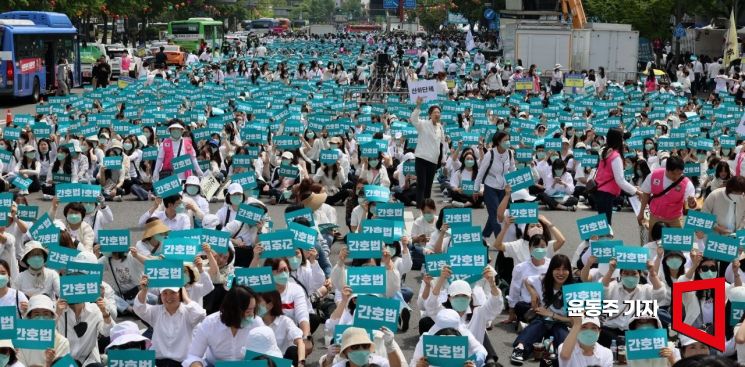 On the 12th, Nurses attending the commemorative celebration held on Sejong-daero, Jongno-gu, Seoul, in honor of International Nurses Day 2023, raised placards and shouted slogans urging the enactment of the Nursing Act. Photo by Dongju Yoon doso7@
The process of enacting the Nursing Act has so far escalated into conflicts among healthcare professions, and both ruling and opposition parties have turned it into a political dispute rather than mediating, dividing the healthcare sector that should be working for public health. Regardless of how the Nursing Act is concluded, this incident is expected to remain the worst example of the healthcare sector being manipulated by politics.
Foreseen Ruling Party and Government Veto Recommendation
On the 14th, the ruling party and government held a high-level party-government meeting and decided to recommend that President Yoon exercise his veto regarding the Nursing Act bill. It is highly likely that President Yoon will accept this. At the Cabinet meeting scheduled for the 16th, President Yoon is expected to review and decide on the request for reconsideration of the Nursing Act bill. Kang Min-guk, the senior spokesperson for the People Power Party, explained the reason for the recommendation during a briefing that day, saying, "If nurses are separated from the current medical system, trust and cooperation among professions in medical sites will be broken, and conflicts are very likely to expand," and "If the Nursing Act is promulgated, it will clearly set a bad precedent of the government leaving conflicts unattended in the field of people's livelihoods."
This decision by the ruling party and government was somewhat anticipated. When the Nursing Act bill passed the National Assembly plenary session, ruling party members had left the chamber, and the decision was made under opposition leadership. The 'Health and Welfare Medical Solidarity,' which includes 13 healthcare professional organizations opposing the Nursing Act such as the Korean Medical Association and the Korean Association of Assistant Nurses, announced plans for a general strike on the 17th, continuously pressuring the government and ruling party. The Ministry of Health and Welfare, the competent ministry, has consistently expressed a negative stance, citing concerns that the Nursing Act would hinder cooperation among healthcare professions and that sufficient discussion had not taken place.
 Prime Minister Han Duck-soo is speaking at the High-level Party-Government Consultation held at the Prime Minister's official residence in Jongno-gu, Seoul on the 14th.
 [Photo by Yonhap News]
Strong Opposition from the Nursing Community... First-Ever Strike Possible
In contrast, the nursing community has demanded the promulgation of the Nursing Act, arguing that the current bill has undergone sufficient discussion and was promoted regardless of party lines. Recently, representatives including Kim Young-kyung, president of the Korean Nurses Association, began a hunger strike, urging President Yoon to promulgate the Nursing Act. At the 'International Nurses Day Celebration' held on the 12th, President Kim stated, "The Nursing Act does not hinder cooperation with other healthcare professions in any way, legally or procedurally," and added, "Despite preparing a revised bill after four intense legislative reviews, the government and ruling party suddenly changed their stance and claim there are problems once the bill was submitted to the plenary session. This is an unjust exercise of public authority."
However, as the likelihood of the president exercising his veto increases, the possibility of collective action by the nursing community has grown stronger. Since the 8th, the Korean Nurses Association has been conducting a survey among its members regarding 'nurses' collective action,' and preliminary results show that 98.4% agree that collective action is necessary if the president exercises his veto. Before the survey, the association stated, "We will not engage in collective action that jeopardizes the lives and safety of the public," but given the worst-case scenario, more active measures have become inevitable. It is reported that the nursing community is even discussing the possibility of the first-ever collective strike in history.
If the nursing community actually launches a general strike, severe chaos is expected in medical sites. The Korean Nurses Association, the Korean Health and Medical Workers' Union, and hospital nursing societies have strong organizational power, and considering that the enactment of the Nursing Act was the nursing community's greatest wish, participation rates are expected to be significant. A healthcare sector official said, "A nurses' strike would affect virtually all medical institutions except some small-scale clinics," and added, "Depending on participation, essential medical staff such as those in intensive care units and emergency rooms may remain, but outpatient care and general wards will inevitably be paralyzed."
Conflict over the Nursing Act Fueled by Politics
The most regrettable aspect of the current Nursing Act crisis is that the political sector, which should have mediated the conflict, turned it into a political dispute, causing extreme confrontation. Improving nurses' working conditions was a common policy both ruling and opposition parties aimed to pursue after the COVID-19 pandemic. In fact, the Nursing Act bills proposed in the 21st National Assembly were introduced regardless of party lines. Currently, no political party or healthcare professional organization opposes improving nurses' working conditions. However, the political sector failed to show the ability to mediate professional conflicts and instead divided into 'my side' and 'your side,' going their own way. The opposition pushed for legislation citing "sufficient discussion," while the ruling party confronted the nursing community under the pretext of "preventing legislative overreach."
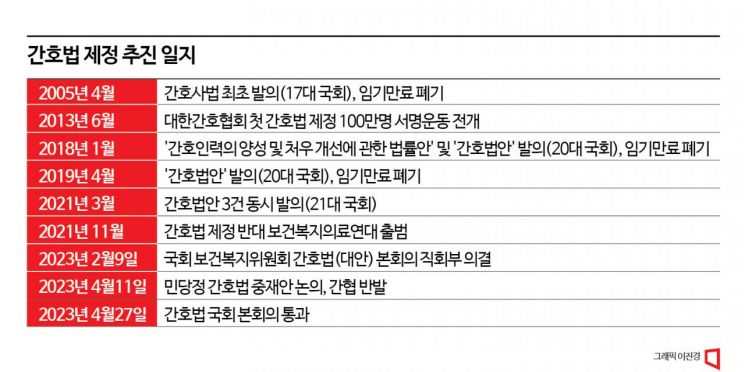
In fact, during the persuasion process with the nursing community, the ruling party and government offered improvements in nurses' working conditions as a 'carrot,' but failed to achieve significant results and instead were suspected of lacking sincerity. At the end of last month, ahead of the Nursing Act's passage in the National Assembly plenary session, the Ministry of Health and Welfare suddenly announced a 'Comprehensive Support Plan for Nursing Personnel.' However, it was criticized for lacking concrete financial support measures and being merely declarative. The Health and Medical Workers' Union pointed out, "There is direction but no concrete substance," and urged, "A specific implementation plan must be established so that practical compensation and benefits reach nurses in the field." The Korean Nurses Association also welcomed the plan but emphasized, "We strongly demand that the Nursing Act not be used as a political tool to block its enactment and diminish its significance." As a result, it became clear that the government's comprehensive support plan for nurses was intended to block the Nursing Act's enactment.
Meanwhile, attention is also focused on the 'exit strategy' if President Yoon exercises his veto on the Nursing Act. Yoon Jae-ok, floor leader of the People Power Party, previously stated, "Efforts must be made to reach a new agreement between the two parties to restore the medical cooperation system," adding, "The original function of legislation is to minimize and reduce social conflicts." More advanced discussions on improving working conditions or legislation on the so-called 'Nurses' Working Conditions Improvement Act,' proposed earlier as a mediation plan by the ruling party and government, are being mentioned. However, since the nursing community has already opposed such measures, it remains uncertain how persuasive these efforts will be.
© The Asia Business Daily(www.asiae.co.kr). All rights reserved.
![Clutching a Stolen Dior Bag, Saying "I Hate Being Poor but Real"... The Grotesque Con of a "Human Knockoff" [Slate]](https://cwcontent.asiae.co.kr/asiaresize/183/2026021902243444107_1771435474.jpg)













