1st and 2nd Instance Courts "Applicable to Diplomatic Premises, Domestic Jurisdiction Not Recognized"
Supreme Court "Claim for Monetary Payment, No Concern of Interference with Diplomatic Mission Duties"
If a foreign diplomatic embassy in Korea occupies part of privately owned land, the embassy cannot be demolished, but the owner can claim usage fees, according to a Supreme Court ruling.
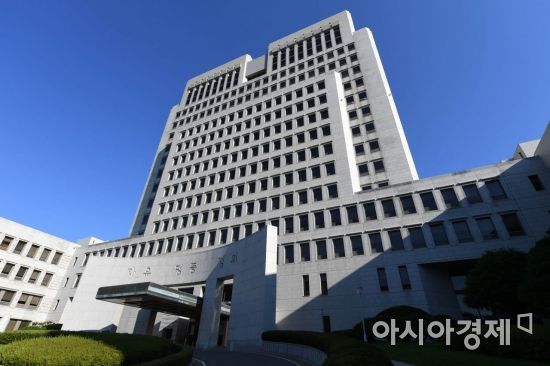
The Supreme Court's 3rd Division (Presiding Justice No Jeong-hee) overturned the lower court's dismissal in a lawsuit filed by A Corporation, a KOSDAQ-listed company, against Mongolia seeking restitution of unjust enrichment, and remanded the case to the Seoul Western District Court, the court announced on the 12th.
In 2015, A Corporation purchased land adjacent to the Mongolian Embassy in Yongsan-gu, Seoul, and later discovered that about 30㎡ of the land it owned was being used by the Mongolian Embassy for embassy buildings and auxiliary warehouses. The embassy building was constructed in 1998.
In February 2017, A Corporation filed a lawsuit demanding "the demolition of the building occupying our company's land and the return of the land," and requested "payment of an amount equivalent to rent as compensation for unauthorized occupation."
The first trial court dismissed the case, ruling that the Korean courts did not have jurisdiction. This was based on the Vienna Convention on Diplomatic Relations, which states that civil lawsuits concerning buildings and land within embassy premises are not subject to the jurisdiction of Korean courts.
The appellate court also ruled, like the first trial, that Korean courts lacked jurisdiction. However, it accepted A Corporation's preliminary claim to confirm ownership. The appellate court stated, "A judgment confirming ownership alone cannot be enforced compulsorily, nor does it constitute an improper interference with Mongolia's sovereign activities," and ruled that "issuing a judgment confirming ownership falls within the legitimate jurisdiction of Korean courts."
The Supreme Court ruled this time that "while claims for demolition of buildings and delivery of land are outside the jurisdiction of Korean courts, claims for restitution of unjust enrichment fall within their jurisdiction."
The court stated, "A foreign country occupying real estate as embassy premises is closely related to sovereign activities, and under international law, foreign embassy premises are, in principle, inviolable, and the receiving state has an obligation to protect them." However, the court also ruled that "claiming rent or similar fees against the foreign country when a foreign embassy occupies real estate owned by a Korean and infringes on private rights or interests does not constitute an infringement on the foreign country's sovereign duties."
© The Asia Business Daily(www.asiae.co.kr). All rights reserved.
![Clutching a Stolen Dior Bag, Saying "I Hate Being Poor but Real"... The Grotesque Con of a "Human Knockoff" [Slate]](https://cwcontent.asiae.co.kr/asiaresize/183/2026021902243444107_1771435474.jpg)
















