KAIST Researchers "Development of Nickel-Molybdenum Material"
Domestic researchers have developed an inexpensive catalyst that can significantly reduce the cost of hydrogen fuel cells. It costs only 1/80th of the price of conventional platinum.
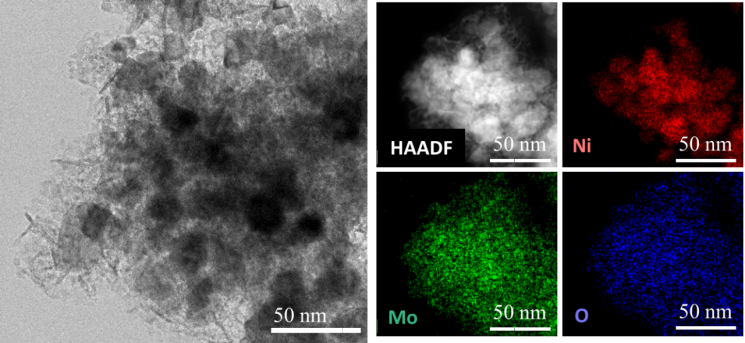 Transmission electron microscope image and composition distribution map of nickel-molybdenum oxide composite, a hydrogen fuel cell replacement catalyst developed by KAIST researchers that is 1/80th the cost of platinum. Image source: Provided by KAIST
KAIST announced on the 11th that a research team led by Professor Eun-Ae Jo from the Department of Materials Science and Engineering's Energy Conversion and Storage Materials Laboratory succeeded in developing an affordable yet high-performance electrode material that can replace platinum. They developed a 'nickel-molybdenum material' with superior performance to platinum as an electrode material for anion exchange membrane fuel cells, which are being developed as next-generation fuel cells.
Newly developed catalysts often fail to achieve actual performance in fuel cells due to various factors. However, the research team overcame this challenge and successfully applied the newly developed catalyst to actual fuel cells in this study. Nickel has attracted attention as a non-precious metal electrode material for anion exchange membrane fuel cells, but its performance was less than 1/100th that of platinum, preventing practical application. However, the nickel-molybdenum catalyst developed by the research team this time outperforms platinum (platinum: 1.0 mA/cm², nickel-molybdenum catalyst: 1.1 mA/cm²) and costs only 1/80th as much, making it expected to replace platinum. The research team also succeeded in securing performance by applying the nickel-molybdenum catalyst to fuel cells.
Professor Jo said, "Pure nickel has low performance, but by using molybdenum oxide to change the electronic structure of nickel, we dramatically improved its performance," adding, "Due to the nature of the process, it is suitable for mass production and is expected to be applied to anion exchange membrane fuel cells in the future."
The results of this study were published online on the 5th of last month in the international materials science journal Applied Catalysis B: Environmental.
© The Asia Business Daily(www.asiae.co.kr). All rights reserved.
![Clutching a Stolen Dior Bag, Saying "I Hate Being Poor but Real"... The Grotesque Con of a "Human Knockoff" [Slate]](https://cwcontent.asiae.co.kr/asiaresize/183/2026021902243444107_1771435474.jpg)











