IBS Research Team: "Preference for Diverse Natural Environments Led to Successful Adaptation and Evolution"
Humankind has survived and evolved through harsh climate changes over the past 3 million years. This contrasts with other ancient humans and animals that failed to adapt and became extinct or did not evolve. A domestic research team has analyzed that the reason for human adaptation and evolution lies in their preference for diverse environments, vegetation, and animal groups.
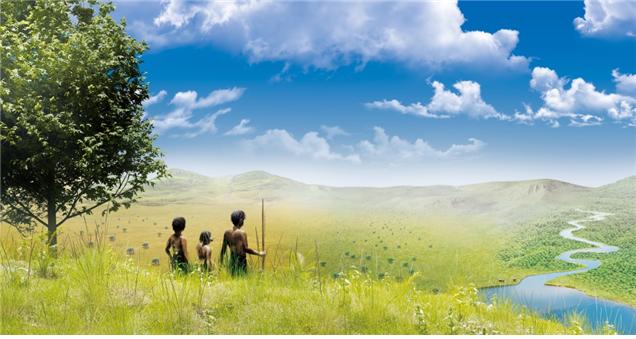 The Institute for Basic Science (IBS) announced on the morning of the 12th (Korean time) research findings that humans were able to adapt and evolve because they preferred habitats with diverse natural environments, unlike other ancient humans or animals, which allowed them to survive harsh environmental changes.
 Image source=IBS
The Institute for Basic Science (IBS) announced on the 12th that the research team led by Axel Timmermann, head of the Climate Physics Research Division and adjunct professor at Pusan National University, revealed the natural environment preferences of human ancestors over 3 million years by combining the results of the longest-ever paleoclimate simulations with archaeological data. This research was published on the same day in the international journal Science, attracting global attention.
The Homo species, classified as ancestors of modern humans, evolved through several ice ages and interglacial periods over the past 3 million years. However, how early humans adapted to climate change and the resulting natural environment changes has not been clearly understood. Related to this, the research team published a study in April last year in the international journal Nature, simulating climate over the past 2 million years and estimating the habitats of human ancestors by era. In this study, they generated climate data such as temperature and precipitation for the past 3 million years, extending 1 million years further back, and constructed a climate-based vegetation model. They then applied this simulation data to a vast archaeological dataset of 3,232 sites and fossils across Africa, Europe, and Asia, classifying the biome types of Homo species’ habitats into 11 categories. Subsequently, they identified the preferred biomes of each Homo species.
The earliest Homo species (Homo ergaster, Homo habilis), which first appeared in Africa 2 to 3 million years ago, lived only in open environments such as grasslands and dry shrublands. However, around 1.8 million years ago, Homo erectus, Homo heidelbergensis, and Homo neanderthalensis migrated to Eurasia and developed adaptability to various biomes, including temperate and boreal forests, during which they developed several social technologies. This high adaptability to diverse biomes made Homo sapiens, our direct ancestors who appeared in Africa 200,000 years ago, more capable than any previous Homo species in mobility, flexibility, and competitiveness. Thanks to this, they could live in harsh environments such as deserts and tundras that other Homo species had not pioneered.
Furthermore, the research team closely examined the environmental characteristics preferred by Homo species and found that their habitats were concentrated in regions with increased biome diversity. In other words, Homo species preferred mosaic natural environments where diverse plant and animal resources were nearby. This preference for diversity is suggested to have influenced tool development and cognitive abilities, increasing the resilience and adaptability of Homo species to extreme changes.
Elke Zeller, a graduate researcher leading the study (PhD candidate at Pusan National University), said, “We confirmed that diverse natural environments and vegetation are essential elements for human survival and potential driving forces for socio-cultural development,” adding, “This presents an unprecedented perspective on the survival strategies of early humans.”
Axel Timmermann, head of the division, stated, “Thanks to integrating climate-vegetation modeling into anthropology, we have demonstrated for the first time on a continental scale the habitat preferences of human ancestors regarding natural environments,” and emphasized, “It is significant that we newly proposed the ‘Diversity Selection Hypothesis’ for Homo species.”
This research utilized ‘Aleph,’ one of Korea’s fastest scientific supercomputers operated by IBS.
© The Asia Business Daily(www.asiae.co.kr). All rights reserved.

















