'Powerful Drive to Join G8'
Green Light for Thaw in Korea-Japan Relations
Persuasion Key for Japan, the 'Only Asian G7' with Privileged Status
With the restoration of Korea-Japan shuttle diplomacy, expectations for South Korea's entry into the 'G8 (Group of Eight major countries)' have grown. The expansion and reorganization of the advanced nations' group G7 (United States, Japan, Germany, United Kingdom, France, Italy, Canada) was attempted during the Moon Jae-in administration in 2020 but was thwarted due to Japan's blatant obstruction and lack of support from European member countries. However, with the Korea-Japan talks in March and May this year ushering in a thawing mood in bilateral relations, the atmosphere is changing. Under the active support of Japan, a G7 member country, and if other member countries do not oppose, it is now considered less difficult to establish a G8 system.
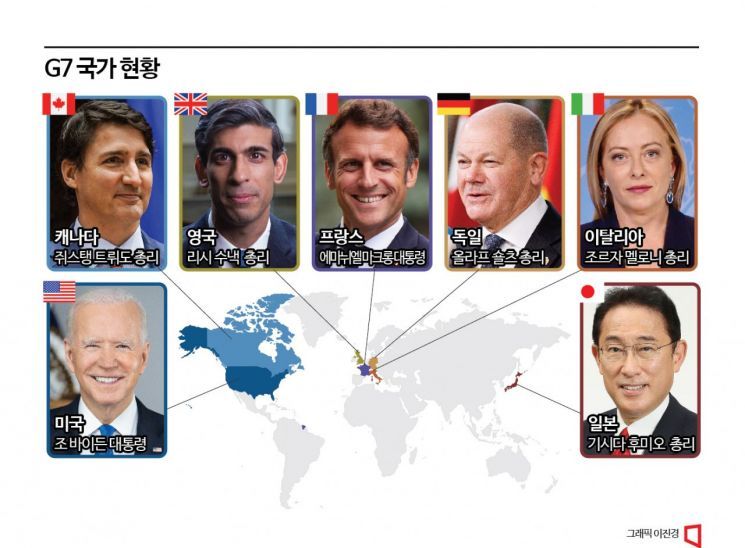
'G8 Diplomacy' Drive...Green Light from Thawing Korea-Japan Relations
According to diplomatic circles on the 12th, the South Korean government is mobilizing all diplomatic capabilities to enter the de facto 'major powers' group, G7. Foreign Minister Park Jin held a dinner meeting last month on the 10th with G7 ambassadors to South Korea. Diplomats are also meeting G7 officials through various channels to explore South Korea's entry into the G8. Joining the G7, an advanced nations' club, is crucial for realizing the Yoon Suk-yeol administration's strong push for becoming a 'global pivotal state.' The Hiroshima G7 summit, which President Yoon will attend as an invited country on the 19th, will be a turning point in determining G8 membership. Membership decisions require unanimity.
This is not the first time South Korea's potential G8 entry has been mentioned under the Yoon Suk-yeol administration. In 2020, then U.S. President Donald Trump advocated expanding the G7 to include Australia, India, and South Korea. However, at that time, Korea-Japan relations were at an extreme low under the Abe administration. Japanese Foreign Minister Motegi clearly opposed, stating that South Korea did not share the G7's stance on dealing with North Korea and China. Germany also aligned with this lukewarm stance. Additionally, other G7 members (Canada, Italy, France), who had little incentive to give up their privileged status, reacted passively, preventing the formation of a G8 system.
However, this year marked a turning point in Korea-Japan relations, South Korea joined the Indo-Pacific strategy, and the value confrontation between North Korea, China, Russia, and G7 countries intensified, increasing the possibility of G8 expansion. The argument is that South Korea should no longer engage in 'balancing acts' or 'double-dealing' diplomacy but should participate actively in global governance as a pivotal country to establish its status in international consultative bodies.
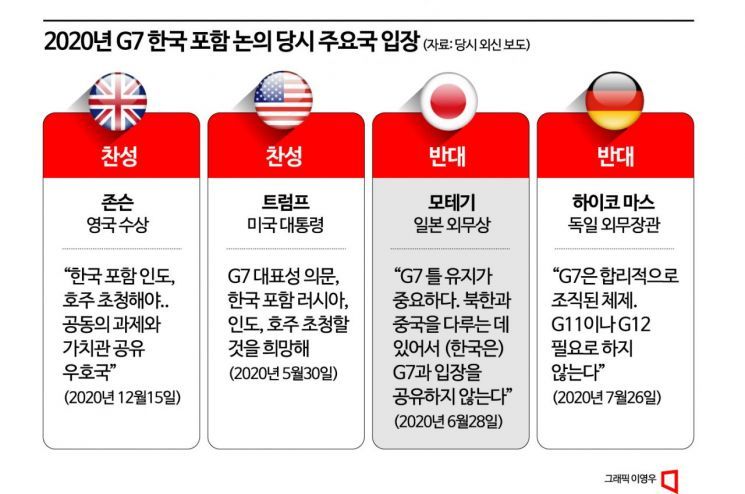
Will the 'Only Asian G7 Member' Relinquish Its Privileged Status? Persuading Japan is Key
Experts see Japan's choice, as a G7 member, as crucial. Former Ambassador to Japan Shin Gak-su said, “Japan may be conscious of its privilege as the only Asian G7 country, but if it forms a value alliance with South Korea, it could positively view South Korea's entry with a shared vision within the G7, which is a possible reversal of thinking at this time.” Shin explained, “South Korea's economic power is already within the G10 and ranks among the G5 in manufacturing. The G7's continuous invitations to South Korea can be seen as recognition of its enhanced status.”
However, there is also speculation that Japan will be negative about South Korea's entry because it values its symbolism and voice as the 'representative Asian G7 country.' Eun-mi Choi, a researcher at the Asan Institute for Policy Studies, said, “Historically, Japan has aimed for 'Datsu-A Ny?-?' (??入?, leaving Asia to enter Europe) but maintains a strong identity as the 'leader of Asia.' As a G7 member, Japan's pride is significant, and it will not easily concede membership qualifications to South Korea.”
In fact, Japan rose rapidly as a global actor and advanced nation through G7 membership. The turning point was its invitation to the G5 summit in Rambouillet, France, in 1975. Until then, Japan was far from 'international respect' as a former wartime aggressor, defeated nation, and victim of atomic bombings. However, after joining the G7, Japan actively contributed internationally and emerged as a center of the Western world.
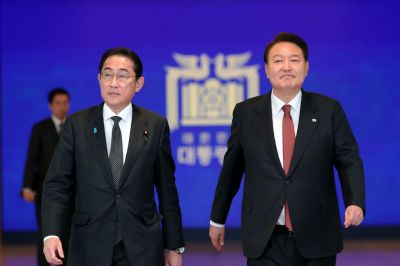
No More 'Strategic Ambiguity' Balancing Diplomacy...Raise National Prestige by Joining International Consultative Bodies
Therefore, there is an interpretation that South Korea should leverage Japan's support for G7 membership to help Japan advance to a permanent seat on the UN Security Council and secure an official endorsement for the Busan Expo, thereby dramatically advancing bilateral relations. South Korea's first invitation to the NATO summit in January this year is also seen as a positive sign. The view is that rather than resting on the alliance with the United States, South Korea needs to internalize and accumulate the norms, values, and reputation of advanced societies to enter the ranks of advanced countries. It is necessary to seek a detour to resolve peace and denuclearization issues on the Korean Peninsula. The same applies to joining the Quad (an informal security dialogue among the U.S., India, Japan, Australia) or CPTPP (Comprehensive and Progressive Agreement for Trans-Pacific Partnership).
Meanwhile, the G7 started in 1973 as the G5, when finance ministers from the United States, United Kingdom, France, West Germany, and Japan gathered to address the first oil shock (oil crisis). It was elevated to a summit meeting after the second oil shock in 1975. Italy and Canada joined, solidifying the G7 system. Initially focused on economic issues, it expanded to political and diplomatic fields, such as demanding the withdrawal of Soviet troops who invaded Afghanistan in 1980. The former Soviet Union participated as a quasi-member in 1991, and Russia formally joined the G7 summit in 1997, expanding it to the G8. However, Russia was excluded again in 2014 following its annexation of Crimea in Ukraine.
© The Asia Business Daily(www.asiae.co.kr). All rights reserved.
![Clutching a Stolen Dior Bag, Saying "I Hate Being Poor but Real"... The Grotesque Con of a "Human Knockoff" [Slate]](https://cwcontent.asiae.co.kr/asiaresize/183/2026021902243444107_1771435474.jpg)


















