Grand Bench: "Male Heirs Have Priority as Jesa Hosts... Constitutes Gender Discrimination"
The Supreme Court en banc ruling that it is not necessary to designate the memorial ceremony host as the son has changed the precedent after 15 years. Previously, the en banc had given priority to the deceased's eldest son or eldest grandson, regardless of whether they were legitimate or illegitimate, as the memorial ceremony host unless there were special circumstances in 2008.
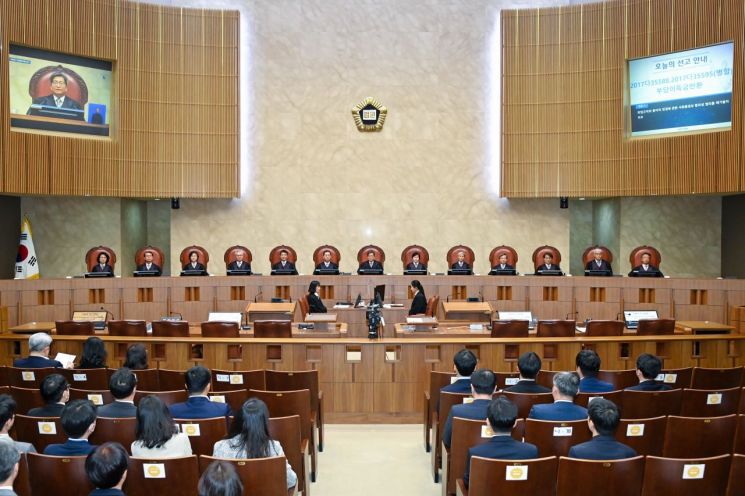 Chief Justice Kim Myung-soo and the Supreme Court justices are seated in the Grand Courtroom of the Supreme Court in Seocho-gu, Seoul, on the afternoon of the 11th, for the plenary session ruling on whether to recognize the status of ritual officiant./Photo by Supreme Court
The Supreme Court en banc (Presiding Justice Jo Jae-yeon) overturned the lower court's ruling that "sons have priority as memorial ceremony hosts" in the remains handover lawsuit filed by Mr. A on the 11th and sent the case back to the Seoul High Court.
Mr. A married Ms. B in 1993 and had two daughters, but Ms. B had an illegitimate son with another woman in 2006. After Ms. B passed away in 2017, the biological mother of the illegitimate son enshrined the deceased's remains in a columbarium at a memorial park in Paju, Gyeonggi Province, without agreement from the spouse and other daughters.
In response, Mr. A and his daughters filed a lawsuit against the biological mother and the memorial park, demanding the return of Ms. B's remains. Ownership of the deceased's remains and burial property for memorial ceremonies belongs to the memorial ceremony host under civil law.
However, both the first and second trials rejected the claims of Mr. A and his daughters. The lower courts cited the en banc ruling from 15 years ago, which stated, "If there is no agreement among the deceased's co-heirs, the eldest son or eldest grandson, regardless of legitimacy, becomes the memorial ceremony host; if there is no son, the eldest daughter becomes the host."
The lower courts judged that "as society changes, the custom that the legitimate eldest son should succeed the memorial ceremony first ignores the autonomous will of the heirs and discriminates between legitimate and illegitimate children."
However, the en banc ruled that the previous en banc precedent regarding the method of deciding the memorial ceremony host when there is no agreement among co-heirs is no longer reasonable and cannot be maintained.
The en banc stated, "Prioritizing male heirs such as the eldest son or eldest grandson as memorial ceremony hosts is inconsistent with the constitutional spirit prohibiting discrimination based on gender," and ruled, "Discriminating between male and female heirs in the succession of memorial property has no reasonable justification."
It added, "In modern society, the patrilineal male-centered family succession meaning in memorial ceremonies has largely faded, and the respect and remembrance of the deceased have become more important. Therefore, male heirs cannot be considered more justified than female heirs as memorial ceremony hosts," and "Prioritizing male heirs such as the eldest son or eldest grandson as memorial ceremony hosts cannot be regarded as a tradition to be preserved or justified by the Constitution."
Furthermore, the en banc introduced a new legal principle: "If there is no agreement among co-heirs, unless there are special circumstances that prevent it, the eldest direct descendant of the deceased, regardless of gender or legitimacy, who is closest in kinship degree, shall have priority as the memorial ceremony host."
Accordingly, the en banc applied this new legal principle and sent Mr. A's case back to the second trial. The court instructed to examine whether the eldest closest direct descendant among Ms. B's heirs, regardless of gender, should be prioritized as the memorial ceremony host and whether there are any reasons that would make that person's appointment as host manifestly unfair.
© The Asia Business Daily(www.asiae.co.kr). All rights reserved.
![Clutching a Stolen Dior Bag, Saying "I Hate Being Poor but Real"... The Grotesque Con of a "Human Knockoff" [Slate]](https://cwcontent.asiae.co.kr/asiaresize/183/2026021902243444107_1771435474.jpg)
















