Expected Annual Growth of 15%
Regulatory Situations Vary by Country
'Hybrid' Approach Needed to Find Balance Point
"Decentralized Clinical Trials (DCT) will experience explosive growth. It is important to find ways to enable DCT within various regulatory environments."
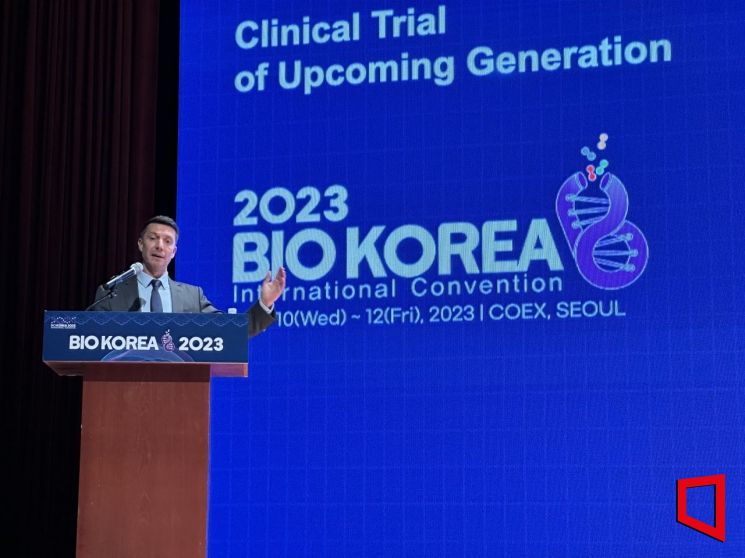 Jerome Amelini, Head of Clinical Development and Operations Strategy at IQVIA Asia, is giving a lecture at 'Bio Korea 2023' held on the 11th at COEX, Gangnam-gu, Seoul.
 [Photo by Lee Chunhee]
Jerome Amelini, Head of Clinical Development and Operations Strategy at IQVIA Asia, said this during his lecture at ‘Bio Korea 2023’ held on the 11th at COEX in Gangnam-gu, Seoul, introducing global trends and growth strategies for DCT.
DCT refers to clinical trials in which some or all clinical-related activities are conducted remotely at participants' homes rather than at traditional clinical sites such as hospitals or research institutes. IQVIA, recognized as the world's largest global Contract Research Organization (CRO) accounting for 16.7% of the global clinical outsourcing market, has also been developing related platforms for DCT.
Amelini stated, “DCT is not new,” adding, “Attempts at DCT have existed since 2010, but the technology was not mature enough.” The COVID-19 pandemic played a decisive role in the explosive growth of DCT. He noted, “Since 2018, approaches to DCT have gradually been made, but the pandemic accelerated the pace dramatically,” and pointed out, “As the number of DCTs continues to increase, it is expected to show an explosive annual growth rate of 14.8% until 2027.” In fact, the proportion of clinical trials using DCT has recently been actively increasing in countries such as the UK (14.6%), Australia (13.6%), and the US (8.4%).
Earlier in the lecture, Cynthia Burst, Head of Clinical Design at IQVIA, also praised the significance of DCT, saying, “About 75% of clinical data was collected by investigators 10 years ago, but now it has decreased to 25%. Digital technology has replaced this, reducing the burden on investigators and enabling the collection of more accurate data.”
Burst repeatedly emphasized that ‘patient-centricity’ is the greatest advantage and core of DCT. She explained, “Patients are becoming more trusting of clinical trials and want information about the results of the trials they participate in, leading to increased participation. Regulatory agencies in various countries are also emphasizing ‘patient-first’.”
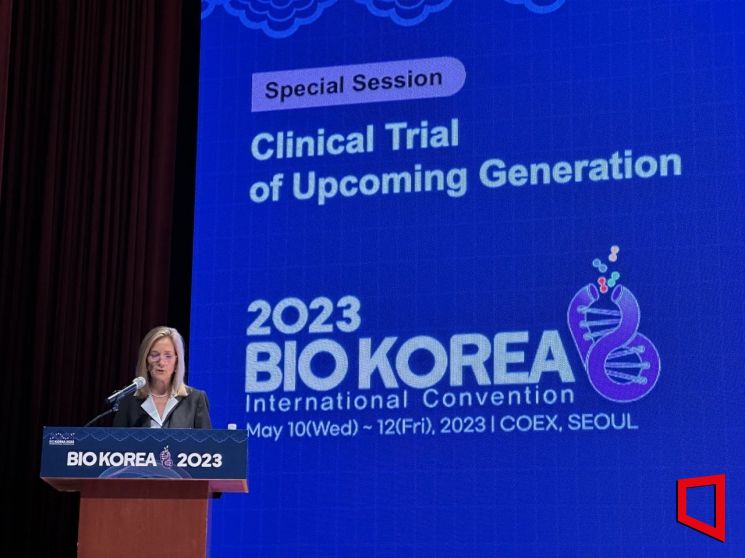 Cynthia Burst, Head of Clinical Design at IQVIA, is giving a lecture at 'Bio Korea 2023' held at COEX in Gangnam-gu, Seoul on the 11th.
 [Photo by Lee Chunhee]
DCT Environments Vary by Country... Could 'Hybrid DCT' Be the Solution?
However, Amelini also cautioned against having overly high expectations due to differing circumstances in each country. He explained, “Some countries allow telemedicine, while others require patients to visit clinical sites in person to sign documents by hand. Some countries permit drug delivery, whereas others require patients to pick up medications at nearby pharmacies.”
In fact, Welt, which recently received approval from the Ministry of Food and Drug Safety for the insomnia digital therapeutic device (DTx) 'PillowRx' through DCT, attempted a fully decentralized clinical trial from patient enrollment to outcome generation in its phase 2 trial but was unable to achieve this. Due to trust issues during the patient enrollment process, patients were required to visit clinical sites in person for face-to-face enrollment.
As a solution, Amelini mentioned ‘hybrid DCT.’ He pointed out, “DCT varies depending on clinical protocols and country-specific regulations. It is not a one-size-fits-all solution like ready-made clothing.” He explained that a hybrid DCT, which finds an appropriate point between traditional clinical trials and fully decentralized trials, is necessary.
Amelini also viewed the proactive attitude of regulatory agencies toward DCT as hopeful. Citing examples from various countries, he emphasized, “Regulatory agencies recognize the need to start DCT by creating DCT guidelines,” and “They are gradually enacting laws to support DCT growth.”
He also acknowledged that DCT results are not always perfect but expressed confidence in overcoming challenges. Amelini said, “About half of respondents in surveys indicated that DCT still needs improvement,” but added, “These technical issues can continue to be improved.”
© The Asia Business Daily(www.asiae.co.kr). All rights reserved.
![Clutching a Stolen Dior Bag, Saying "I Hate Being Poor but Real"... The Grotesque Con of a "Human Knockoff" [Slate]](https://cwcontent.asiae.co.kr/asiaresize/183/2026021902243444107_1771435474.jpg)

















