KDI's Economic Outlook for the First Half of 2023
"Inflation Deceleration Is Weak, Tightening Must Continue"
The Korea Development Institute (KDI) advised that the Bank of Korea's base interest rate of 3.5% should be maintained for the time being to achieve the '2% inflation stabilization target.' It also stated that fiscal policy should refrain from expanding expenditures as domestic demand and employment remain favorable despite the economic downturn.
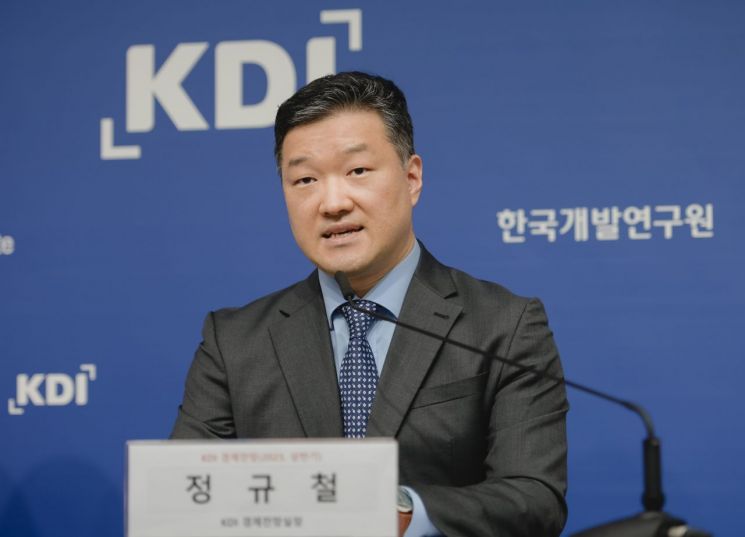 Jung Kyu-cheol, Director of the Economic Outlook Office at the Korea Development Institute (KDI), holding a press conference on the 'KDI Economic Outlook' at the Government Complex Sejong on the 11th.
On the 11th, through its economic outlook for the first half of 2023, KDI analyzed, "Although the consumer price inflation rate is declining, it still significantly exceeds the inflation stabilization target, and the underlying trend of slowing inflation is weak," adding, "It is necessary to maintain a tight monetary policy stance until there is a clear trend of inflation returning to the target level."
KDI also judged that inflationary pressure from increased demand remains. Although growth has slowed due to recent manufacturing sector weakness, the service sector continues to show strong growth. Core inflation, excluding food and energy, has also recorded around 4% since June last year. Therefore, if public utility charges rise, there is a possibility that inflationary pressure could expand again.
Regarding fiscal policy, KDI mentioned that the need to expand fiscal spending is not high. This is because the cause of the recession is a contraction in exports, the employment market is favorable, and the domestic demand slump is easing. Jung Kyu-chul, head of KDI’s Economic Outlook Division, explained, "When the government stimulates the economy, domestic demand mainly revives, which could further fuel inflation," adding, "I think the current budget for this year is sufficient."
However, it was suggested that efficient management plans should be prepared as fiscal soundness recovery could be delayed due to fiscal deficits. Representative methods include conducting performance evaluations for micro-level fiscal projects and setting priorities for macro-level projects. There was also a call for establishing a systematic system to cut expenditures with low priority or efficiency. Regarding the introduction of fiscal rules, it was evaluated as "potentially effective for securing fiscal capacity."
Meanwhile, the report also included a call to assess the response capacity of financial institutions in preparation for uncertainties in domestic and international financial markets. Although the domestic financial market has remained stable despite crises such as Silicon Valley Bank (SVB), concerns over corporate debt defaults, especially centered on real estate project financing (PF), have increased. KDI proposed normalizing emergency policies introduced during COVID-19, such as principal and interest repayment deferrals, and reducing risks through the disposal of non-performing assets.
© The Asia Business Daily(www.asiae.co.kr). All rights reserved.

















