Ministry of Agriculture, Food and Rural Affairs Announces Legislative Notice for 'Amendment to Enforcement Rules of the Farmland Act'
'Decks, Terraces, etc. Also Included in Total Floor Area' Specified
Violations Such as Illegal Extensions to Be Checked Every 3 Years
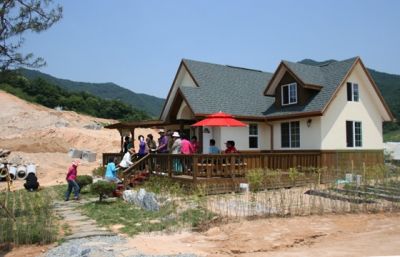
The government has decided to clarify related regulations to prevent violations such as using agricultural sheds (nongmak) as country houses or villas. Although current laws prohibit using nongmak for residential purposes, the standards were not clear, and this time, specific criteria for illegal activities have been established.
On the 11th, the Ministry of Agriculture, Food and Rural Affairs announced that it has prepared a revision of the "Enforcement Rules of the Farmland Act" containing these details and will announce it for legislative notice until the 19th of next month.
Recently, the Board of Audit and Inspection conducted a nationwide audit on the "Installation and Management Status of Temporary Structures (Nongmak)" (April to December 2022) and notified the Ministry of Agriculture, Food and Rural Affairs of the need to "establish standards for nongmak forms and supplement installation requirements."
Accordingly, the Ministry of Agriculture, Food and Rural Affairs aims to clearly organize the regulations related to nongmak under the Farmland Act through enforcement rules to ensure that nongmak are used according to legislative intent, while also improving and supplementing the limitations of local governments' post-management of nongmak.
Nongmak are facilities installed for storing agricultural materials directly needed for farming, simple processing of harvested agricultural products, or taking short breaks during farm work (with a total floor area of 20㎡ or less), and residential use is prohibited. Since they are temporary structures not subject to fire safety standards, residential use in nongmak is vulnerable to safety accidents such as fires, and the Ministry of Agriculture, Food and Rural Affairs is concerned that they could be used as a means to evade the one household two houses rule.
In fact, in March of this year, the Ministry of Agriculture, Food and Rural Affairs, together with local governments, inspected the installation status of nongmak mainly in areas where many nongmak have recently been installed. Among the 252 nongmak inspected, 129 (51%) were illegally expanded for residential use or were illegally used as gardens or parking lots without proper farming.
Accordingly, the Ministry of Agriculture, Food and Rural Affairs decided that cases such as registering a change of residence to a nongmak, overnight sleeping or lodging during farm work, or using it as a leisure facility without farming, which go beyond "temporary rest," will be considered residential use. The same applies if the rest area exceeds 25% of the floor area.
A Ministry of Agriculture, Food and Rural Affairs official explained, "When such violations are detected, the nongmak owner’s explanation is first heard, and if judged to be illegal, corrective measures are issued. If the illegal activity is not resolved after the correction period, a restoration order is issued, followed by a penalty based on 25% of the nongmak area calculated using the publicly announced land price. If the owner does not comply, they will be reported to the police."
Additionally, the revision requires that when installing nongmak, they must be reported as temporary structures under the Building Act that can be restored to farmland. This is intended to prevent farmland damage or permanent use of nongmak as villas by reporting them as buildings. Also, if reported as temporary structures, violations such as illegal expansions are checked every three years under the Building Act, enabling periodic cross-checks with the Farmland Act.
To prevent illegal expansions of nongmak, the enforcement rules clearly specify that auxiliary facilities such as decks and terraces, which are excluded from the total floor area calculation under the Building Act, are included in the nongmak’s total floor area.
The Ministry of Agriculture, Food and Rural Affairs plans to identify the installation status of nongmak through the maintenance of farmland registers nationwide and strengthen post-management through cooperation with related ministries. Park Su-jin, Director of Agricultural Policy at the Ministry of Agriculture, Food and Rural Affairs, said, "With this system improvement, we will supplement the insufficient nongmak regulations to prevent safety accidents in nongmak as temporary structures and strengthen support to ensure there are no difficulties in post-management on the ground."
© The Asia Business Daily(www.asiae.co.kr). All rights reserved.

















