Survey of Opinions from Presidents of 73 Associations
Regarding the first anniversary of President Yoon Suk-yeol's administration, the business community evaluated that corporate tax systems and advanced industry sector policies have improved.
The Korea Chamber of Commerce and Industry (KCCI) announced on the 11th that, based on a survey conducted from the 4th to the 9th targeting 73 chairpersons of regional chambers representing various domestic areas, 66% responded that the government-led changes in corporate systems and environment were either "greatly improved" (2.7%) or "somewhat improved" (63.0%). Responses indicating "worsened" accounted for 5.5%, and "no change" was 28.8%.
Regarding the most improved system and policy areas, "labor sector" (41.1%) was selected the most. KCCI analyzed that the labor sector ranked first because companies sympathized with the government's commitment to labor reform as a national agenda and its firm response to illegal strikes. This was followed by the "industrial sector" (19.2%) and the "tax sector" (17.8%).
Among specific improvements, the tasks with high effectiveness were establishing the rule of law in labor-management relations through strict handling of illegal strikes (56.2%), fostering advanced industries such as designation of advanced industry special zones (46.6%), expansion of investment tax credits for national strategic technologies (45.2%), improvement of industrial workforce supply including expansion of foreign labor introduction (41.1%), and energy transition policies such as revitalization of the nuclear power industry (41.1%), in that order.
Chairpersons of chambers nationwide identified the "labor sector" (32.9%) as the area requiring further improvement in systems and policies. This was followed by the "regulatory sector" (21.9%) and the "economic sector" (16.4%). KCCI explained that the reason for many opinions calling for additional improvements in the labor sector is due to remaining legislative tasks in the National Assembly, such as flexibilization of working hour systems and legislative supplementation of the Serious Accidents Punishment Act.
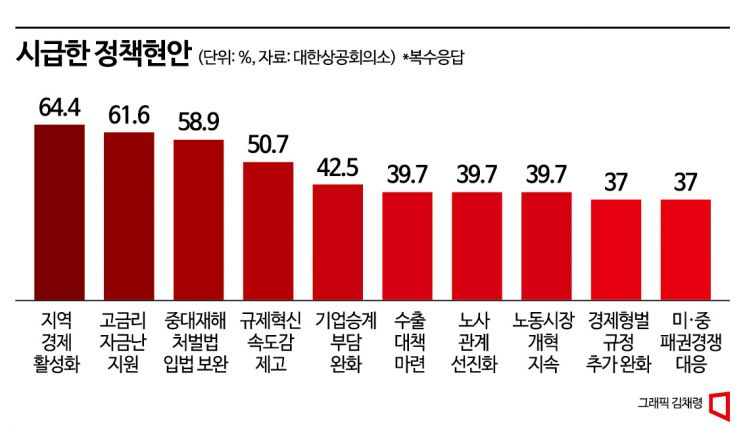
The most urgent policy issues were answered in the order of revitalizing regional economies through bold tax benefits and deregulation (64.4%), support for high-interest financial difficulties through expanded supply of policy funds (61.6%), legislative supplementation of the Serious Accidents Punishment Act including easing excessive penalty provisions (58.9%), and accelerating the pace of regulatory innovation (50.7%).
Kang Seok-gu, head of the KCCI Research Department, said, "Since the launch of the current government, there have been many opinions that voices from the field have been reflected in many areas such as labor, industry, taxation, fair trade, and regulation, resulting in changes in the corporate environment," adding, "We hope that the Yoon Suk-yeol administration will maintain its policy stance of 'transition to a private-led market economy,' reforming rigid systems and policies that hinder companies' innovation capabilities."
© The Asia Business Daily(www.asiae.co.kr). All rights reserved.

















