Analysis of 36 Financial Companies Among Top 50 by Market Cap Excluding Holding Companies
Estimated 294.1 Billion KRW per Company This Year...Samsung Electronics -1.1 Trillion KRW
Number of Negative Companies Expected to Increase from 9 in 2020 to 12 in 2023
One out of every three major domestic companies, including Samsung Electronics, is expected to record negative free cash flow (FCF) this year. FCF is the surplus cash used for new product development, corporate acquisitions, dividend payments, debt repayment, and share buybacks. Due to economic slowdown and high interest rates, earnings have declined, worsening corporate financial conditions.
According to a survey by financial information firm FnGuide, among the top 50 companies by market capitalization excluding financial firms and holding companies, 36 companies have seen a sharp decline in FCF since last year. The average corporate FCF decreased from KRW 12.051 trillion in 2020 to KRW 9.772 trillion in 2021, turning negative to -KRW 4.372 trillion last year. The forecast for this year is KRW 2.941 trillion.
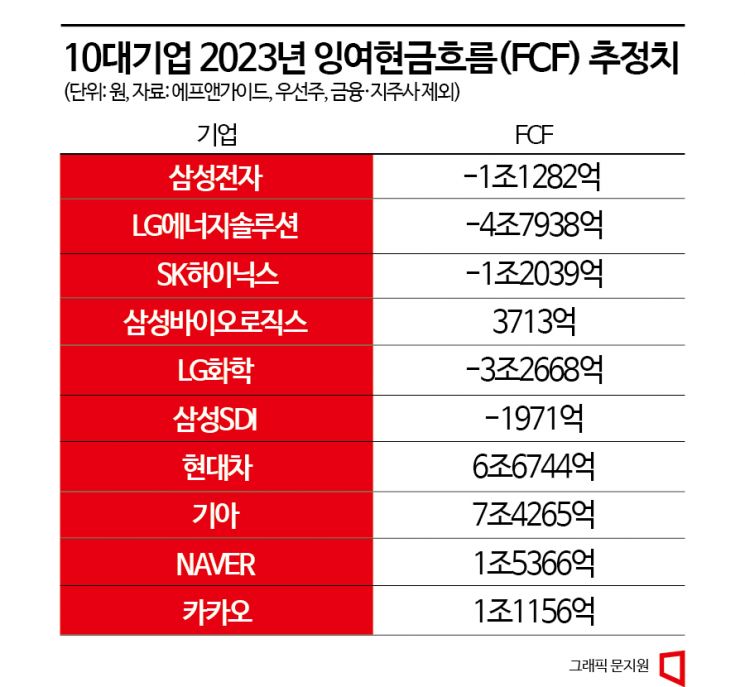
Among the 36 companies, those with negative FCF numbered 9 in 2020, 9 in 2021, and 7 last year. This year, it is estimated to increase to 12. Companies expected to struggle with cash shortages include Korea Electric Power Corporation (KEPCO) (-KRW 65.91 trillion), LG Energy Solution (-KRW 47.938 trillion), LG Chem (-KRW 32.668 trillion), SK Innovation (-KRW 31.052 trillion), Lotte Chemical (-KRW 20.282 trillion), POSCO Future M (-KRW 12.350 trillion), SK Hynix (-KRW 12.039 trillion), Samsung Electronics (-KRW 11.282 trillion), EcoPro BM (-KRW 6.725 trillion), Hanwha Solutions (-KRW 3.701 trillion), L&F (-KRW 3.622 trillion), and Samsung SDI (-KRW 1.971 trillion).
The company expected to see the largest decrease in FCF compared to 2020 is Samsung Electronics. Its FCF is estimated to drop from KRW 27.695 trillion in 2020 to -KRW 11.282 trillion this year, a decrease of KRW 28.823 trillion. Korea Electric Power Corporation (-KRW 6.518 trillion), LG Energy Solution (-KRW 4.928 trillion), and SK Hynix (-KRW 3.449 trillion) are also expected to experience significant declines.
FCF increases when cash flow from operating activities rises and capital expenditures decrease. Even if investments increase, good operating performance indicates healthy financial conditions. However, if investments decrease and operating performance is poor, leading to a decline in FCF, it signals risk.
Among companies with negative FCF, battery firms are considered stable, while semiconductor and utility companies are somewhat concerning. Battery companies’ performance increased, but semiconductor and utility companies’ performance declined. The combined operating profit of five battery companies (LG Energy Solution, Samsung SDI, POSCO Future M, EcoPro BM, and L&F) rose 81.1% from KRW 2.117 trillion in 2021 to KRW 3.834 trillion last year. During the same period, the electrical and electronics sector (Samsung Electronics, SK Hynix, LG Electronics, Samsung Electro-Mechanics) decreased 21.1% from KRW 69.589 trillion to KRW 54.920 trillion. Utilities (Korea Electric Power Corporation, Doosan Enerbility, Hanwha Solutions) dropped 58.3% from KRW 3.143 trillion to KRW 1.310 trillion.
Experts explained that cases where both earnings (cash flow) and FCF decline in poor performance situations are divided into those where accounts receivable increase and those where capital expenditures increase despite risks. Joo In-ki, honorary professor at Yonsei University and former president of the International Federation of Accountants, said, "In Samsung Electronics’ case, it is judged as a case of boldly increasing future investments despite declining performance, rather than issuing uncollectible bad debts."
Samsung Electronics had poor performance last year but increased investments to an all-time high. Last year’s capital expenditure (acquisition of tangible assets) was KRW 49.430 trillion. Research and development (R&D) investment was KRW 24.929 trillion, also a record high. In contrast, some companies like SK Hynix are reducing capital expenditures. At its first-quarter earnings conference on the 26th of last month, SK Hynix stated, "We are minimizing investments in all areas except essential investments to maintain competitiveness." SK Hynix’s capital expenditure last year was KRW 19.010 trillion.
© The Asia Business Daily(www.asiae.co.kr). All rights reserved.
![Clutching a Stolen Dior Bag, Saying "I Hate Being Poor but Real"... The Grotesque Con of a "Human Knockoff" [Slate]](https://cwcontent.asiae.co.kr/asiaresize/183/2026021902243444107_1771435474.jpg)

















