Controversies Including February Remarks on Jeju 4·3 Incident
'Disparaging Comments about Teacher Kim Gu'
'JMS Democratic Party' Facebook Posts
On the 10th, Tae Young-ho, a member of the People Power Party, voluntarily resigned from his position as a Supreme Council member ahead of the party's Ethics Committee disciplinary decision. This comes about three months after the controversy surrounding the 'Jeju 4·3 Incident.'
The controversy surrounding Tae began during the party convention race in February. At the joint speech session in Jeju during the convention, Tae claimed that the '4·3 Incident was triggered under the orders of North Korea's Kim Il-sung.' The 4·3 Incident was defined by the government in 2003 as a 'massive civilian casualty caused by state authority.' The claim of North Korean orders is a narrative pushed by some far-right groups. As a result, bereaved families and organizations related to the 4·3 Incident criticized Tae for 'distorting facts' and engaging in 'color politics.'
Despite this situation, Tae secured a place in the party leadership by receiving 13.11% of the votes in the Supreme Council election.
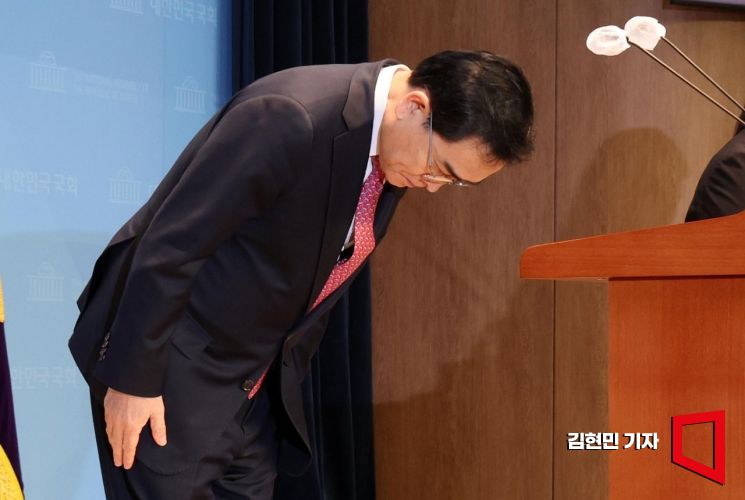 Tae Young-ho, Supreme Council Member of the People Power Party, held a press conference at the National Assembly Communication Office on the 10th, announcing his voluntary resignation from the Supreme Council position and bowing his head in apology. Photo by Kim Hyun-min kimhyun81@
The issue flared up again on the 17th of last month. Tae posted on Facebook targeting the Democratic Party, which was embroiled in a cash envelope scandal during the party convention, writing, “Trash (Junk) Money Sex Democratic Party. Indeed JMS Democratic Party,” which drew criticism.
At the time, Tae explained it as a “staff mistake.” He said, “The staff in my office decided in their own meeting to upload the message and requested my final confirmation. However, at the final confirmation stage, the message that should have been reported as ‘private’ was mistakenly made ‘public.’” Seemingly anticipating disciplinary action from the party’s Ethics Committee, Tae apologized, saying, “I am sorry for causing trouble to the party and apologize. I will accept any measures the party takes.”
However, just one day later, he was embroiled in another controversy over ‘disparaging Kim Gu.’ Tae, a former North Korean defector diplomat, said in an interview with Monthly Chosun released on the 18th of last month, “During last Lunar New Year, I was shocked to see on KBS’s ‘History Journal That Day’ program that President Syngman Rhee opposed the establishment of a unified government, while Kim Gu worked until the end for the establishment of a unified government and was assassinated.” He added, “People who do not know North Korea might think Kim Gu worked for unification, but from the perspective of someone who understands North Korea’s strategy toward the South, Kim Gu was used by Kim Il-sung’s united front strategy.” He further stated, “Kim Il-sung used Kim Gu to prevent the establishment of a South-only government and to set up a communist regime. Shouldn’t we also inform people of such North Korean strategies for an accurate comparison?”
This drew criticism not only from opposition parties but also within his own party. Representative Heo Eun-ah pointed out that Tae’s remarks deny the history and legitimacy of the People Power Party. On her Facebook, Heo emphasized, “It has been less than a year. On the 73rd anniversary of the death of Baekbeom Kim Gu last year, our People Power Party officially stated through the chief spokesperson’s commentary that ‘Kim Gu worked until his death to prevent the division of the Korean Peninsula and for unification, loved the country and the nation, and sought national unity, and we will carry on his will.’” She added, “If Kim Gu’s unification efforts 80 years ago were ‘used by Kim Il-sung,’ does that mean the 21st-century People Power Party is also being manipulated by Kim Il-sung? Why on earth are such outrageous remarks being made, and for what purpose? How long will the party leadership continue to overlook this situation?”
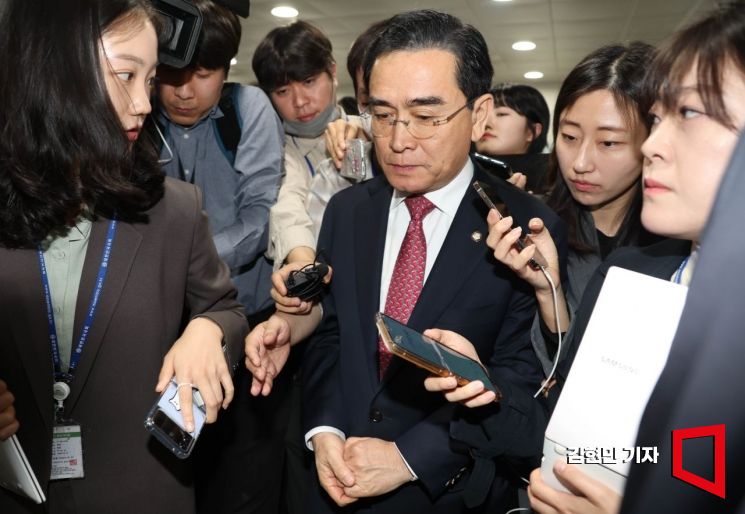 Tae Young-ho, Supreme Council Member of the People Power Party, is moving while receiving questions from reporters after holding a press conference to voluntarily resign from his Supreme Council position at the National Assembly Communication Office on the 10th. Photo by Hyunmin Kim kimhyun81@
In response to the controversy, Party Leader Kim Ki-hyun reportedly met with Tae and advised him to refrain from external activities such as media interviews. This was due to concerns that Tae could become another liability for the People Power Party, especially as support from youth and centrist voters remained stagnant and Supreme Council member Kim Jae-won was already facing criticism for various remarks.
The final blow came with the ‘recording leak scandal’ that sparked controversy over presidential office interference in candidate nominations. On the 1st, a recording was released in which Lee Jin-bok, Senior Secretary for Political Affairs at the Presidential Office, allegedly asked Tae to make remarks defending Korea-Japan relations while discussing the general election nominations. Both Tae and Lee denied the allegations, but the controversy over presidential office interference in nominations expanded inside and outside the party.
The party’s Ethics Committee initiated disciplinary proceedings against Tae on the 1st for his Facebook post related to JMS and his remarks on the Jeju 4·3 Incident, and on the 3rd, at the request of Leader Kim, decided to merge the review of the recording controversy.
Until then, Tae chose to ‘face the issue head-on.’ On the 3rd, he held a press conference at the National Assembly communication center, stating, “Since the party convention, starting with my remarks on the 4·3 Incident, and even after becoming a Supreme Council member, various political attacks demanding my resignation and a ‘group lynching to kill Tae Young-ho’ have been carried out in many ways.” He declared, “I will never yield. I may be broken, but I will not bend.”
The tide began to turn from the night before. Tae silently left the group chat with other Supreme Council members. The next day at 9 a.m., he notified the media of a press conference and announced his voluntary resignation at 10 a.m.
Tae said, “Over the past year, I have done my best, though limited, for the success of the Yoon Seok-yeol government. Two months ago, I ran in the party convention to play a more active role and was elected as a Supreme Council member by party members. However, due to my shortcomings, I have recently caused various controversies, bringing great harm to the people, party members, the party, and the Yoon Seok-yeol government,” bowing his head. After the press conference, he explained the reason for his resignation, saying, “I spent sleepless nights over the past two days after much consideration. I decided that resigning today is the right thing to meet the expectations of the party, government, and party members at this time.”
Tae’s voluntary resignation is expected to influence the Ethics Committee’s disciplinary decision. Jeon Ju-hye, the Ethics Committee vice-chairperson, told reporters, “I think Tae’s attitude of taking political responsibility is very meaningful,” and added, “It will be reflected in today’s disciplinary severity decision.”
The Ethics Committee originally planned to decide the disciplinary level at the meeting on the 8th but postponed the decision to this day, judging that further discussion was necessary.
© The Asia Business Daily(www.asiae.co.kr). All rights reserved.
![Clutching a Stolen Dior Bag, Saying "I Hate Being Poor but Real"... The Grotesque Con of a "Human Knockoff" [Slate]](https://cwcontent.asiae.co.kr/asiaresize/183/2026021902243444107_1771435474.jpg)

















