Examining Kim Nam-guk's Estimated Wallet Holdings
Total Transfer Amount Estimated Around 8.5 Billion KRW
'NFT Fund' Launch Raises Potential Conflict of Interest
Suspicions surrounding Kim Nam-guk, a member of the Democratic Party of Korea, who has been embroiled in a 'cryptocurrency investment controversy,' continue to grow. Allegations have surfaced that he held more coins than the approximately 800,000 WEMIX coins previously reported, along with revelations that he launched a fund utilizing non-fungible token (NFT) technology ahead of last year's presidential election, further intensifying the conflict of interest debate. Kim requested a "strong and thorough fact-finding investigation including external experts."
On the 10th, the virtual asset community ‘Byeon Chang-ho Coin Academy’ revealed a KLIP (KLIP is the name of the wallet service provided by Kakao) wallet presumed to be owned by Kim. It showed that on January 31 and February 14 last year, he transferred over 850,000 WEMIX coins from Bithumb to Upbit in 12 transactions.
This ‘KLIP’ wallet is different from the electronic wallet of Upbit, which the FIU (Financial Intelligence Unit) had identified as having 'suspicious transactions.' That electronic wallet was opened in January last year, and on the 27th of the same month, a large transfer of 417,481 WEMIX coins (estimated at around 2.5 billion KRW) was made from the Bithumb exchange. Accordingly, it is estimated that Kim held more than 1.27 million WEMIX coins on Bithumb. This is over 300,000 coins more than the approximately 800,000 coins he was previously known to have withdrawn in February last year. The total transfer amount exceeds 8.5 billion KRW, suggesting it could be higher than the initially reported 6 billion KRW.
WEMIX coins estimated to be over 1.27 million from 800,000... Kim Nam-guk calls for "thorough fact-finding investigation"
Kim had issued several explanations after the cryptocurrency investment controversy erupted, but since he did not disclose the exact timing of acquiring the WEMIX coins, the debate over the scale of his coin investment is expected to continue. Additionally, there are allegations that the coins he purchased by selling stocks in 2021 were not WEMIX but 'BitTorrent' coins, raising the need for further clarification.
Moreover, it was revealed that Kim planned and launched the 'Lee Jae-myung Fund' using NFT technology ahead of the presidential election in February last year while holding WEMIX coins, reigniting the conflict of interest controversy.
The WEMIX coins he held were issued by the game company Wemade and are a representative NFT-themed coin that allows game items or characters to be issued as virtual currency or NFTs and traded on virtual asset exchanges. On February 7, last year, a month before the March 9 presidential election, Kim held a press conference at the Democratic Party headquarters announcing the launch of an NFT-based fund to raise election expenses for then-presidential candidate Lee Jae-myung. Following the announcement, NFT-themed coins in the cryptocurrency industry were confirmed to have risen. WEMIX rose from 7,501 KRW the day before the announcement to 7,750 KRW on the day and 8,135 KRW the following day.
Previously, Kim faced conflict of interest allegations for co-sponsoring the 'Income Tax Act Amendment' (led by Rep. Noh Woong-rae) that postponed taxation on virtual asset income. The Anti-Corruption and Civil Rights Commission is currently reviewing whether Kim's participation in the related bill constitutes a violation of the Conflict of Interest Prevention Act.
On the same day, Kim posted on his Facebook, requesting "a stronger and more thorough fact-finding investigation including external experts," and stated, "I will accept all investigation teams and verification methods formed by the party." He added, "From the beginning of the incident, there was no illegal or unlawful activity, and all transactions were made only through accounts verified by real-name authentication, making verification easy. However, baseless distortions and suspicious reports have continued, so I believe thorough and strong verification is necessary." He also pledged, "I will actively participate in a more rigorous fact-finding investigation" and asked, "Please conduct a thorough investigation promptly."
Why did Kim Nam-guk sell coins ahead of the presidential election?
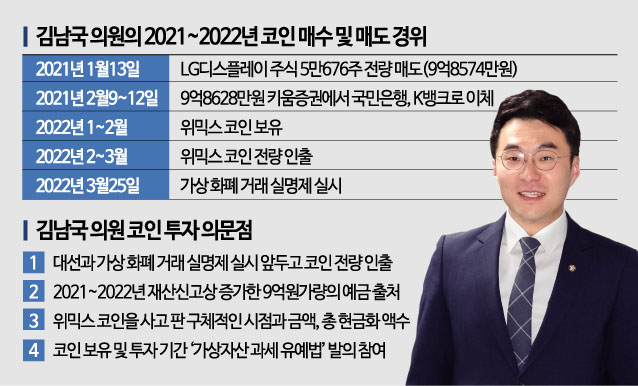
According to political circles and Kim's explanations, his cryptocurrency investment dates back to January 2021. Kim used 985.74 million KRW from selling all his LG Display stocks as initial investment capital for virtual assets. He appeared on the YouTube show ‘Kim Eo-jun’s News Factory’ the day before and said, "The lease expired, so I invested 600 million KRW of the deposit to buy LG Display stocks," adding, "I used it as initial capital for cryptocurrency investment." He leveraged the liquidity unleashed during the COVID-19 pandemic to invest the 600 million KRW deposit in stocks, making what is called ‘Yeongkkeul’ (pulling together all resources), and after earning nearly 400 million KRW in profit, he used it as seed money for virtual asset investment.

However, according to the stock investment and virtual asset transaction account details Kim disclosed on the 8th, from February 9 to 12, 2021, he transferred 986.28 million KRW from Kiwoom Securities, where the LG Display sale proceeds were held, to Kookmin Bank, and then moved it again to K Bank. K Bank, where the LG Display sale proceeds were deposited, is a dedicated account of Upbit, the top virtual asset exchange in Korea. Since WEMIX was listed on Upbit in January last year, it was impossible to purchase WEMIX on Upbit at the time Kim sold LG Display stocks, leading to criticism that he disclosed an unrelated account.
Kim disclosed transaction details with Kiwoom Securities and Kookmin Bank, as well as between Kookmin Bank and K Bank, but did not disclose the NongHyup Bank account, which is the main bank for Bithumb, where he currently holds WEMIX.
Regarding the possibility of using the funds for the presidential election, he said, "Only 4.4 million KRW was withdrawn in cash from all accounts during the entire election period," and "The virtual currency transferred in mid-February 2022 was not withdrawn or cashed out. It was only moved to another real-name wallet under my name." He also rebutted the transfer process between exchanges, saying, "I only traded through accounts verified by real-name authentication, and I only transacted with my own real-name wallet address without transferring to or receiving from others."
Where did the 900 million KRW deposit come from?
Through this explanation, Kim stated that about 1 billion KRW from stock sales was used as initial investment capital for coins, but the whereabouts of approximately 900 million KRW in deposits, which increased between 2021 and 2022 (from 147.69 million KRW to 1.11581 billion KRW) in his asset declaration, remain unexplained.
In response, Jang Ye-chan, the youth supreme council member of the People Power Party, wrote on Facebook on the 8th, "Explaining that the 900 million KRW from selling LG Display stocks in 2021 was invested in cryptocurrency is self-defeating," and criticized, "The 900 million KRW from stock sales is fully reflected as deposits in the asset declaration. Then where did the 900 million KRW suddenly invested in cryptocurrency come from? I am very curious about the secret of making a sudden 900 million KRW appear."
There was also criticism that the exact timing, amount, and total cash-out amount of buying and selling WEMIX coins were not disclosed in the explanatory statement. In fact, the transaction details Kim disclosed showed transfers of 300 million KRW on February 9, 200 million KRW on the 11th, and 500 million KRW on the 12th, respectively, to banks and cryptocurrency exchanges, but did not reveal the actual purchase history of WEMIX coins.
Participation in tax deferral bill while investing in coins?
The current Conflict of Interest Prevention Act for public officials stipulates that "if a public official judges that private interests make it difficult to perform duties fairly and with integrity, they must avoid performing such duties to prevent conflicts of interest." The Anti-Corruption and Civil Rights Commission is reportedly reviewing whether Kim's participation in the related bill constitutes a violation of this law.
As this controversy erupted, voices emerged calling for restrictions on holding and investing in virtual assets above a certain amount, similar to the 'stock blind trust system.' The Citizens' Coalition for Economic Justice issued a statement on the 8th, saying, "Because cryptocurrencies guarantee anonymity, they have a greater potential to be used by politicians for illegal wealth accumulation and concealment, so monitoring and regulation are necessary," and added, "Legislation to prohibit holding cryptocurrencies above a certain amount, similar to the stock blind trust system, should also be considered."
In the political sphere, criticism arose that a member of the National Assembly, an elected public official, holding and trading large amounts of virtual assets violates public official ethics. Lee Sang-min, a Democratic Party lawmaker, said on YTN Radio’s ‘Shin Yul’s News Face-off’ the previous day, "Boasting about stock or coin investments as good financial management is not the right attitude for a public official," and added, "Whether running a business or a startup, it is inappropriate to have a side job while serving as a lawmaker."
Daegu Mayor Hong Joon-pyo said on Facebook the same day, "The fact that a young politician held 6 billion KRW worth of virtual currency from an unknown source means he is a money speculator, not a young politician anymore," and added, "How much disappointment must the youth of Korea have felt because of this. It will be difficult to escape with shallow tricks."
This controversy also raised the need for disclosure of virtual asset holdings. Kim declared assets worth 1.53 billion KRW this year, but virtual assets worth tens of billions of KRW were excluded from the declared assets. In the 21st National Assembly, five bills, including the 'Partial Amendment to the Public Officials Ethics Act' led by Democratic Party lawmaker Min Hyung-bae in November 2020, have been proposed.
© The Asia Business Daily(www.asiae.co.kr). All rights reserved.
![Clutching a Stolen Dior Bag, Saying "I Hate Being Poor but Real"... The Grotesque Con of a "Human Knockoff" [Slate]](https://cwcontent.asiae.co.kr/asiaresize/183/2026021902243444107_1771435474.jpg)













