A warning has emerged again that if the U.S. federal government's debt ceiling is not raised, a default situation could occur as early as early June. Despite a sudden meeting between U.S. President Joe Biden and House Speaker Kevin McCarthy, it is expected to be difficult to find an easy breakthrough. Amid the confrontation between the ruling and opposition parties, anxiety is spreading, and short-term Treasury yields are also soaring.
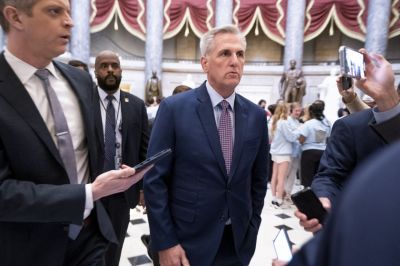
According to the daily Wall Street Journal (WSJ), President Biden held a meeting from 4 p.m. local time on the 9th with Republican House Speaker McCarthy and leaders of both parties in the House and Senate to discuss the debt ceiling. However, the prevailing view is that a final agreement is unlikely to be reached at this meeting. The Republicans are demanding large-scale government spending cuts as a precondition, while President Biden and the Democrats are insisting on raising the debt ceiling unconditionally, leading to a standoff.
Before entering negotiations on the day, Speaker McCarthy dismissed the prospect of a three-month temporary suspension to avoid default, saying there are no plans to agree to such a measure. The White House also drew a line, stating that a temporary suspension is not part of the government's plan. The U.S. exhausted its $31.4 trillion debt ceiling on January 31 and has been holding on with special measures since then.

The bipartisan think tank Bipartisan Policy Center (BPC) predicted that the so-called X-day, when the federal government runs out of cash and cannot repay its debt, will occur between early June and early August. This is an advancement from the previous February estimate, which expected it in summer to early fall. Initially, the White House and financial markets had suggested the possibility of default around July, but it has been brought forward due to spring tax revenues falling short of expectations. The timing suggested by BPC is also similar to the June 1 X-day warning recently issued by U.S. Treasury Secretary Janet Yellen.
Shai Akabas, Director of Economic Policy at BPC, said, "The next few weeks are critical in assessing the government's cash flow strength," adding, "If a solution is not found before June, policymakers will be playing a daily game of 'Russian roulette' with the nation's credit, pushing voters and the country toward a financial disaster crisis."
Market caution is also evident. In the afternoon session, the yield on Treasury securities maturing on June 6 surged to 5.53%. Before Secretary Yellen set the X-day as June 1, the yield was around 4.85%. WSJ evaluated, "This rise in Treasury yields has become a typical feature during debt ceiling standoffs over the past decade." Investors are reluctant to hold short-term Treasuries, leading to continued selling pressure. Dow Jones reported, "Short-term Treasury yields are rising amid concerns over the worst-case scenario of default."
However, Bill Gross, the former PIMCO founder known as the "Bond King," commented on this market atmosphere, saying, "In the past, Treasury yields rose as the potential default date approached," and "I think it’s nonsense because it’s always a problem that gets resolved." Steven Sosnick, Chief Strategist at Interactive Brokers, said, "We have seen this movie before," adding, "Most market participants will wait until the default is more imminent. The situation can change as the deadline approaches." Some analysts suggest that even if there is no clear progress in the meeting between President Biden and Speaker McCarthy on this day, the announcement of a follow-up discussion schedule could be a good sign to avoid default.
Currently, experts are focusing on the fact that this debt ceiling standoff is happening at a time when the economy has become vulnerable due to the Federal Reserve's aggressive tightening. If a default occurs, it is expected to inevitably cause millions of job losses and financial market turmoil. Earlier this month, the White House Council of Economic Advisers released an economic damage scenario due to default, estimating that if it lasts more than three months, the stock market could plunge 45% and up to 8.3 million jobs could disappear. Moody’s also expressed concerns that GDP could shrink by 4% and 6 million jobs could be lost. Even a short-term default is expected to negatively impact more than 2 million jobs.
Some speculate that the Biden administration may ultimately take emergency measures to raise the debt ceiling without congressional approval based on the 14th Amendment. For President Biden, who has officially declared his bid for re-election, whether a default occurs could be a major variable in the future presidential race. On the following day, the 10th, President Biden is scheduled to give a speech at Westchester College in northern New York, where he is expected to reiterate the position that the Republicans must raise the debt ceiling without preconditions.
© The Asia Business Daily(www.asiae.co.kr). All rights reserved.
![Clutching a Stolen Dior Bag, Saying "I Hate Being Poor but Real"... The Grotesque Con of a "Human Knockoff" [Slate]](https://cwcontent.asiae.co.kr/asiaresize/183/2026021902243444107_1771435474.jpg)












