'Korea Economic Research Report'
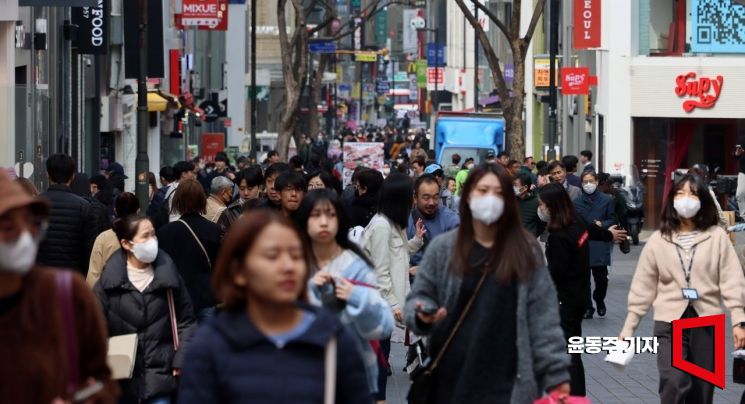 On March 28, Myeongdong Shopping Street in Jung-gu, Seoul, was bustling with foreign tourists and citizens. Photo by Dongju Yoon doso7@
As the working-age population decreases due to aging and low birth rates, an analysis suggests that increasing employment rates of women, the elderly, and foreigners could facilitate workforce expansion in high-skilled service industries, which are growth sectors, and in manufacturing, which is a less favored industry.
According to the Bank of Korea's report titled "Estimation of Changes in Industry-Specific Employment Due to Demographic Changes and the Effects of Policy Alternatives," released on the 9th, the contribution of policies promoting employment of women, the elderly, and foreigners to workforce expansion varies by industry.
To analyze the effects of policies promoting employment of women, the elderly, and foreigners on industry-specific employment changes, the Bank of Korea used regional employment survey data (2013?2022) to calculate the retention rates of workers by industry, then incorporated future population projections to estimate the number of workers in each industry over the next 10 years.
 The Bank of Korea unveiled the exterior of its newly constructed integrated annex, completed after six years, in Jung-gu, Seoul on the morning of the 27th. Photo by Joint Press Corps
First, in the case of women, if the employment rate of women aged 30?44, who often experience career interruptions, rises from 65.9% in 2019 to 70.2%, the average level of the Group of Seven (G7) countries by 2032, employment is expected to increase mainly in high-skilled service industries.
Specifically, employment significantly increased in industries such as video and audio recording production and distribution, information services, financial and insurance-related services, and creative, arts, and leisure-related services. These industries are future growth sectors with increasing labor demand, and are expected to be highly preferred by female job seekers.
The Bank of Korea explained, "It is a desirable outcome in that more female workers than currently employed in high-skilled service industries, which are expected to produce high added value in the future, can positively impact total production growth through employment."
Additionally, the employment rate of the elderly (aged 50?64), which is already higher than the G7 average (64%), is expected to rise to the level of Japan in 2032 (76.8%), which could lead to employment expansion in both high-skilled and low-skilled manufacturing industries.
As the employment rate of the elderly increases, employment in high-skilled manufacturing is projected to increase by 70,000 compared to previous estimates, mitigating the decline in employment in that industry. Employment in low-skilled manufacturing, which is predicted to decrease from a peak of 2.07 million in 2016 to 1.76 million, is expected to be maintained around 1.84 million.
The Bank of Korea stated, "Considering the potential future productivity improvements of workers in low-skilled service industries, policies to expand elderly employment are likely to have a greater employment effect in low-skilled service industries than currently predicted."
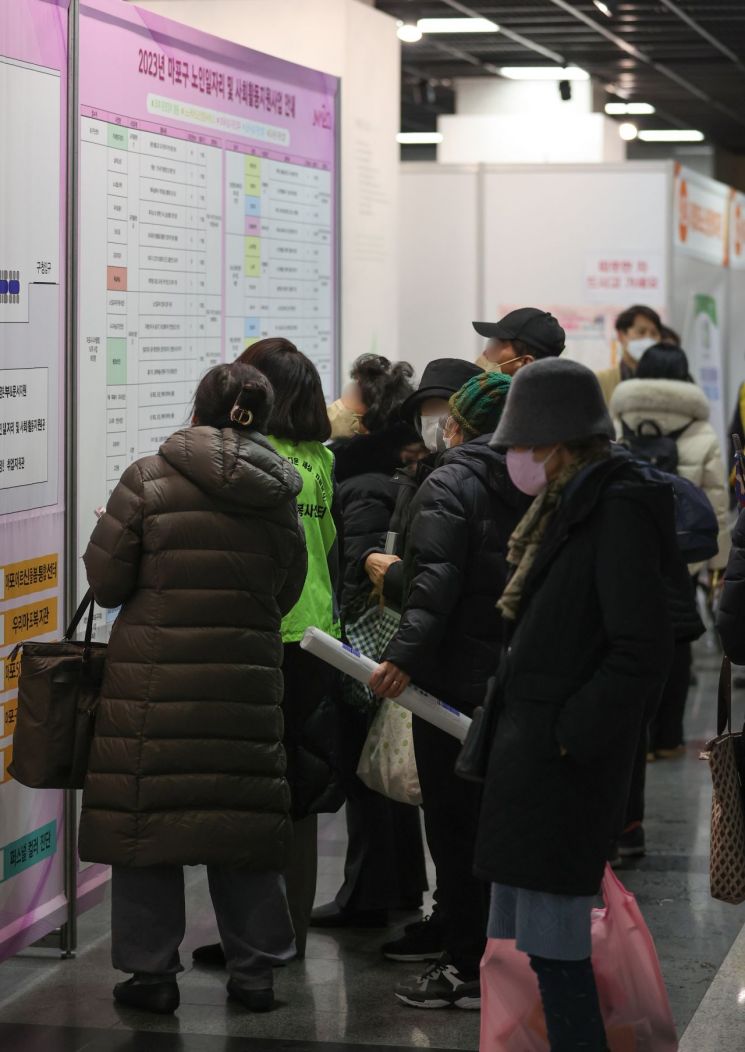
The foreign population, which accounted for 3.8% (1.95 million) of the total population in 2019, is expected to increase to 7.8%, the average level of G7 countries, by 2032, leading to job growth evenly across all industry sectors.
Employment in high-skilled manufacturing, which was expected to decline after peaking at 2.52 million in 2022, is estimated to reverse the trend and maintain levels in the 2.6 million range. Additionally, significant effects were observed with increases of 460,000 (from 7.72 million to 8.18 million) in high-skilled services and 690,000 (from 12.17 million to 12.86 million) in low-skilled services.
However, this analysis was conducted under the assumption that foreign workers have the same skill levels as domestic workers, and did not consider foreign workers' job preferences or social costs during their settlement process.
The Bank of Korea explained that since the impact on employment numbers varies by industry depending on labor supply expansion measures, an appropriate mix of policies is necessary.
The Bank of Korea stated, "Utilizing female labor appears effective for workforce expansion in high-skilled service industries, which include major growth sectors," and added, "To expand the workforce in high-skilled and low-skilled manufacturing industries, which include many less favored and declining sectors, policies promoting employment of the elderly and foreigners should be considered."
It further added, "For industries experiencing severe workforce outflow that cannot be addressed by employment policies alone, fundamental measures such as enhancing industrial competitiveness and improving employment environments are required."
© The Asia Business Daily(www.asiae.co.kr). All rights reserved.
![Clutching a Stolen Dior Bag, Saying "I Hate Being Poor but Real"... The Grotesque Con of a "Human Knockoff" [Slate]](https://cwcontent.asiae.co.kr/asiaresize/183/2026021902243444107_1771435474.jpg)


















