Collecting Various Evaluations on the Korea-Japan Summit
Kishida's Past Issues Remarks Mark Important Progress
Yoon's Forced Labor Solution Announcement as a Turning Point in Korea-Japan Relations
The Presidential Office on the 8th evaluated the visit of Japanese Prime Minister Fumio Kishida to Korea and the Korea-Japan summit as marking "the normalization phase of Korea-Japan relations."
Lee Do-woon, spokesperson for the Presidential Office, stated at a briefing at the Yongsan Presidential Office that day, "There are many evaluations that this visit by Prime Minister Kishida was an important opportunity to open a future-oriented relationship between Korea and Japan, while some criticisms point out a lack of expression regarding historical issues. The Presidential Office will gather various media evaluations and use them as reference materials for future diplomatic and national affairs execution," he said.
Spokesperson Lee emphasized, "The shuttle diplomacy between the Korea and Japan heads of state, which had been cooled for the past 12 years and practically neglected and severed during the previous administration, has been restored. Specifically, exchanges have begun in various fields such as military security, economic security, advanced industries, science and technology, youth exchanges, and cultural cooperation, and in some areas, it has been confirmed that these have become full-fledged."
Furthermore, the Presidential Office evaluates that the value-centered diplomacy pursued under the Yoon Seok-yeol administration is yielding results. The spokesperson said, "In March, before President Yoon's visit to Japan, he made a decisive decision on third-party compensation for forced labor victims and expressed a progressive stance on historical issues between Korea and Japan, which faced domestic criticism, but ultimately this started to move Korea-Japan relations. There is an aspect of taking the initiative in Korea-Japan relations, which in turn moved the United States, and it is true that this played an important leverage role in leading to the Washington Declaration, a joint Korea-US nuclear defense declaration, during the state visit to the US."
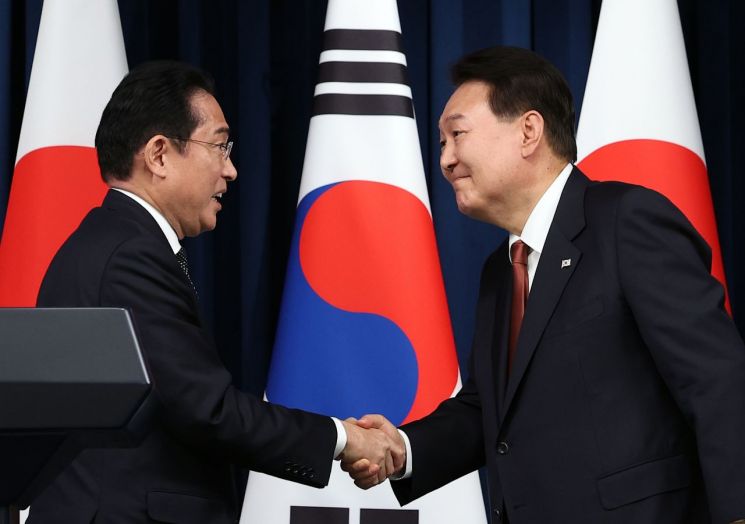
There is also speculation that Prime Minister Kishida's visit could strengthen Korea-Japan and Korea-US-Japan relations. Regarding this, the spokesperson explained, "If President Yoon won the hearts of the Japanese people during his visit to Tokyo in March, this summit showed that the Japanese government's efforts to open the hearts of Koreans have begun."
He added, "Prime Minister Kishida said that he is heartbroken that many people suffered due to historical issues as a result of his own political decision. Of course, some may judge this as insufficient, but considering the 12 years of cooled relations, it is evaluated as an important progress. The expert inspection related to Fukushima contaminated water and the joint Korea-Japan summit visit to the Hiroshima memorial for Korean atomic bomb victims can also be seen as meaningful progress," he added.
When asked whether the Korean forced labor victims, who are numerous at the Hiroshima memorial where President Yoon and Prime Minister Kishida will pay respects during the G7 summit at the end of this month, were recognized and proposed by the Japanese side, a key official from the Presidential Office replied, "I understand that many of the Korean residents who were victims in Hiroshima were actually taken there as forced laborers, and specific company names seem to be identified. Whether the Japanese government knew this and proposed it is not yet known."
He continued, "Many of our forced labor victims sacrificed their lives in Japan, but in the past, it was difficult for their sacrifices to be widely known or commemorated. In that regard, the joint Korea-Japan summit visit to pay respects to Korean victims is meaningful," he added.
Regarding the planned visit of the inspection team to Fukushima on the 23rd and 24th of this month, and the criticism that inspection alone is insufficient and that Korea should participate in empirical verification work, he said, "First, the agreement has now been made, and the composition and timing of the inspection team need to be decided internally and coordinated with Japan. When we look at the situation, the most important thing is the scientific aspect, and it must be scientifically verified. The public sentiment is also important. I think there will be opportunities to consider these points even when the inspection team goes," he answered.
When asked about reports in Japanese media that the Korean government demanded an apology and expression of remorse from Prime Minister Kishida, while the Korean government stated that Kishida's remarks were voluntary, resulting in conflicting claims, he said, "Before our delegation visited Japan in March, when the third-party compensation method was decided and a progressive stance on historical issues was expressed, it was not at the request of the Japanese government. I think the same applies to Prime Minister Kishida. Our government has never officially made such demands to the Japanese government," he answered.
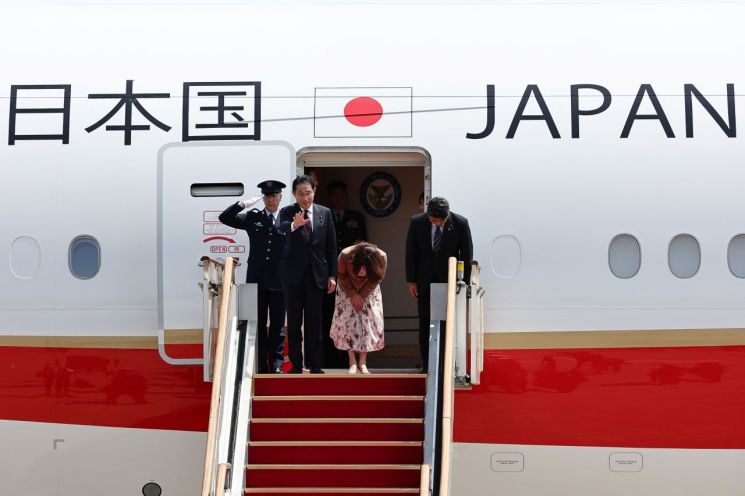
He added, "However, if Prime Minister Kishida visits Korea for a future-oriented Korea-Japan relationship, there will be public opinion in Japan, Korea, and the international community including the United States that expects this, and the Kishida government would have made its decision considering these well," he emphasized.
Regarding the possibility of a Korea-US-Japan summit at the G7 summit and whether a roadmap for concrete nuclear deterrence measures against North Korean provocations or Japan's participation in a nuclear consultation group would emerge, he said, "There have been reports that a Korea-US-Japan trilateral meeting is being pursued, but nothing has been decided yet, so it is difficult to say clearly. The Nuclear Consultation Group (NCG) was recently initiated between Korea and the US with the Washington Declaration, but detailed parts have not been decided." He added that Japan's participation is a matter to be reviewed after the launch and system establishment of the NCG and is not a stage to mention currently.
Earlier, President Yoon Seok-yeol instructed at the senior secretaries meeting held at the Yongsan Presidential Office that morning, "Please thoroughly follow up on the security, industry, science and technology, culture, and future generation exchanges discussed at the Korea-Japan summit."
© The Asia Business Daily(www.asiae.co.kr). All rights reserved.
![Clutching a Stolen Dior Bag, Saying "I Hate Being Poor but Real"... The Grotesque Con of a "Human Knockoff" [Slate]](https://cwcontent.asiae.co.kr/asiaresize/183/2026021902243444107_1771435474.jpg)


















