Meaning of 'Urging Resolution' on North Korean Abduction Issue
Japanese Politicians All Wear It at Official Events
Japanese Prime Minister Fumio Kishida, who visited South Korea, has attracted attention for wearing a 'blue ribbon'-shaped badge throughout his schedule. The badge symbolizes the issue of Japanese abductees by North Korea and is interpreted as a message not only for security cooperation to counter the North Korean nuclear threat but also for condemning North Korea's human rights violations.
According to diplomatic sources on the 8th, Prime Minister Kishida wore the 'blue ribbon' badge without fail from the time he departed Japan the previous day to when he visited the National Seoul Memorial Cemetery as his first schedule in South Korea. Earlier, in January this year, Kishida also wore this badge on his lapel during the Japan-US summit with US President Joe Biden in Washington, DC.
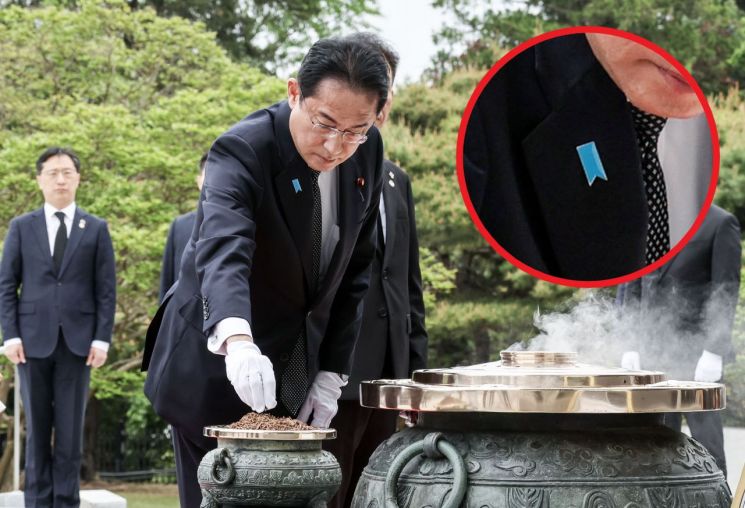 Japanese Prime Minister Fumio Kishida, who visited Korea for a 2-day trip, visited the National Seoul National Cemetery in Dongjak-gu, Seoul on the 7th and laid a wreath at the Memorial Tower.
In diplomatic circles, the meaning behind the badge on the right lapel of Prime Minister Kishida's suit is widely known. This badge, symbolizing the issue of 'Japanese abductees' by North Korea, was first created by a Japanese civic group called Sukukai (救う?, Rescue Association). The trigger was in 2002 when Kim Jong-il, then Chairman of the National Defense Commission of North Korea, admitted to then Japanese Prime Minister Junichiro Koizumi that North Korea had abducted Japanese citizens. Since then, a civilian-led movement to rescue abductees began in Japan, and the 'blue ribbon' badge has been used as its symbol. The blue color represents the abductees, their families, and the Japanese people looking at the blue sky and sea connecting Japan and North Korea, waiting for a 'reunion.'
A source close to Japan said, "In Japan, this ribbon is called the 'Blue Ribbon,' and when politicians wear it, it signifies their determination not to forget the abduction issue and urges the release of Japanese nationals detained in North Korea." He added, "Besides Prime Minister Kishida, all cabinet ministers wear this badge at official events. Former Prime Ministers Yoshihide Suga and Shinzo Abe did the same."
It is known that 12 Japanese nationals are detained in North Korea, with their whereabouts and survival status unknown. North Korea is believed to have abducted 17 Japanese citizens in 12 separate incidents during the 1970s and 1980s for purposes such as training operatives. Among them, five returned to Japan temporarily during the 2002 North Korea-Japan summit between Kim Jong-il and Koizumi. At that time, Kim Jong-il reportedly explained that the abductions were to train operatives by teaching them Japanese language and natural Japanese culture. The Japanese government has continuously demanded the repatriation of the remaining 12, but North Korea claims that eight have died and the other four never came to North Korea.
Meanwhile, since the 1953 armistice agreement, North Korea has refused to repatriate at least 50,000 South Korean prisoners of war and 100,000 abducted civilians over 70 years. Even after the armistice, North Korea continued abducting South Korean POWs and civilians through incidents such as the Vietnam War, the capture of the naval broadcasting ship 'I-2,' and the KAL plane abduction. In the past 10 years alone, North Korea has detained at least six South Korean citizens (Kim Guk-gi, Choi Chun-gil, Kim Jeong-wook, Kim Won-ho, Go Hyun-cheol, and one unidentified person).
Japanese Society Remembering 'North Korean Abductions'...The Trigger Was a Missing Girl
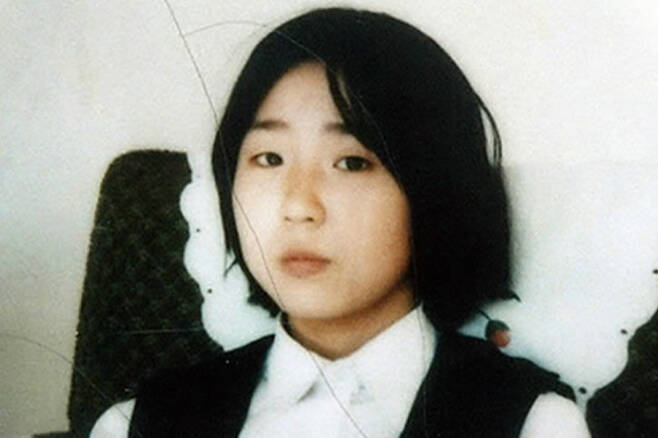
The issue of Japanese abductions by North Korea came to light with the 'Megumi Yokota' case. In November 1977, Megumi, then 13 years old and living in Niigata Prefecture, Japan, disappeared on her way home from school. Her parents searched the neighborhood daily but found no clues. Twenty years later, in 1997, a defector revealed for the first time that Megumi and many other Japanese abductees were being held in North Korea. According to testimonies from those who met Megumi in North Korea, the young girl was confined in a cargo hold on a ship heading to North Korea for over 40 hours and reportedly scratched the door until her nails fell out, calling for her parents.
Later, during the first North Korea-Japan summit in 2002, Kim Jong-il acknowledged the 'Japanese abductions' for the first time and disclosed some related information. Megumi was included in the list of deceased released by North Korea, which claimed she was hospitalized for mental illness in 1993 and subsequently committed suicide. However, testimonies from abductees who returned to Japan suggest that Megumi was still alive until 1994, and the remains North Korea handed over to Japan during the second North Korea-Japan summit in 2004 were proven by DNA testing not to be hers. For this reason, both the Japanese government and society do not rule out the possibility that Megumi is still alive.
© The Asia Business Daily(www.asiae.co.kr). All rights reserved.


















