Ministry of Land, Infrastructure and Transport Confirms Underground (Deep Tunnel) Construction for GTX-C Dobong Section
Announcement of Underground (Deep Tunnel) Construction for GTX-C Dobong Section... Restoration to Underground after 2 Years of Controversy over Aboveground Construction
Additional Construction Cost Negotiations Completed between Ministry and Preferred Negotiation Partner (Hyundai Construction Consortium)
Expected to Start Construction by Year-End after Submission to Private Investment Review Committee and Signing of Implementation Agreement
Dobong-gu (Mayor Oh Eon-seok) announced that the GTX-C line section in Dobong-gu, which had been controversial for the past two years, has been finally confirmed to be constructed underground (deep tunnel).
The controversy over the aboveground construction of the GTX-C Dobong section arose in 2020 when the Ministry of Land, Infrastructure and Transport accepted the private operator's proposal for aboveground construction due to an unclear basic facility project plan. The design change led to opposition from Dobong-gu and local residents, resulting in a public audit by the Board of Audit and Inspection and a feasibility study by the Korea Development Institute (KDI).
Since the launch of the 8th local government, Dobong-gu Mayor Oh Eon-seok, along with Kim Jae-seop, the People Power Party Dobong-gap district committee chairman, and Kim Seon-dong, the People Power Party Dobong-eul district committee chairman, have repeatedly visited the Presidential Office, the Minister of Land, Infrastructure and Transport, and the Minister of Strategy and Finance to express the position that the underground construction of the Dobong section must be realized to restore government policy credibility, eliminate discrimination against peripheral areas, and correct procedural issues. With the recent confirmation of underground (deep tunnel) construction for the Dobong section, the controversy over aboveground construction of the GTX-C Dobong section has come to an end.

Mayor Oh Eon-seok said regarding the confirmation of the underground construction of the GTX-C Dobong section, “This is the fruit of tireless efforts to alleviate the concerns of 300,000 Dobong residents worried about all possible damages caused by aboveground GTX-C construction,” adding, “I welcome that the GTX project has regained its original form under the new government and express my gratitude to the government for making this significant decision.”
With the completion of additional cost-sharing negotiations between the Ministry of Land, Infrastructure and Transport and the preferred negotiation partner (Hyundai Construction Consortium), it is expected that construction will begin by the end of this year after submission to the Private Investment Review Committee, signing of the implementation agreement, and approval of the implementation plan.
Park Kang-su, Mayor of Mapo-gu, Meets with Minister Won Hee-ryong of the Ministry of Land, Infrastructure and Transport, Requests Positive Consideration for Adding DMC Station on Daejang-Hongdae Line
Digital Media City Station Sees 52,000 Daily Boardings and Alightings; Floating Population in Area Reaches 120,000
Additional Station Essential for Public Transit Transfers and Commuting Convenience for Residents of Sangam-dong and Nearby Areas
Minister Won Promises Positive Review... Expected to Dramatically Improve Transportation and Residential Convenience
Park Kang-su, Mayor of Mapo-gu, met with Won Hee-ryong, Minister of Land, Infrastructure and Transport, on the 3rd.
During the meeting, Mayor Park strongly requested the addition of Digital Media City Station to the ongoing Bucheon Daejang-Hongdae private railway project (connecting Bucheon Daejang New Town to Hongdae Entrance Station).
The Daejang-Hongdae Line is a metropolitan railway project connecting Bucheon Daejang New Town in Bucheon, Gyeonggi Province, through Yangcheon-gu and Gangseo-gu in Seoul, Deogeun-gu in Goyang, Gyeonggi Province, Mapo-gu in Seoul, and ending at Hongdae Entrance Station.
Among the stations currently under consideration, the Mapo-gu section includes Sangam, Seongsan, and Hongdae Entrance stations. The district argues that Digital Media City Station should be added, creating four stations within Mapo-gu.
Mayor Park Kang-su stated, “Digital Media City Station is a transfer station served by three lines: Subway Line 6, Gyeongui-Jungang Line, and Airport Railroad, with daily boardings and alightings reaching approximately 52,200 people. For the convenience of public transit users, Digital Media City Station must be added to the Daejang-Hongdae Line.”
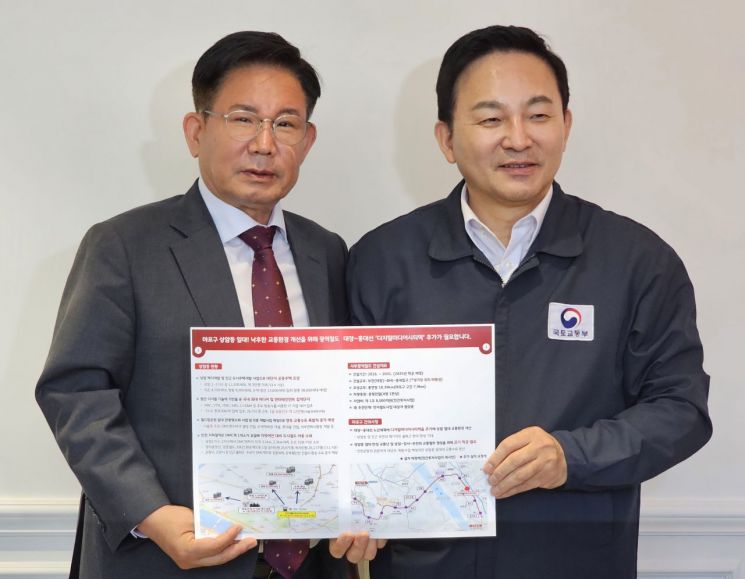 Park Kang-su, Mayor of Mapo-gu (left), delivering a request to Won Hee-ryong, Minister of Land, Infrastructure and Transport
Looking at the residential and business status of Sangam-dong, the need for an additional station becomes even more urgent.
The area around Digital Media City Station has undergone large-scale urban housing development in addition to the Sangam residential land development. Only in Sangam 1 and 2 districts, 11,300 households reside. Including adjacent areas such as Deogeun (4,700 households), Hyangdong (8,300 households), Susaek and Jeungsan (13,600 households), and the planned Changneung district (estimated 38,000 households), a total of 75,900 households live in large-scale apartment complexes.
Currently, 840 companies, including major broadcasting stations and IT firms, are located there (as of April 2023), and considering the daily floating population of 120,000 people (according to Seoul Economic Research Institute data), commuting demand is inevitably concentrated.
Moreover, with planned development projects such as the Sangam-dong DMC Landmark and Lotte Mall, the district expects transportation demand to increase explosively in the future.
Therefore, Mayor Park emphasized, “Adding Digital Media City Station to the Daejang-Hongdae Line will significantly improve commuting convenience not only for Sangam-dong but also for nearby residents in Gyeonggi Province. Given the rapid increase in transportation demand due to development projects in the area, Digital Media City Station must be installed to alleviate traffic inconvenience and promote the development of western Seoul.”
Seocho-gu Conducts ‘Beneficial Road Campaign’ to Leap Forward as a Safe Cultural City
District Holds Safe Shared Road Campaign with T-money Welfare Foundation at Sinjung Children's Park in Seocho Music Culture District from 12th to 16th
Various Attractions for Pedestrians Including Busking Performances, Face Painting, and Board Games Provided at Park Benches
Seocho-gu, home to the nation’s only music culture district, is launching a pedestrian-friendly campaign to safely enjoy culture and arts.
Seocho-gu (Mayor Jeon Seong-su) will conduct the ‘Beneficial Road Campaign’ in cooperation with the T-money Welfare Foundation from the 12th to the 16th at Sinjung Children's Park within the Seocho Music Culture District.
The ‘Beneficial Road Campaign,’ the first of its kind among Seoul’s autonomous districts, is a program designed to build consensus on a safe traffic culture that protects vulnerable road users.
Accordingly, on March 30, Seocho-gu signed a business agreement with the T-money Welfare Foundation and Soso City.
Through this campaign, the district aims to improve the ‘driver-centered’ traffic culture and create a cultural street where anyone can walk safely and comfortably.
The campaign will transform the car-centered roads around Sinjung Children's Park into people-centered roads through various activities. Key activities include ▲Classic Dessert performances ▲Campaign information booths and cultural events ▲Pedestrian satisfaction surveys on walkway usage.
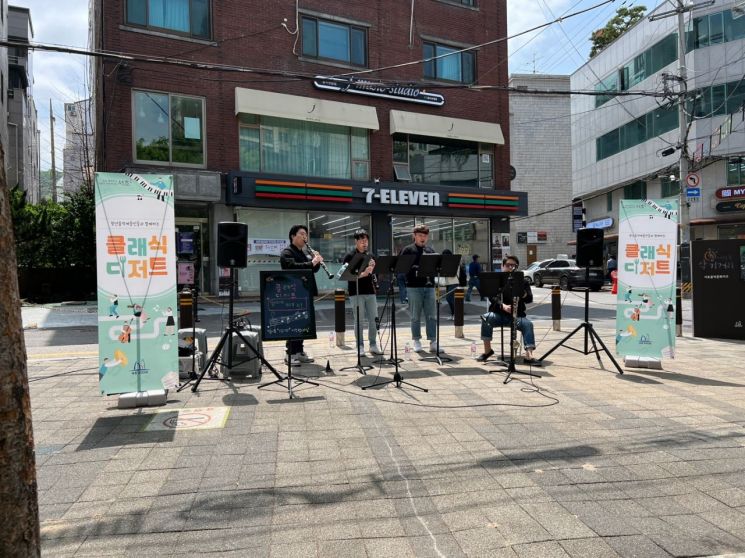
First, leveraging the characteristics of the Seocho Music Culture District, young artists will perform busking shows called ‘Classic Dessert’ for pedestrians starting at 12:30 PM. The performances will be held five times over three days: the 12th, 13th, and 16th, featuring a range of genres from movie and drama OSTs to jazz and classical music, captivating pedestrians’ eyes and ears.
Additionally, during the campaign period, Sinjung Children's Park will transform into an urban oasis-like cultural space where children and adults can enjoy ample rest and fun.
On the 11th and 12th, face painting experience booths for children will be operated. Furthermore, throughout the campaign, books and board games will be freely lent at benches to encourage reflection and relaxation.
For inquiries, contact the Seocho-gu Office Cultural Tourism Division.
Mayor Jeon Seong-su of Seocho-gu said, “I hope the ‘Beneficial Road Campaign’ held within the Music Culture District will create a street where culture can be enjoyed in a safe and pleasant environment.”
© The Asia Business Daily(www.asiae.co.kr). All rights reserved.
![Clutching a Stolen Dior Bag, Saying "I Hate Being Poor but Real"... The Grotesque Con of a "Human Knockoff" [Slate]](https://cwcontent.asiae.co.kr/asiaresize/183/2026021902243444107_1771435474.jpg)


















