Yoon Strengthens Security Cooperation with Japan, Expands 'Washington Declaration'
Reaffirms White List Restoration... Semiconductor Supply Chain Coordination
Kishida Expresses Regret Instead of Apology, Saying "Sad and Heartbreaking"
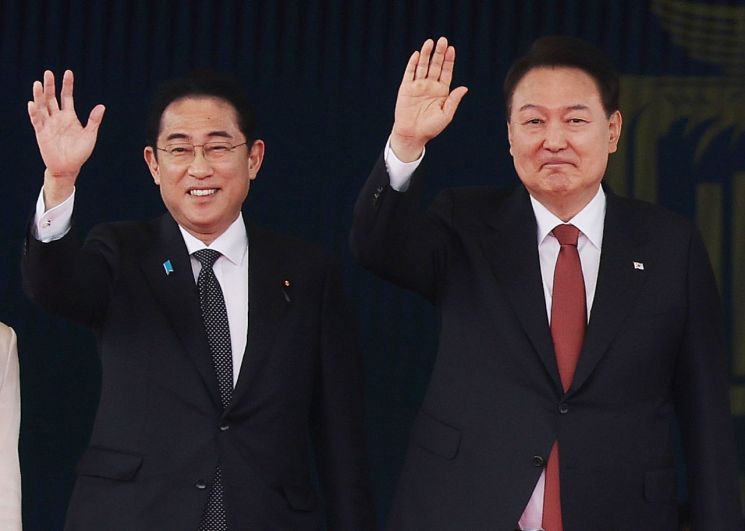
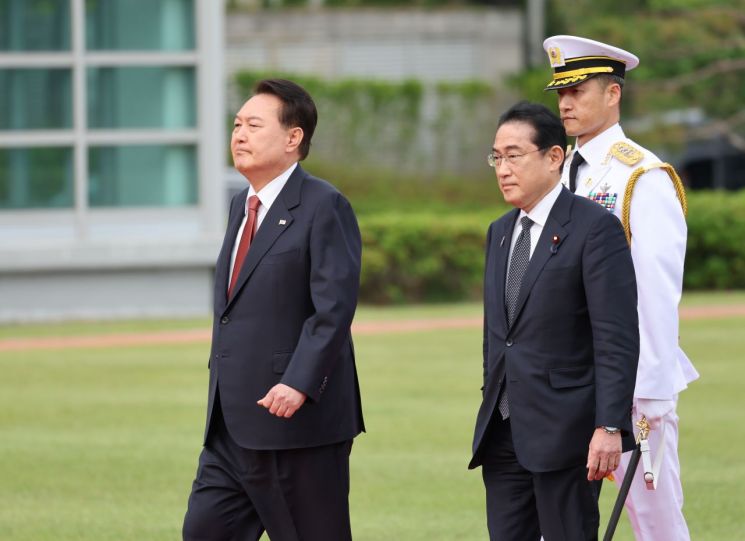
Fifty-two days after the summit in March, President Yoon Suk-yeol and Japanese Prime Minister Kishida Fumio met again and reaffirmed their commitment to cooperation in the economic and security sectors. In addition to concrete discussions aimed at strengthening semiconductor supply chain cooperation between South Korean semiconductor manufacturers and Japanese related so-bu-jang (materials, parts, and equipment) companies, the future role of Japan was newly presented in the 'Washington Declaration,' which was regarded as the greatest achievement of the recent state visit to the United States.
The Japanese Prime Minister also expressed his first stance on the victims of forced labor. However, Prime Minister Kishida did not use the terms 'apology' or 'sorry' directly. President Yoon also only reaffirmed his position that "we must move away from the perception that there can be no future cooperation if historical issues are not resolved." Unlike the achievements in the economic and security sectors, public judgment and political controversy over historical issues are expected to continue for the time being.
Yoon: "The Washington Declaration is not finalized... Japan's participation is not excluded"
On the afternoon of the 7th, President Yoon and Prime Minister Kishida held a joint press conference at the Yongsan Presidential Office after the Korea-Japan summit, expressing a stronger will than at the March summit regarding cooperative responses and expanded vigilance against North Korea's nuclear and missile threats. Security was considered the sector where cooperation between the two countries would broaden the most through this summit. Recently, South Korea and the United States adopted the 'Washington Declaration' at their summit, strengthening extended deterrence against North Korea. As South Korea and the U.S. agreed to establish a Nuclear Consultative Group (NCG) and accelerated cooperation, it was also expected that Korea and Japan could align their efforts on security.
In particular, when asked by reporters whether the 'Washington Declaration,' which includes measures to strengthen extended deterrence between South Korea and the U.S., could be expanded to include trilateral cooperation with Japan, President Yoon responded, "We do not exclude Japan's participation." He added, "The Washington Declaration is not finalized; it is a process of ongoing discussion, joint planning, and joint implementation, where the content will be filled in. Once this is on track and Japan is ready in its relationship with the U.S., I think it is an issue where we can cooperate anytime."
On the same day, President Yoon mentioned North Korea's continuous provocations, stating, "We shared the recognition that these are serious threats to peace and stability not only on the Korean Peninsula and Japan but worldwide." Prime Minister Kishida also pointed out North Korea's provocations as "unilateral changes by force" and emphasized the need to strengthen deterrence and response capabilities among the U.S., South Korea, and Japan. Regarding the real-time sharing of North Korean missile data agreed upon at the trilateral summit in November last year, he explained, "I welcome the progress in discussions."
There was also a notable indication that the security cooperation system among the U.S., South Korea, and Japan will be further strengthened beyond Korea-Japan relations. Both leaders forecasted that discussions on strengthening the security system among the three countries would deepen at the G7 Hiroshima summit. President Yoon stated, "I welcome the progress in discussions among authorities regarding the implementation of real-time sharing of North Korean missile warning information agreed upon at the November summit in Phnom Penh, and we decided to continue trilateral security cooperation." Prime Minister Kishida also said, "We will hold a trilateral summit at the G7 to deepen discussions further."
Before the summit, the South Korean and Japanese governments held consultations on mutual interests. On the 3rd, Cho Tae-yong, South Korea's National Security Office chief, held a Korea-Japan security chiefs meeting and National Security Council (NSC) economic security dialogue with Akiba Takeo, Director-General of Japan's National Security Secretariat, in Seoul, broadly discussing mutual concerns such as North Korea and regional and international situations. The two sides also held the inaugural meeting of the Korea-Japan NSC economic security dialogue, agreed upon during the March summit, discussing ways to strengthen cooperation in supply chains, advanced technology, and other fields.
Strengthened Will for Semiconductor Cooperation... Fund Launched for Future Generations' Cooperation
Achievements in the economic sector were also clear. The two leaders reaffirmed their commitment to steadily implementing procedures to restore South Korea to Group A (formerly the White List), Japan's preferential export treatment group. Based on the recovering atmosphere of economic cooperation, plans emerged for South Korean semiconductor manufacturers and Japanese related so-bu-jang (materials, parts, and equipment) companies to strengthen cooperation in the semiconductor supply chain.
Previously, during President Yoon's visit to Japan and the March summit, an agreement was reached with Prime Minister Kishida regarding the lifting of Japan's export restrictions on South Korea and the restoration of the White List. Accordingly, the South Korean government withdrew its World Trade Organization (WTO) complaint related to past export restrictions, and the Japanese government is taking steps to restore export-related measures. Prime Minister Kishida also mentioned in his opening remarks at the joint press conference, "Active dialogue between export control authorities is underway, and as a result, the Japanese government is proceeding with procedures to add South Korea to Group A."
President Yoon also explained, "I welcomed that the security dialogue between diplomatic and security authorities, the NSC economic security dialogue, and the finance ministers' meeting, all agreed upon at the March summit, are now fully operational." Prime Minister Kishida added, "On the 2nd, the finance ministers' meeting was held in Incheon for the first time in seven years, and we agreed to resume financial dialogue." The Korea-Japan finance ministers' meeting is a channel where the heads of financial authorities, such as South Korea's Ministry of Economy and Finance and Japan's Ministry of Finance, discuss economic cooperation plans. It had been suspended since August 2016 but was held again earlier this month.
They also explained achievements in cooperation for future generations and people-to-people exchanges. President Yoon said, "During my visit to Japan in March, the Korea-Japan Future Partnership Fund, which the Federation of Korean Industries and the Japan Business Federation agreed to establish, is in the final stages of preparation before its official launch." He emphasized, "We both pay great attention to expanding exchanges among future generations of Korea and Japan and will continue to do what is necessary."
He particularly noted, "Prime Minister Kishida and I welcomed that the scale of human exchanges between Korea and Japan has rapidly recovered to nearly 2 million people within just three months this year. We share the recognition that exchanges among future generations are important for deepening mutual understanding and building friendship and trust between our peoples." He added, "At the government level, we agreed to discuss concrete measures to expand future generation exchanges centered on youth. Considering the significant increase in human exchanges between Korea and Japan, we also agreed to work on restoring domestic and regional air routes to pre-COVID levels, not just in the metropolitan area."
Prime Minister Kishida introduced, "Regarding exchanges between future generations of the two countries, we decided to fully resume face-to-face exchanges under the Korea-Genesis program and double the number of participants compared to last year, which I shared with President Yoon."
Furthermore, the two leaders explained that discussions were held on joint research and research and development (R&D) cooperation in advanced scientific and technological fields such as space, quantum, artificial intelligence (AI), digital bio, and future materials. Prime Minister Kishida mentioned, "Following the direction presented by both leaders at the March summit, dialogue and cooperation between the two countries have begun to move vigorously over the past two months."
Regrettable Historical Issue Resolution... Kishida Expressed Regret but No 'Apology' or 'Sorry'
Before the Korea-Japan summit, the Japanese government's stance on forced labor, which attracted significant public and media attention, as well as sensitive issues such as the discharge of contaminated water from Fukushima, were addressed. Prime Minister Kishida expressed his position on South Korea's announced 'third-party compensation' plan for forced labor victims, saying, "I am deeply saddened by the painful and sorrowful experiences of many people who had to work under difficult conditions at that time." This was the first time Prime Minister Kishida personally expressed regret for forced labor victims in an official setting.
However, Prime Minister Kishida avoided direct expressions such as 'apology' or 'sorry.' When asked by a South Korean reporter whether the phrase "deeply saddened" was directed at the forced labor victims, he did not provide a clear answer.
Prime Minister Kishida briefly replied, "This statement honestly reflects my feelings toward those who had difficult experiences at that time." He added, "We want to inherit the efforts of our ancestors who overcame difficult times and, for the future, cooperate with President Yoon and the South Korean side to build a cooperative relationship that benefits the peoples of both countries."
Prime Minister Kishida also stated, "When President Yoon visited Japan in March, I clearly stated that I uphold the positions of past administrations regarding historical awareness, including the Korea-Japan Joint Declaration announced in October 1998." He added, "This government stance will not waver in the future." The Korea-Japan Joint Declaration announced in October 1998 refers to the Kim Dae-jung-Obuchi Joint Declaration, which expressed "deep remorse and sincere apology" for colonial rule.
Regarding concerns in South Korea about Fukushima contaminated water, Prime Minister Kishida said he is well aware of them and has decided to accept the dispatch of an inspection team. He stated, "To help the South Korean people understand this issue, we have decided to accept the dispatch of a South Korean expert inspection team to the Fukushima Daiichi Nuclear Power Plant this month." He promised, "As Prime Minister of Japan, I will not allow any actions that negatively affect the health of our citizens or the South Korean people or the marine environment." He added, "I think it is important that we accept the dispatch of the inspection team," and said, "We will continue efforts to respond to the concerns and anxieties of many people in South Korea through communication with the South Korean side."
© The Asia Business Daily(www.asiae.co.kr). All rights reserved.