Kishida Likely to Visit Hyeonchungwon First... Small-Scale, Expanded Talks, etc.
Through Summit Talks, Covering Security, Advanced Industries, Youth, and Culture
Measures on Contaminated Water Discharge May Also Be Discussed: "No Need to Exclude"
President Yoon Suk-yeol will hold a Korea-Japan summit with Japanese Prime Minister Fumio Kishida at the Yongsan Presidential Office on the 7th. Prime Minister Kishida's visit to Korea is a one-night, two-day working visit. This meeting marks a reciprocal visit following President Yoon's trip to Tokyo, Japan, in March, with the two leaders meeting again after 52 days. The main agenda of the summit includes economic and security issues, but attention is also focused on whether the Japanese government will issue an apology or express remorse regarding historical issues, and what kind of agreement the two countries will reach on the Fukushima contaminated water discharge issue.
After arriving in Korea, Prime Minister Kishida is expected to begin his first schedule by paying respects at the Seoul National Cemetery in Dongjak-dong. This visit to the National Cemetery by a Japanese prime minister is the first in 12 years since Prime Minister Noda in 2011. Following this, President Yoon and Prime Minister Kishida will start with an official welcoming ceremony at the Yongsan Presidential Office, followed by a small-scale meeting attended only by a few aides, an expanded meeting, and then a joint press conference.
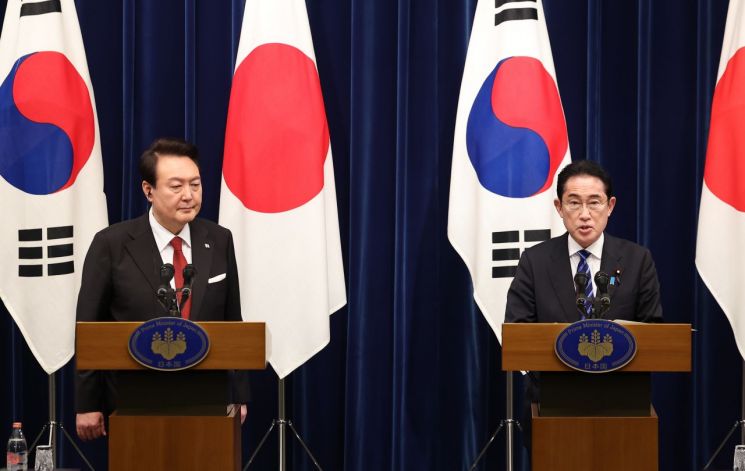
Yoon's Willingness to Improve Relations Bears Fruit... Shuttle Diplomacy Between Korea and Japan Leaders Fully Launched
Earlier, President Yoon requested Prime Minister Kishida's visit to Seoul during his trip to Japan in March. With Kishida's visit to Korea, shuttle diplomacy between the leaders is now in motion, and Mrs. Kishida Yuko will accompany him on this visit.
Before his visit, Prime Minister Kishida expressed expectations, saying, "Based on the deep trust between the leaders, this will be a good opportunity to accelerate Korea-Japan relations and openly exchange views on the rapidly changing international situation." The two leaders have already focused discussions on export controls, restoration of the whitelist, and normalization of the Korea-Japan General Security of Military Information Agreement (GSOMIA).
Kishida's earlier-than-expected reciprocal visit clearly signals goodwill toward the Yoon administration's willingness to improve Korea-Japan relations. Analysts in Japan also interpret this as an intention to accelerate relationship improvement in response to President Yoon's proactive stance, as evidenced by the early visit following his March trip to Japan without much delay.
The United States' intentions also appear to be a significant factor. It is said that the Japanese government aims to demonstrate the Korea-Japan alliance, which is important to their ally, the U.S. John Kirby, Coordinator for Strategic Communications at the White House National Security Council (NSC), expressed gratitude for President Yoon's leadership in efforts to improve Korea-Japan relations during Yoon's recent visit to the U.S. He stated, "I want to express my sincere thanks for President Yoon's leadership, especially in improving bilateral relations with Japan. We are seeing significant improvements not only between the two countries but also in the region," emphasizing that "this aligns with President Biden's desire to strengthen the trilateral relationship among Korea, the U.S., and Japan."
'Washington Declaration' Between Korea and the U.S.... Korea and Japan Also Coordinate on Security Cooperation
Security is an area where cooperation between the two countries could significantly expand through this summit. In response to North Korea's nuclear and missile threats, Korea and the U.S. recently adopted the 'Washington Declaration' during their summit, strengthening extended deterrence against North Korea. As Korea and the U.S. accelerate efforts, including agreeing to establish a Nuclear Consultative Group (NCG), Korea and Japan can also coordinate on security matters.
On June 3rd, Cho Tae-yong, Director of the National Security Office, held a Korea-Japan security chiefs meeting and NSC economic security dialogue with Takeo Akiba, Director of Japan's National Security Secretariat, in Seoul. They extensively discussed mutual concerns such as North Korea and regional and international situations. The two sides also held the inaugural meeting of the Korea-Japan NSC Economic Security Dialogue, agreed upon during the March summit, discussing ways to strengthen cooperation in areas such as supply chains and advanced technology.
On the economic front, cooperation on economic security, including semiconductor supply chains, is expected to be addressed. Recently, Japan re-designated Korea as Group A (formerly the White List), a preferential export treatment group. Since most issues between Japan and Korea, including export controls and trade conflicts, have been resolved, detailed discussions on cooperation areas are expected to intensify.
Besides advanced industries like semiconductors and batteries, new industries such as quantum technology, space, and biotechnology, joint entry into the global order market, and future response areas like low birthrate, aging population, and climate change are also mentioned as fields where mutual benefits can be created. Additional discussions may include increasing flights, expanding exchanges among high school and international students to restore human exchanges between the two countries, and restoring and expanding dialogue channels at both private and government levels.
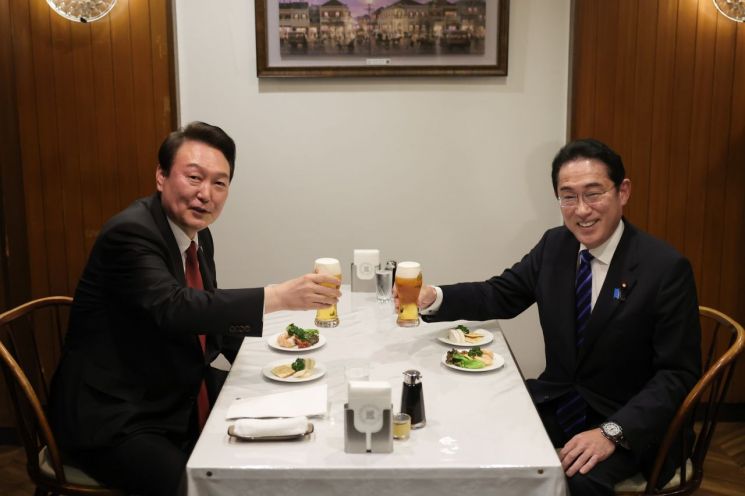
No 'Joint Declaration' but Fukushima Contaminated Water Discharge Issue Likely to Be Addressed
However, the possibility of a separate 'joint declaration' on sensitive issues during this summit is low. A presidential office official explained, "There will be a joint press conference, but it is unlikely that any declaration will come out of it. It is a matter to be decided after consultations and the actual summit." Regarding the possibility of announcing a youth fund, the official added, "Efforts such as visas and employment for future generations are reflected. When leaders of all countries, including Korea and Japan, hold consultations, what to do for youth and future generations is a very important concern, so I think consultations will be held accordingly."
Regarding the Fukushima contaminated water discharge issue, the official responded, "If the public considers it an important issue, I don't think we need to exclude it by our own judgment." However, they added the condition, "Consultations on the agenda have not been completed, so it is unclear how the conclusion will be."
Some speculate that sensitive issues such as historical matters and measures regarding Fukushima nuclear power plant contaminated water discharge may be addressed. In particular, there is analysis that the Japanese government might use historical issues as leverage to resolve the contaminated water discharge problem. Given the lack of international support for the discharge, the Japanese government prioritizes obtaining consent from its closest neighbor, Korea. Even if not extending to apology or remorse, it is said that the Japanese government will approach resolution by delivering a message beyond merely 'successor to previous cabinets' regarding historical issues.
Even without linking to the contaminated water discharge, the level of Prime Minister Kishida's apology and remorse message remains the greatest focus. Public opinion overwhelmingly holds that for Korea-Japan relations to return to a normal track, there must be a statement going beyond the expression of 'successor to previous cabinets.' It is known that the Korean government has continuously conveyed this domestic public opinion to the Japanese side through back channels.
© The Asia Business Daily(www.asiae.co.kr). All rights reserved.
![Clutching a Stolen Dior Bag, Saying "I Hate Being Poor but Real"... The Grotesque Con of a "Human Knockoff" [Slate]](https://cwcontent.asiae.co.kr/asiaresize/183/2026021902243444107_1771435474.jpg)

















