Shuttle Diplomacy Restored After 12 Years... Attention on 'Sincere Response' to Historical Issues
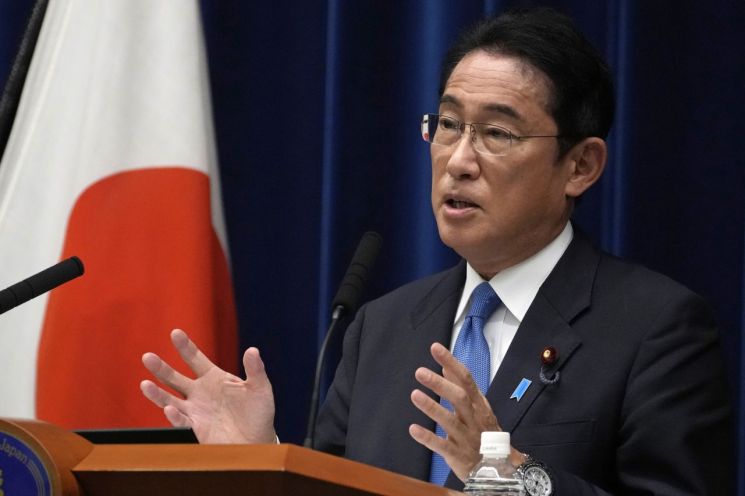
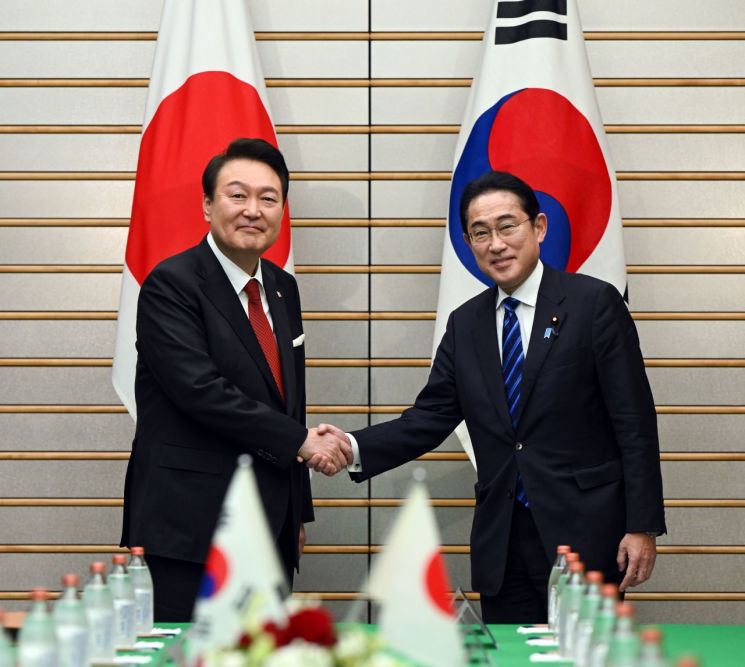
Prime Minister Kishida Fumio arrives in South Korea today. During his 1-night, 2-day visit, he is scheduled to meet with various diplomatic and security officials, drawing attention to what message he will deliver regarding the most pressing issue of historical awareness.
The Korea-Japan summit will be held on the afternoon of the first day of his visit, the 7th. The key agenda items are expected to be security, economic cooperation, and the issue of Fukushima contaminated water discharge. The issue of historical matters may also be mentioned depending on the level of response from the Japanese side.
First, the immediate issue is expected to be sharing the importance of trilateral cooperation among South Korea, the U.S., and Japan to strengthen deterrence against North Korea. Discussions on economic cooperation following the restoration of the “white list” (preferred export screening countries) are also anticipated. There is also a possibility of concluding a Korea-Japan currency swap agreement, which is a relatively less sensitive agenda item.
'Sincere Response' and Relationship Restoration... The Key is an Advanced Apology on Historical Issues
The biggest point of interest is the level of Prime Minister Kishida’s apology and reflection message on historical issues. Public opinion strongly holds that for Korea-Japan relations to return to a normal track, there must be an apology that goes beyond simply “inheriting previous cabinets.”
The South Korean government has demanded a “sincere response” including compensation by the Japanese defendant companies and an apology from the Japanese side during the process of defining the forced labor issue as a “third-party subrogation payment.” However, Prime Minister Kishida did not mention a direct apology or reflection at the Korea-Japan summit held in Tokyo last March. He only stated that “the position of previous cabinets is being inherited as a whole.”
Previously, in the 1998 Korea-Japan Joint Declaration, then-Prime Minister Obuchi Keizo stated that Japan humbly accepts the historical fact that it once caused damage and suffering to the Korean people through colonial rule and offers a “deep remorse and heartfelt apology” for this.
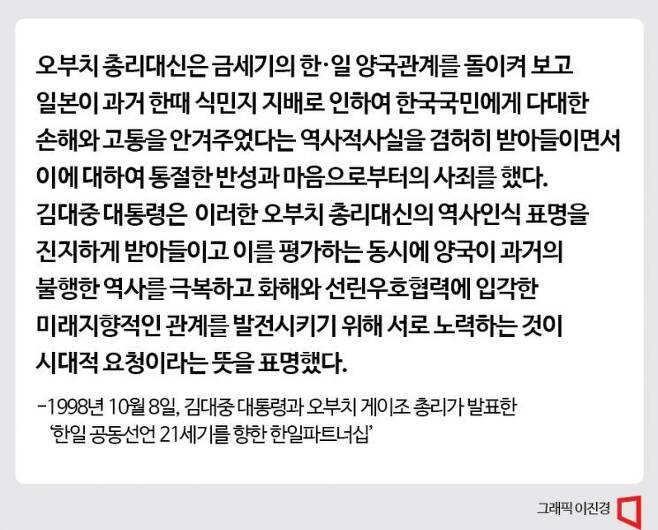
In South Korea, there has been continuous criticism that Prime Minister Kishida’s indirect statement of inheriting historical awareness without directly mentioning apology and compensation cannot be seen as a “sincere response.” This is because it can be interpreted not as “apologizing now” but merely reaffirming that “past governments apologized.” In fact, the “New Korea-Japan Partnership for the 21st Century Joint Declaration (1998)” between President Kim Dae-jung and Prime Minister Obuchi Keizo and Prime Minister Murayama Tomiichi’s “50th Anniversary Statement on the Postwar Period (1995)” contained very clear apologies, but the Japanese government’s awareness of historical issues has not significantly changed. The passive expression of inheriting previous cabinets was also criticized for being interpreted as following the Abe administration.
There is growing support for the argument that Prime Minister Kishida should directly mention an apology in addition to “inheriting historical awareness” at this summit to appease domestic criticism in South Korea and achieve a breakthrough on the forced labor issue. It is known that the South Korean government has repeatedly conveyed this domestic public opinion to the Japanese side through back channels.
Choi Eun-mi, a research fellow at the Asan Institute for Policy Studies, said, “The starting point for improving Korea-Japan relations is, after all, the forced labor issue, so it would be strange to pass by without any mention (at this summit).” She added, “As a friendly and neighboring country, Japan is expected to offer words of consolation, empathy, and acknowledgment of the situation at that time regarding the forced labor issue.” Hosaka Yuji, a professor at Sejong University, said, “Kishida had planned to visit South Korea after the G7 summit, but advancing the schedule likely reflects a strong intention to take the lead in setting the agenda as the host country,” and predicted that it would be difficult to expect an advanced apology during this visit.
LDP Landslide Victory After March Korea-Japan Summit... Apology on Historical Issues Seen as a 'Reciprocal' Gesture
After the Korea-Japan summit in March, the Liberal Democratic Party (LDP) won a landslide victory in last month’s local and by-elections. The Kishida cabinet’s approval rating also exceeded 50%, securing the initiative in national governance. On the other hand, if the “half-full glass” is not achieved after Prime Minister Kishida’s visit to South Korea, it is highly likely to negatively affect President Yoon’s approval rating once again.
Japanese media are also reporting that Kishida should make progressive remarks regarding historical issues, being aware of this domestic public opinion. The Nihon Keizai Shimbun noted, “Criticism is emerging in South Korea that there is no clear apology from the Japanese side.” The Yomiuri Shimbun commented, “Attention is focused on whether Prime Minister Kishida will make more advanced statements on historical issues at this summit.”
Meanwhile, Prime Minister Kishida’s visit to South Korea is the first by a Japanese prime minister in 5 years and 3 months since then-Prime Minister Abe Shinzo visited South Korea in February 2018 during the PyeongChang Winter Olympics. It is also the first visit by a Japanese prime minister for shuttle diplomacy since then-Prime Minister Noda Yoshihiko in October 2011, marking a 12-year interval.
© The Asia Business Daily(www.asiae.co.kr). All rights reserved.



















