Below 5% Market Share Next... Separation into CIC
Naver and Zoom Decline Amid Google and MS Pursuit
AI Search Rapidly Rising... Search Landscape Changing
Kakao is separating its portal Daum into an in-house independent company (CIC). After its search market share fell below 5%, it was judged that an organization focused solely on the portal was necessary. Google took market shares from Naver and Daum, and with the rapid rise of AI chatbot search, the domestic search market is undergoing a major transformation.
On the 4th, Kakao announced that it is considering converting the portal Daum into a CIC. On the same day, it plans to hold a briefing session for employees to gather opinions.
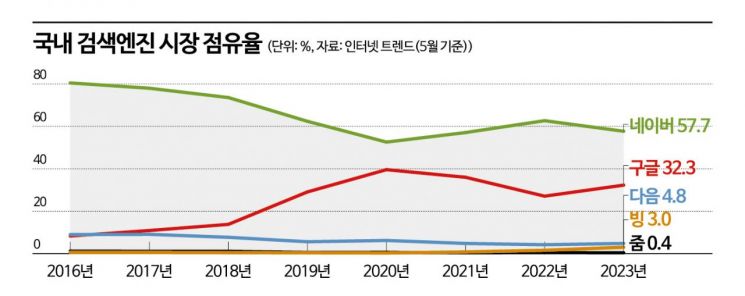
The reason for promoting the CIC is that Daum's position is no longer what it used to be. At one time, Naver and Daum divided the market at a 7 to 3 ratio, but they were overtaken by Google. According to the website analysis page Internet Trends, as of the 1st, Daum's search market share is only 4.8%. There is a large gap compared to Naver's 57.7% and Google's 32.3%.
In 2014, Kakao merged with Daum to seek synergy, but there were no significant results. Since the company focused its overall capabilities mainly on KakaoTalk, Daum was pushed to the sidelines. It was only two years after the merger that the service organization was divided into portal and social sectors, and efforts were made to strengthen Daum's competitiveness.
Meanwhile, Google surged ahead starting with mobile search. Google was pre-installed on smartphones using the Android operating system (OS), benefiting from the pre-installation effect. On PCs, the spread of the Chrome web browser increased search usage. As a result, in 2017, Google pushed Daum aside and took second place. Kakao's response was considered late in the rapidly changing search market.
The same goes for Naver. Although it maintains first place, it has lost a significant share to Google. Its market share, which was 80.5% in 2016, dropped to 57.7% this year. When COVID-19 became widespread in 2020, the gap narrowed to 13.0 percentage points. Including YouTube, which functions as a search engine, some analyses predict that Google will surpass Naver.
A similar pattern is seen outside the top three. Microsoft's (MS) search engine Bing has gradually increased its market share, overtaking the domestic portal Zoom.com. Bing's share was less than 1%, but it rapidly grew from 1.6% last year to 3.0% this year. On the other hand, Zoom.com's share fell from the 1% range to 0.4%.
Recently, generative AI chatbots such as ChatGPT have emerged as game changers in the search market. ChatGPT is equipped with GPT-4, considered the smartest AI. When questions are asked conversationally, it understands the intent and shows only the most accurate answers. This differs from existing search engines that show multiple options that might answer the question. In February, MS applied ChatGPT to Bing to shake Google. Google also countered by integrating its AI chatbot 'Bard' into its search engine.
Domestic portal companies have also jumped in. Naver plans to unveil its AI search service 'SearchGPT (tentative name)' in July. Kakao launched the AI chatbot 'Dadaum' but temporarily suspended it due to a surge in users. Although it emphasized a Korean language-specialized model as a strength, the competition is so fierce that predicting the search market landscape is difficult. An IT industry insider said, "If domestic portals do not respond nimbly, they could quickly lose their positions."
© The Asia Business Daily(www.asiae.co.kr). All rights reserved.

















