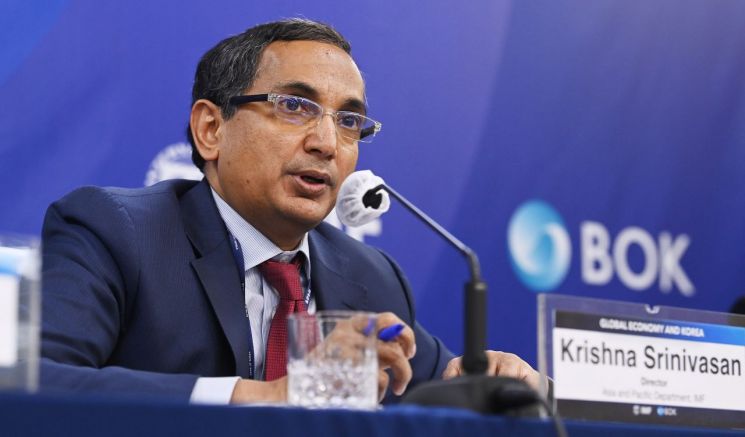
 Krishna Srinivasan, Director of the Asia and Pacific Department at the International Monetary Fund (IMF), is presenting on "The Global Economy and Korea" at a press briefing held at the Bank of Korea in Jung-gu, Seoul, on October 25 last year.
 [Image source=Yonhap News]
Krishna Srinivasan, Director of the Asia and Pacific Department at the International Monetary Fund (IMF), emphasized that although South Korea's inflation rate is gradually easing, it remains at a high level, and South Korea should focus its monetary policy on curbing inflation.
Director Srinivasan made these remarks during a press conference held on the 4th at the Songdo Convensia in Incheon, where the Asian Development Bank (ADB) Annual Meeting is taking place.
He pointed out, "Despite the slowdown in growth, inflation in South Korea remains significantly above the Bank of Korea's target of 2%. While headline inflation has declined alongside falling international energy prices, core inflation (excluding food and energy prices) has not yet decisively decreased."
He added, "Inflation is expected to decline further over the next few months, but in the short term, monetary policy needs to focus on the inflation issue, and premature easing should be avoided."
Director Srinivasan stated, "At the same time, growth momentum is expected to slow, and labor market tightness is anticipated to ease. Therefore, the risk of excessive policy tightening should also be minimized."
He evaluated that, from this perspective, the Bank of Korea's Monetary Policy Committee's recent decision to hold the base interest rate steady for two consecutive times was appropriate, adding, "(The Monetary Policy Committee) is keeping the possibility of further rate hikes open depending on future economic indicators."
Director Srinivasan said, "Fiscal policy normalization in South Korea began in the second half of last year and continues this year. Fiscal deficits are expected to decrease to less than 1% of GDP in 2023 and 2024, which helps support the following monetary policies."
He revised South Korea's economic growth forecast for this year down to 1.5%, noting, "South Korea's exports have been affected by the slowdown in growth among its trading partners and the global semiconductor downcycle over recent quarters."
He also said, "Past monetary policy tightening and fiscal policy normalization following large-scale economic stimulus last year have impacted domestic demand," and "high interest rates have played a significant role in the continued adjustment of housing prices. Housing prices are also acting as a factor suppressing domestic demand."
However, he noted, "The contribution of net exports to growth turned positive again in the first quarter of this year, and China's rapid recovery and expansion centered on domestic services will gradually have a positive effect on South Korean exports. Industry experts expect the semiconductor cycle to improve from the second half of this year, which will benefit South Korean exports."
© The Asia Business Daily(www.asiae.co.kr). All rights reserved.

















