Presidential Office: "Hard to Overlook"
Japanese Government May Address Issue Linked to Historical Matters
Yoon-Kishida, Key Is Level of Historical Awareness and Succession
The governments of South Korea and Japan are in the final stages of coordinating the agenda for the Korea-Japan summit scheduled to take place in three days. The Presidential Office explained that security and the economy are the core agenda items, but sensitive issues such as historical disputes and measures regarding the discharge of contaminated water from the Fukushima nuclear plant may also be addressed. Some analysts suggest that the Japanese government might use the historical issues as leverage to resolve the contaminated water discharge problem.
According to the Presidential Office on the 4th, Cho Tae-yong, Director of the National Security Office, met with Takeo Akiba, Director of Japan’s National Security Secretariat, yesterday afternoon to discuss preparations related to Japanese Prime Minister Fumio Kishida’s visit to South Korea. The Presidential Office described the meeting as "an opportunity to confirm positions on core agenda items such as security and the economy," while cautiously conveying that it is difficult to overlook issues raised in public opinion and other areas.
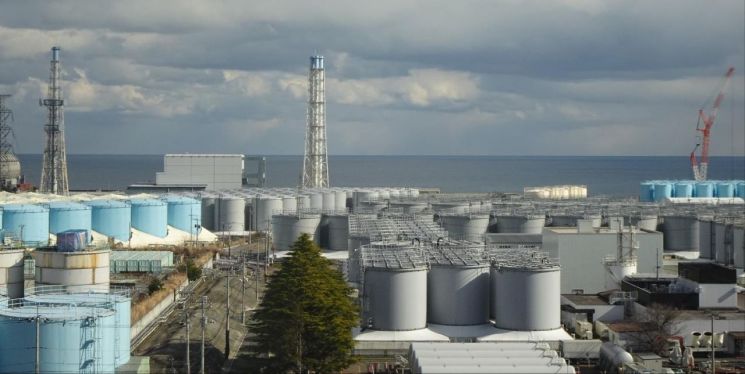
At present, the South Korean government may raise the need for a bilateral scientific investigation between Korea and Japan to verify the safety of the nuclear plant’s contaminated water discharge plan. This would be a separate effort from the ongoing monitoring by the International Atomic Energy Agency (IAEA), which involves international experts. Domestic concerns about unauthorized discharge of contaminated water are growing, and the Presidential Office has repeatedly stated the position that "thorough scientific verification is necessary, and it must be confirmed that there is no risk." Unlike the summit held last March, which was achieved and concluded through "South Korea’s sincerity," this time the South Korean government may take the lead.
However, there is an analysis that the Japanese government might link the contaminated water discharge issue with historical disputes. In a situation where international support for the discharge is lacking, the Japanese government prioritizes obtaining consent from its closest neighbor, South Korea. While not necessarily including an apology or reflection, it is expected that the Japanese government will approach resolution by delivering a message on historical issues that goes beyond simply "successor to previous cabinets."
Even if not linked to the contaminated water discharge, the level of Prime Minister Kishida’s apology and reflection remains a major point of interest. Public opinion overwhelmingly holds that for Korea-Japan relations to return to a normal track, there must be a statement that goes beyond the expression of "successor to previous cabinets." It is known that the South Korean government has continuously conveyed this domestic public opinion to the Japanese side through back channels.
Choi Eun-mi, a research fellow at the Asan Institute for Policy Studies, said, "The starting point for improving Korea-Japan relations is fundamentally the forced labor issue, so it would be strange to pass over it without any mention in this summit," adding, "I hope Japan, as a friendly cooperative country and neighbor, will at least express consolation, empathy, and acknowledgment of the circumstances at that time regarding the forced labor issue." Professor Hosaka Yuji of Sejong University commented, "Kishida had planned to visit Korea after the G7 summit, but advancing the schedule likely reflects a strong intention to take the lead in setting the agenda as the host country," and predicted that it would be difficult to expect an advanced apology during this visit.
In fact, after the Korea-Japan summit in March, the Liberal Democratic Party won a landslide victory in last month’s local and by-elections, and the Kishida Cabinet’s approval rating exceeded 50%, securing a dominant position in national governance. On the other hand, if the "half-filled glass" is not completed after Prime Minister Kishida’s visit, it is highly likely to negatively affect President Yoon’s approval rating once again. President Yoon’s approval rating, which had been declining since the last Korea-Japan summit, has shown a slight rebound after his recent visit to the United States. Depending on the level of Prime Minister Kishida’s historical awareness, President Yoon’s approval rating curve is expected to fluctuate.
© The Asia Business Daily(www.asiae.co.kr). All rights reserved.
![Clutching a Stolen Dior Bag, Saying "I Hate Being Poor but Real"... The Grotesque Con of a "Human Knockoff" [Slate]](https://cwcontent.asiae.co.kr/asiaresize/183/2026021902243444107_1771435474.jpg)
















