Celebrating Solar Calendar Children's Day and Lunar Calendar Dano on the Same Day
Traditional Bathing in Changpo Water and Eating Rice Cakes
May 5th is Children's Day, a day when even "adults" want to receive gifts. It is a day full of enjoyment. According to the solar calendar, it is Children's Day, and according to the lunar calendar, May 5th falls on the seasonal term called 'Dano.' On top of that, since it is a public holiday, children feel truly grateful.
Japan also observes May 5th according to both the lunar and solar calendars. Since Japan switched lunar festivals to the solar calendar after modernization, the lunar Dano and solar Children's Day coincide on the same day. Being part of the Confucian cultural sphere, the customs of Dano are very similar to those in Korea, yet there are also some differences. Today, we introduce the culture of May 5th in Japan, which is both similar and different.
May 5th in Japan is not only Children's Day like in Korea but also the day to celebrate 'Tango no Sekku' (端午の節句), the Dano Festival. Dano originated in ancient China and is said to be related to yin and yang. In ancient yin-yang theory, days when odd numbers overlapped were considered "days of strong yin," feared and observed by cleansing the body and performing rituals. There are five such seasonal days in a year, called the 'Five Seasonal Festivals,' which are lunar January 1st, March 3rd (Samjinnal), May 5th (Dano), July 7th (Chilseok), and September 9th (Jungyangjeol).
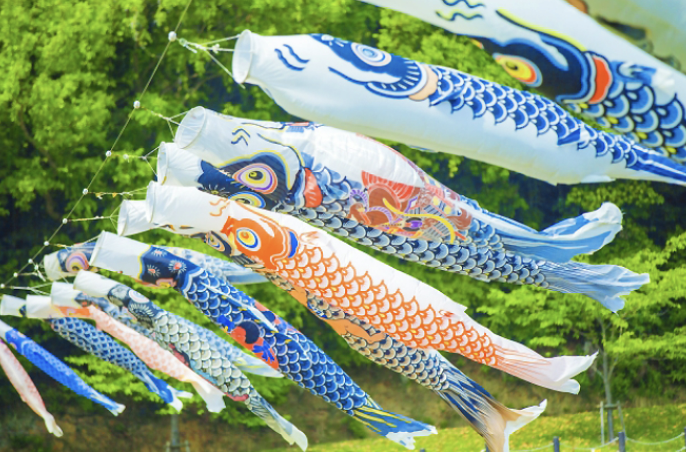
Japan's Dano Festival is a day to pray for the healthy growth of boys. In the past, the day to pray for girls' healthy growth was separated and observed on lunar March 3rd, called 'Momo no Sekku.' During the Edo period, samurai would take out helmets and armor from storage before the rainy season to dry them thoroughly, and because of this custom, helmets and armor models are displayed for boys on this day.
Also, during this season, carp-shaped decorations called 'Koinobori' are hung on poles and flutter in the wind. This custom symbolizes wishing boys to grow strong and lively like the jumping carp. Nowadays, rather than being just a boys' day, it has become a general Children's Day, and the fluttering flags have become a common sight.
In Korea, there is a tradition of washing hair with sweet flag water and eating surichitteok on Dano. Japan has a similar custom. While Koreans wash their hair, the Japanese take a bath in sweet flag water. Since sweet flag has long been regarded as an herb that wards off evil spirits in East Asia, similar customs have been preserved.
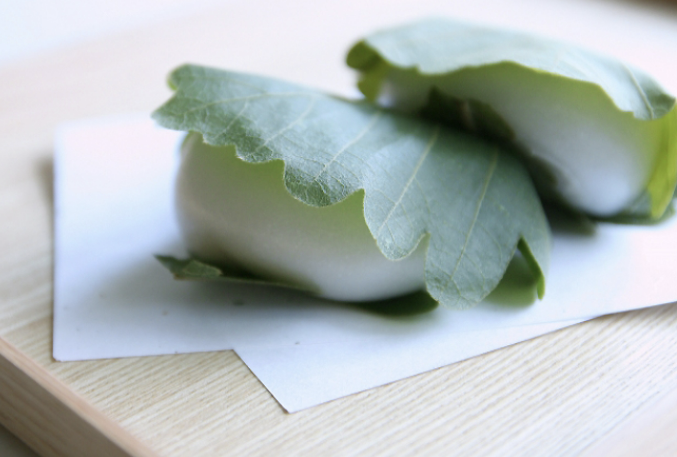
They also eat a rice cake called 'Kashiwa mochi.' It is a white rice cake filled with red bean paste and wrapped in an oak leaf before steaming. It resembles Korea's manggae tteok in shape. This rice cake also varies in form depending on the region.
Having explored the lunar calendar culture, let's look at the solar calendar culture. In Japan, May 5th was declared Children's Day under the Public Holiday Law in 1948. It was established with the meaning of "respecting children's personalities, promoting their happiness, and expressing gratitude to mothers."
Did you know that only Korea and Japan designate May 5th as Children's Day? The International Children's Day established by the World Conference on Child Welfare is June 1st, observed by about 20% of the world, and the United Nations-designated Universal Children's Day is November 20th.
However, although the date is the same, Korea's Children's Day carries the history of the Japanese colonial period. It is also the background of how Korea's Children's Day was created. Bang Jeong-hwan, a cultural activist for children, initiated this day. The original Children's Day was May 1, 1923, but since it overlapped with May Day, which was suppressed by the police in 1928, it was changed to the first Sunday of May every year. At that time, commemorative events were banned due to the suppression. After liberation, since the first Sunday of May fell on the 5th, Children's Day was fixed on May 5th.
Today, we compared May 5th in Korea and Japan. It makes us feel the similarities and differences. Reflecting once again on Bang Jeong-hwan's request to always be close to children and talk to them often, we hope that children have the happiest day today.
© The Asia Business Daily(www.asiae.co.kr). All rights reserved.
![Clutching a Stolen Dior Bag, Saying "I Hate Being Poor but Real"... The Grotesque Con of a "Human Knockoff" [Slate]](https://cwcontent.asiae.co.kr/asiaresize/183/2026021902243444107_1771435474.jpg)

















