Seals and Documents Used in Various Ceremonies... Possess Diachronic and Historical Significance
'Geunmuk' and 'Amitayeoraegujondo' Also Announced as Treasure Candidates
Seals and documents used in Joseon Dynasty rituals become national treasures. The Cultural Heritage Administration announced on the 3rd that it plans to designate the 'Joseon Dynasty Royal Seals, Royal Documents, and Royal Edicts,' jointly managed by the National Palace Museum, the National Museum of Korea, and Korea University, along with 'Geunmuk,' 'Amita Yeorae Gujon-do,' and the 'Wooden Seated Triad Buddha Statues of Seokga Yeorae at Donghwasa Temple in Suncheon' as nationally designated cultural treasures. Opinions from various sectors will be collected for a month, and the designation will be finalized after review by the Cultural Heritage Committee.
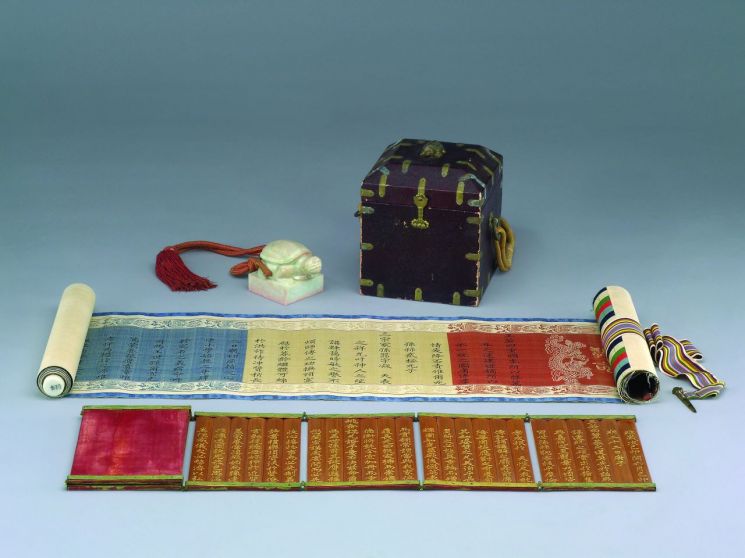
The Joseon Dynasty royal seals, royal documents, and royal edicts are seals and documents used in various rituals from the founding of Joseon in 1392 until its forced annexation by Japan in 1910. The royal seal (Eobo) is a seal made of gold, jade, or silver used when appointing the king, queen, crown prince, etc., or when conferring honorary titles to commemorate their virtues. The royal documents (Eochaek) issued along with the seals are documents recording the historical background, meaning, and content of the rituals. They are classified into jade books, bamboo books, and gold books depending on the social status. The royal edicts (Gyomyeong) are admonitory documents written on dark silk, containing instructions and teachings to fulfill responsibilities.
The seals, documents, and edicts were kept in the palace and, after the owner's death, enshrined in the spirit halls of Jongmyo Shrine. A Cultural Heritage Administration official explained, "The spirit tablet was enshrined in the center of the spirit hall, with the seals and documents placed on both sides in protective cases and bookcases." The items announced for treasure designation include 318 seals, 290 volumes of documents, and 29 royal edicts, totaling 637 items. Items produced during the Japanese colonial period or those belonging to crown princes who never became kings or concubines who bore kings, and thus were not enshrined in Jongmyo, were excluded.
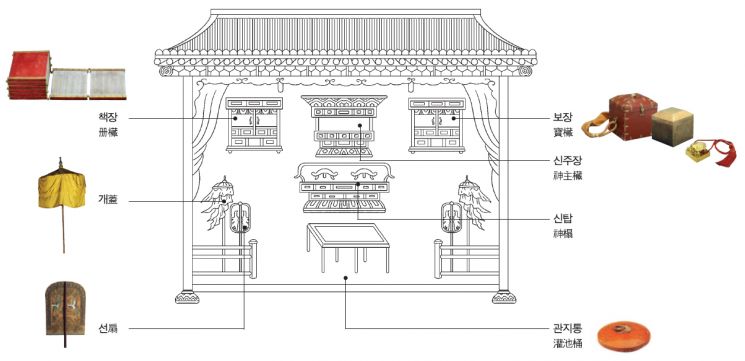
The value most emphasized by the Cultural Heritage Administration is the diachronic and historical significance of Joseon royal rituals. It is seen as symbolizing a unique royal culture unprecedented in world history. Related literature such as the Annals of the Joseon Dynasty, the Diaries of the Royal Secretariat, and the Uigwe of the Joseon Royal Family confirm the makers, materials, and tools of these ritual objects, enhancing their academic value. The seals, documents, and edicts are also masterpieces of decorative art. The texts were written by the best scribes of the time, and the seals were crafted by the finest artisans. They encapsulate the Confucian virtues, the governing ideology of the Joseon Dynasty, and are already registered as UNESCO Memory of the World, making their designation as treasures highly likely.
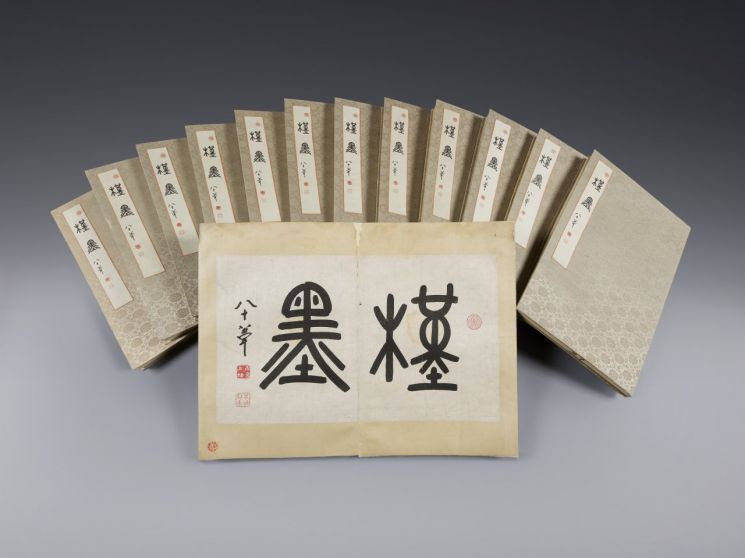
The 'Geunmuk,' also announced for treasure designation, is a calligraphy album compiled by Oh Sechang (1864?1953), a renowned calligrapher and art connoisseur, at the age of eighty. It contains the handwriting of 1,136 individuals, including Jeong Mongju (1337?1392) and Lee Do-young (1884?1933). The time span covers from the late Goryeo period to the Japanese colonial era, and the writers' statuses vary from kings, middle-class officials, to monks. The album comprehensively includes the calligraphy of famous masters throughout history, allowing the study of prevailing calligraphic styles and their evolution in each period. A Cultural Heritage Administration official evaluated it as "the most outstanding in both quantity and quality among existing calligraphy albums."
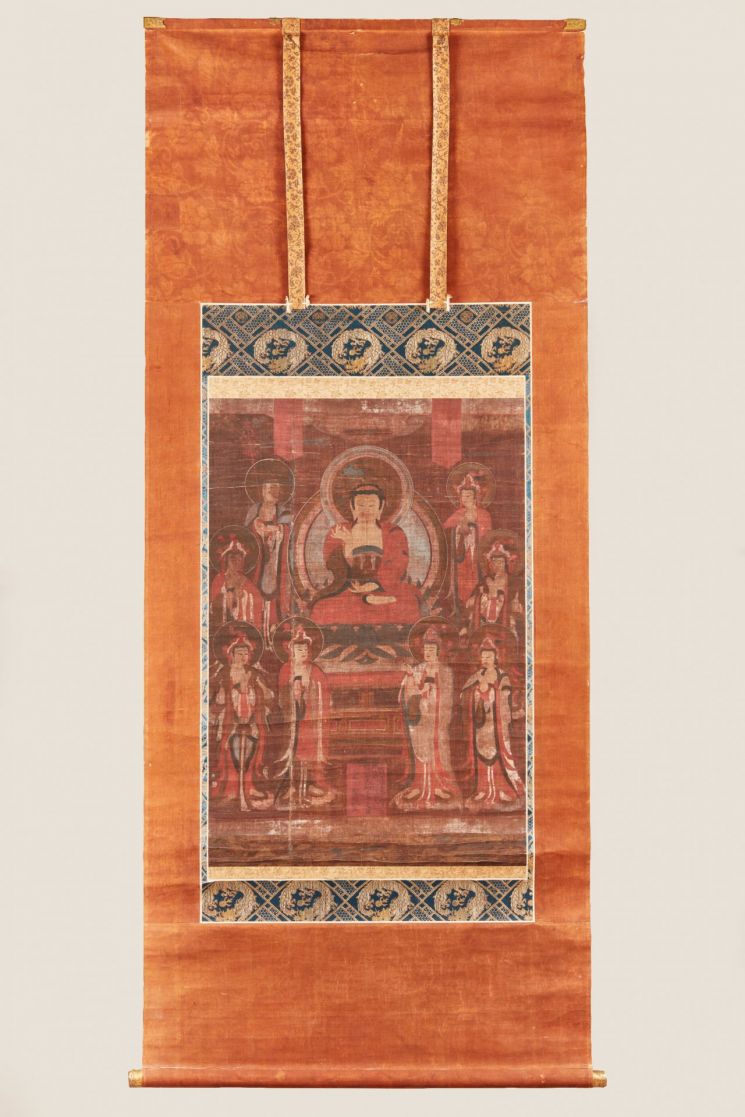
The 'Amita Yeorae Gujon-do' at the Ulsan Museum is a colored Buddhist painting created in 1565. Among the six extant early Joseon period Amita Yeorae Gujon-do paintings, it is the only one with a confirmed production date. The hemp canvas background depicts Amitabha Buddha at the center with the Eight Great Bodhisattvas symmetrically arranged on both sides, similar to late Goryeo Buddhist paintings. The arrangement of bodhisattvas surrounding the principal Buddha, the color-focused painting style excluding patterns, and other elements reflect early Joseon Buddhist painting characteristics. A Cultural Heritage Administration official stated, "It is a valuable resource for studying the forms and styles of late Goryeo and early Joseon Buddhist paintings."
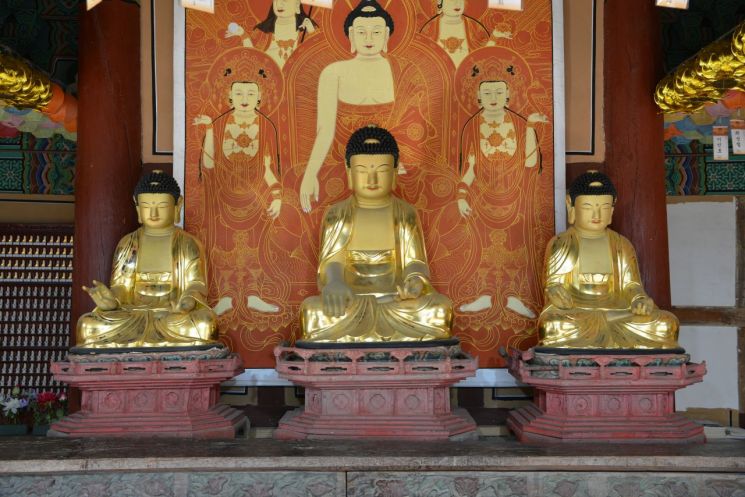
The 'Wooden Seated Triad Buddha Statues of Seokga Yeorae at Donghwasa Temple in Suncheon' were completed in 1657 by seven sculptor monks including Gyechan, Ingye, and Yeong-eon, and enshrined in the main hall of Donghwasa Temple. The statues of the principal Buddha Shakyamuni, Medicine Buddha, and Amitabha Buddha are placed on a table-shaped pedestal (sumidan). The dedication inscription records the date of creation, the makers, and even the list of donors and materials used, indicating rich academic value. A Cultural Heritage Administration official said, "The upper plates of the pedestals of each Buddha also have similar dedication inscriptions written in ink, allowing cross-verification with the main inscription. The statues have been preserved intact at their original enshrinement site, making them fully worthy of treasure designation."
© The Asia Business Daily(www.asiae.co.kr). All rights reserved.
![Clutching a Stolen Dior Bag, Saying "I Hate Being Poor but Real"... The Grotesque Con of a "Human Knockoff" [Slate]](https://cwcontent.asiae.co.kr/asiaresize/183/2026021902243444107_1771435474.jpg)


















