IBS-KIST Transfers Technology to Private Companies
Full-Scale New Drug Development Research Begins
Alzheimer's dementia treatment technology developed by domestic researchers is leading to full-scale clinical trials and drug development.
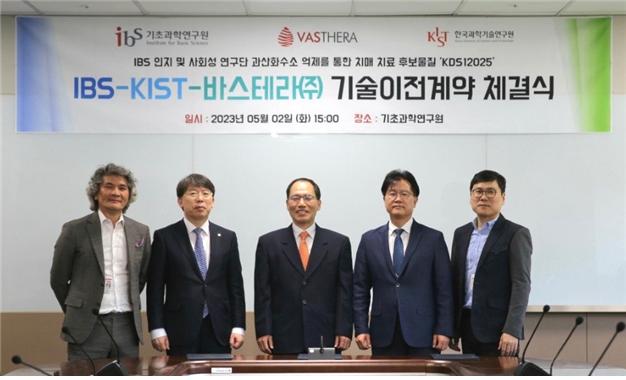
The Institute for Basic Science (IBS) and the Korea Institute of Science and Technology (KIST) transferred the technology of a new drug, ‘KDS12025,’ which demonstrated the fundamental treatment potential for Alzheimer's dementia, to the bio company VASTERA on the 2nd. VASTERA, a startup venture within Ewha Womans University, possesses an innovative drug development platform that regulates redox-based biosignaling systems and is developing global innovative drugs for chronic diseases such as vascular diseases and degenerative brain disorders. The technology transfer deal amounts to a total of 5.3 billion KRW, including royalties (milestones) based on clinical stages, and the contract signing ceremony was held on the 2nd at the IBS headquarters in Daejeon.
Dementia is a brain disease rapidly increasing worldwide due to population aging. It occurs most frequently in people aged 65 and older, significantly reducing the quality of life for patients and their families and imposing a substantial economic burden. However, current treatments targeting amyloid beta and acetylcholine only provide short-term symptom relief and have repeatedly failed in clinical trials. Thus, there is still no clear treatment method, and the demand for drug development is very high.
The transferred therapeutic substance was developed as part of a project to discover new treatments for various degenerative brain diseases and mental disorders by the IBS Cognitive and Sociality Research Group. The KIST Brain Disease Conquest Research Group also participated jointly in this research.
The IBS-KIST joint research team revealed that hydrogen peroxide, a type of reactive oxygen species excessively produced by the MAOB enzyme in reactive astrocytes, is a new cause of Alzheimer's dementia, publishing their findings in Nature Neuroscience in 2020. Based on this research, the team studied effective methods to remove abnormally produced hydrogen peroxide. As a result, they developed the research substance ‘KDS12025’ as a catalyst that promotes the activity of peroxidase, an enzyme that removes hydrogen peroxide.
The researchers confirmed that this substance not only reduces abnormally increased hydrogen peroxide caused by severe reactive astrocytes in dementia animal models but also inhibits neuronal cell death, restoring cognitive ability and memory in Alzheimer's dementia animal models. Additionally, this substance showed significantly improved blood-brain barrier permeability and drug efficacy compared to currently used hydrogen peroxide removal drugs.
Lee Chang-jun, director of IBS, stated, “The development of KDS12025 has opened the possibility of developing new treatments for dementia by removing hydrogen peroxide,” adding, “Building on this technology transfer, we will lead the development of treatments for dementia and hydrogen peroxide-related degenerative brain diseases through future global clinical trials.”
© The Asia Business Daily(www.asiae.co.kr). All rights reserved.
![Clutching a Stolen Dior Bag, Saying "I Hate Being Poor but Real"... The Grotesque Con of a "Human Knockoff" [Slate]](https://cwcontent.asiae.co.kr/asiaresize/183/2026021902243444107_1771435474.jpg)
















