Seeking Solutions Such as Brand Strengthening and Diversification of Overseas Markets
The domestic cosmetics industry, which has been experiencing poor performance due to the global economic recession and the resurgence of COVID-19, is seeking solutions through strengthening premium brands and diversifying overseas markets such as North America. With the mask mandate lifted and China's reopening (resumption of economic activities) gradually boosting consumption, the industry expects to recover its performance in the second half of this year.
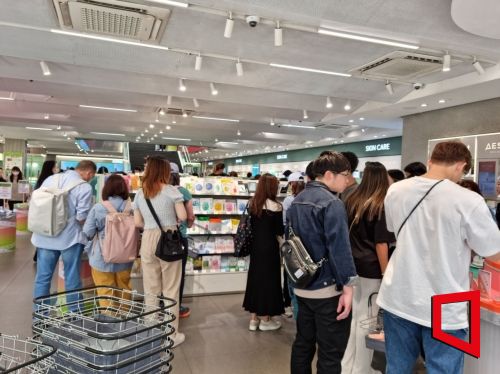 On the 3rd, foreign tourists are shopping at a beauty select shop in Myeongdong, Jung-gu, Seoul. Photo by Moon Hyewon, Asia Economy.
According to the cosmetics industry on the 5th, Amorepacific Group's consolidated sales for the first quarter of this year amounted to 1.0091 trillion KRW, down 20.1% compared to the same period last year, and operating profit was 81.6 billion KRW, a decrease of 52.3% over the same period. The group's total cosmetics division sales for the first quarter were recorded at 925.5 billion KRW.
Amorepacific's domestic business, its main affiliate, recorded sales of 552.2 billion KRW, down 24.6% year-on-year due to sluggish duty-free channels. Operating profit also fell 60.8% due to the decline in duty-free sales and product portfolio restructuring.
Amorepacific's overseas business recorded sales of 349.4 billion KRW, down 16.8% year-on-year due to a slowdown in Asian performance caused by decreased sales in China. Operating profit also decreased by 36.9% during the same period due to the decline in Asian sales.
However, sales in North America increased by 80%, and sales in the EMEA (Europe, Middle East, Africa) region grew by as much as 94%.
LG Household & Health Care's situation is similar. LG Household & Health Care's sales for the first quarter of this year were 1.6837 trillion KRW, up 2.4% from the same period last year, but operating profit decreased by 16.9% to 145.9 billion KRW during this period.
It is explained that operating profit declined as fixed costs and cost burdens increased amid slow sales growth in major business sectors such as cosmetics. Sales in the cosmetics and household goods business divisions increased by 0.3% and 1.9%, respectively, and beverage sales also grew by 6.7%. However, operating profit in the cosmetics and household goods sectors decreased by as much as 11.3%.
Overseas sales, which account for about 30% of total sales, were 500.2 billion KRW, down 1.7% from the same period last year. In particular, sales in China decreased by 14.1% to 193.1 billion KRW, and sales in Japan also fell by 12.8% to 89.9 billion KRW. However, the North American market recorded 136.1 billion KRW, an increase of 21.1%.

Industry analysts interpret that both companies are gradually seeing results from strategies to reduce dependence on China as their North American businesses show strong growth.
In the case of Amorepacific, it strengthened brand marketing in key North American regions, with Laneige's 'Lip Slima' travel kit performing well in sales and driving revenue. In Europe and Russia, sales growth of Laneige Lip Slima and the 25th-anniversary marketing of Goutal's 'Petit Cheri' also contributed to performance.
Amorepacific plans to strengthen its overall global business position this year. It will first launch new Innisfree products exclusive to China and expand the Laneige product line. It will release the 6th generation of Sulwhasoo's luxury cosmetic Yunjo Essence and conduct a full-scale rebranding campaign.
Since the appointment of new CEO Lee Jeong-ae last year, LG Household & Health Care has been expanding its overseas business while reducing dependence on China, targeting markets such as North America, Japan, and Southeast Asia. For example, in North America, it is developing its business by integrating K-beauty with well-known local brands such as Physiogel and The Cr?me Shop.
At the same time, within China, it is strengthening the product lineup of the luxury brand 'Su:m' to enhance competitiveness. In Japan and Southeast Asia, it plans to expand both online and offline distribution bases. It also aims to increase touchpoints with e-commerce and strengthen digital marketing capabilities based on data.
An industry insider said, "Recently, as K-content has gained great popularity in overseas countries such as North America, Japan, and Southeast Asia, K-beauty is also receiving a lot of attention, making this the optimal time for diversifying overseas markets."
© The Asia Business Daily(www.asiae.co.kr). All rights reserved.


















