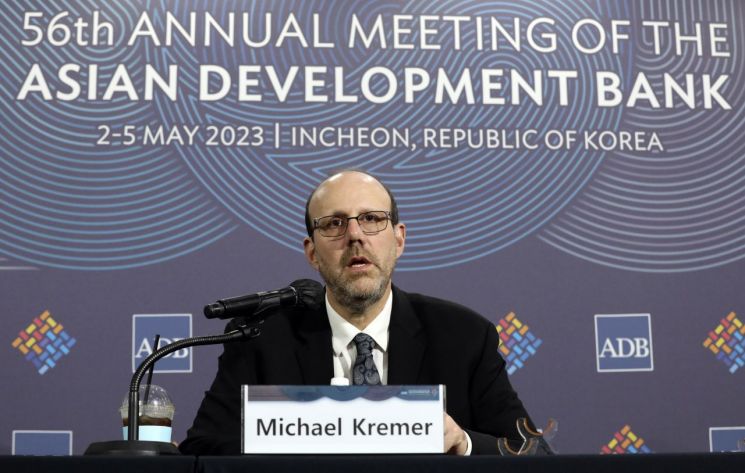
 Professor Michael Kramer of the University of Chicago attended the '56th Annual Meeting of the Asian Development Bank (ADB)' held on the afternoon of the 2nd at Songdo Convensia in Yeonsu-gu, Incheon, and held a press conference. [Image source=Yonhap News]
Michael Kremer, a professor at the University of Chicago who won the 2019 Nobel Prize in Economics, cited expanded immigration as a solution to South Korea's low birthrate and aging population issues on the 2nd. He emphasized, "Expanding immigration will bring benefits across the economy, including reducing inequality and increasing government fiscal revenue."
Professor Kremer made these remarks during a press conference held at the Asia Development Bank (ADB) Annual Meeting in Songdo Convensia, Incheon, where he identified low birthrate and aging population as key challenges for the future of the Korean economy.
Kremer is an economist awarded the Nobel Prize in Economics for his research on poverty alleviation methodologies based on experiments. Prior to the press conference, he also emphasized the need to expand immigration in Korea during the "Korea Seminar Day" event with Cho Dong-chul, president of the Korea Development Institute (KDI).
He stated, "Immigration policy leads to an expansion of the economically active population, which is a great help economically," and cited the "special visa program for foreign domestic helpers" in Hong Kong and Singapore as a representative example.
He continued, "If we accept immigrants to work in caregiving and child-rearing sectors by referring to overseas cases, it would increase the social participation of highly educated women while minimizing political backlash," adding, "As women's economic participation increases, social inequality will be alleviated, and the nation's tax revenue will also increase."
He explained that if it is difficult to implement a full immigration policy due to political and cultural issues, it is necessary to expand immigration at least partially.
He said, "Allowing partial immigration that reduces concerns about crime and culture while being helpful is the way to go," and added, "This means permitting immigrants related to specific industries, such as child and elderly care and domestic work, similar to how many Filipino domestic helpers work in Hong Kong."
Regarding the impact of rising conflicts between the U.S. and China amid growing nationalism, Professor Kremer said, "We need to find areas where cooperation is possible."
He noted, "I am an economist, not a political scientist," but pointed out, "thinking about the Cold War period when the U.S. and the Soviet Union were political rivals, they still cooperated in areas like smallpox eradication."
He added, "One of the lessons economics teaches us is that we do not live in a zero-sum world," and said, "If the U.S. and China cooperate in trade and other areas, everyone can benefit."
© The Asia Business Daily(www.asiae.co.kr). All rights reserved.

















