Jebahyeop-MIT ILP Jointly Host Conference
World-renowned Expert Professor James Collins
"AI Development Enables Creation of Antibiotics
That Are Non-resistant and Fast-acting"
"Despite the rising issue of bacterial infections, the development of new antibiotic drugs is gradually decreasing. If antibiotic development using artificial intelligence (AI) is realized, it will be possible to create antibiotics that show rapid effects, have no resistance, and do not affect other bacteria."
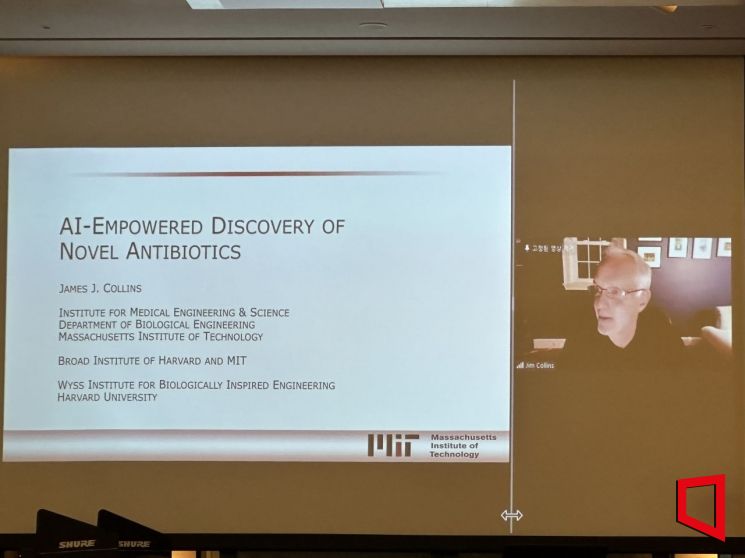 On the 28th, Professor James Collins of MIT delivered a keynote speech via video at the 'MIT-Korea Conference' jointly hosted by the Korea Pharmaceutical and Bio-Pharma Manufacturers Association and the MIT Industry Liaison Program (ILP).
 [Photo by Lee Chunhee]
'If antibiotics are used continuously, eventually no antibiotics will work.' This is a warning about the dangers of antibiotics. Antibiotics that kill bacteria cause the bacteria to develop 'resistance' by adapting to the toxicity when taken over time. When strong resistance develops, antibiotics may become ineffective when truly needed, making treatment impossible. Although the government provides incentives to medical institutions that reduce antibiotic prescriptions and this has proven effective in overcoming bacterial infections, antibiotics are still perceived as something that should not be used once started. As the market size shrinks, pharmaceutical companies are also hesitant to develop new antibiotics.
James Collins, a professor at the Institute for Medical Engineering and Science (IMES) at the Massachusetts Institute of Technology (MIT), is working on developing new antibiotic drugs using AI to overcome this phenomenon. Professor Collins is one of the key researchers at the Broad Institute, jointly established by MIT and Harvard University, and is recognized as an authority in the field of synthetic biology. On the 28th, he presented this possibility through a keynote virtual lecture at the 'MIT-Korea Conference' jointly hosted by the Korea Pharmaceutical and Bio-Pharma Manufacturers Association and the MIT Industry Liaison Program (ILP).
Professor Collins referred to the 1950s and 1960s as the golden age of antibiotic development, stating, "Since then, most new antibiotic drugs have only advanced about one step beyond existing ones, and recently, almost none have been developed." He explained the situation by adding, "During the COVID-19 pandemic, one in seven patients was hospitalized with a concurrent bacterial infection, and there were many deaths caused by bacterial infections." He continued, "As strains resistant to antibiotics continue to increase, the resistance problem is becoming serious," and said, "This led me to take an interest in developing new antibiotic drug candidates by combining deep learning and machine learning using artificial intelligence (AI)."
Searching a Library of 1.5 Billion Compounds Impossible for Humans... AI Makes It Possible
Professor Collins created a library of about 25,000 compounds and exposed them to Escherichia coli to identify which showed antibiotic effects, then further selected 51 candidate substances. Among these, the most outstanding was 'Halicin.' The name is derived from the AI computer 'HAL' in the movie '2001: A Space Odyssey.' When Halicin was discovered in 2020, Professor Collins explained, "It is the first antibiotic discovered using AI," and added, "Although AI has previously assisted in parts of the discovery process, this is the first time an entirely new antibiotic was discovered from scratch without relying on any human assumptions."
Professor Collins emphasized that Halicin induces much less resistance compared to existing antibiotics, explaining, "This is because it targets the mechanism that forms a specific protein rather than the protein itself." He said, "When Halicin was used on E. coli strains with high antibiotic resistance, it rapidly killed them," and "In contrast, only 2% of existing antibiotics were effective against these strains." He also stressed that Halicin demonstrated effectiveness against bacteria resistant to a wide range of antibiotics and that resistance to Halicin itself rarely develops.
Halicin also showed effectiveness against diseases requiring innovative treatments due to difficulty in treatment upon infection, such as Clostridium difficile (CD) and Acinetobacter baumannii. Clostridium difficile infection (CDI) causes severe diarrhea and has a high recurrence rate, with an estimated 15,000 to 30,000 deaths annually in the United States. Professor Collins explained, "When Halicin was administered to CDI mice showing antibiotic resistance, there was no cytotoxicity, and the CD bacteria were eliminated," and "In the case of Acinetobacter baumannii infection, where most antibiotics were ineffective, applying Halicin to the skin eliminated the infection."
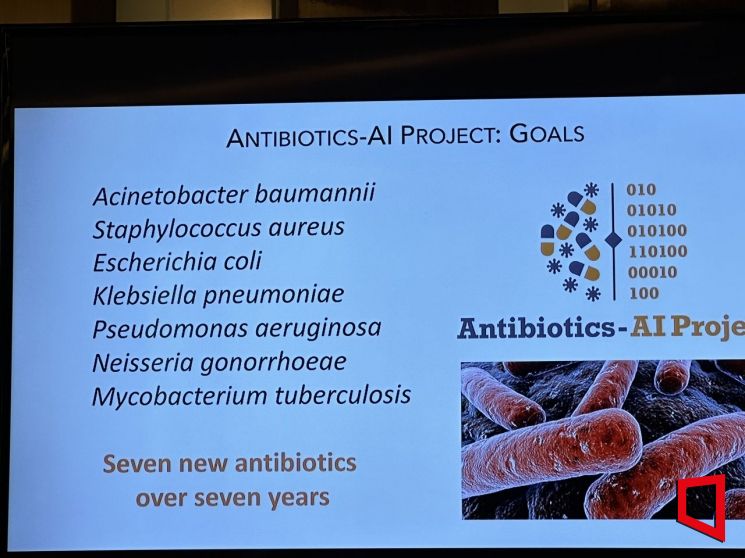 Professor James Collins announced plans to develop seven new antibiotics over the next seven years through AI discovery.
 [Photo by Lee Chunhee]
Professor Collins repeatedly emphasized that such AI-driven discovery will bring innovation to antibiotic development. He said, "Some ask if research on just a few dozen compounds can be done by a few researchers," but explained that "the true value of AI is in providing access to much larger compound libraries," and that he has built a library containing 1.5 billion compounds.
Additionally, Professor Collins described the traditional drug development method as a 'black box' approach, whereas AI enables a 'white box' style of development. Unlike the conventional method, where the input and output are known but the mechanism of action of the drug is unknown and must be inferred from the output, AI allows identification of the molecular mechanisms of newly discovered and designed antibiotics. By examining various metabolic processes and observing changes in these aspects, insights can be gained.
Through this, Professor Collins expressed his ambition to "develop seven new antibiotics over the next seven years." The targets are Acinetobacter baumannii, Staphylococcus aureus, Escherichia coli, Klebsiella pneumoniae, Pseudomonas aeruginosa, Neisseria gonorrhoeae, and Mycobacterium tuberculosis. In particular, for antibiotics targeting Staphylococcus aureus, the white box approach is applied by confirming scaffolds and related structures to verify the actual antibiotic effects. He also explained that antibiotic effects have been confirmed against bacteria with antibiotic resistance, such as methicillin-resistant Staphylococcus aureus and vancomycin-resistant Enterococcus.
© The Asia Business Daily(www.asiae.co.kr). All rights reserved.


















