Jake Sullivan "Reviewing Security Agreements with Major Mineral Producers"
"Do Not Want Confrontation or Conflict with China"
The White House in the United States has announced plans to provide additional incentives to establish a flexible supply chain in the critical minerals sector. This is due to the current incentives under the Inflation Reduction Act (IRA) being deemed insufficient. Amid high dissatisfaction from foreign companies excluded from electric vehicle subsidies, including Hyundai Motor and Kia Motors, attention is focused on whether additional measures from the U.S. administration in the critical minerals sector could alleviate disadvantages faced by the domestic automotive industry.
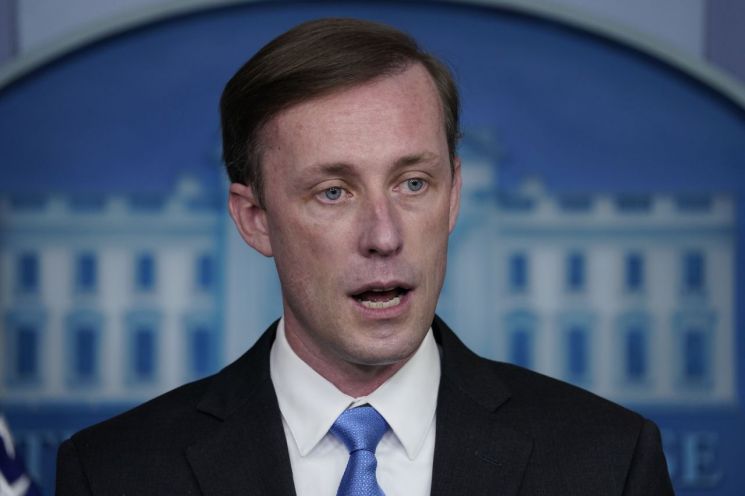
Jake Sullivan, U.S. National Security Advisor, stated on the 27th (local time) during a discussion at the Brookings Institution think tank in Washington, D.C., "While the IRA has created many market incentives, it is not enough," adding, "We need to take additional actions to close the gap between our current situation and future goals."
Initially, the U.S. limited the origin requirements for critical minerals for electric vehicle subsidies to the U.S. and countries with which it has free trade agreements (FTA). However, it has since taken steps to allow benefits through separate agreements with countries like Japan and the European Union (EU), which do not have FTAs. Sullivan went a step further by mentioning the need for additional incentives.
He explained, "Ultimately, we need to consider expanded dialogues between major mineral-producing countries and holders of clean energy technologies," adding, "We are exploring whether this could be a minerals club, a minerals security agreement, or cooperation we have already begun."
He emphasized that the goal is not to build the entire supply chain within the U.S. and that they do not intend to harm allied countries.
Sullivan said, "The U.S. does not see it as possible or desirable to build everything domestically," explaining, "Our goal is not an isolated economy but supply chain flexibility and security." He continued, "The start is strengthening domestic capabilities, but this will lead to building partners' capabilities and flexibility beyond borders."
He stated, "We will not leave our friends behind," emphasizing, "Through the IRA, we have built a clean energy manufacturing ecosystem based in North America and are expanding it to Europe, Japan, and other regions. This is how we turn the IRA from a source of friction into a source of strength and trust."
Sullivan maintained his previous stance identifying China as the greatest challenge and made clear the intention to reduce the threat posed by China.
He explained, "Today, the U.S. accounts for only 4% of global lithium production and 13% of cobalt production, while over 80% of critical minerals are processed in China," adding, "The supply chain for critical minerals for clean energy production and consumption is at risk of weaponization, similar to oil in the 1970s or natural gas in Europe in 2022." He clarified, "Supply chain issues concern how much production can be secured and how to respond to markets with significantly unstable prices."
However, he clarified that efforts to reduce the threat from China do not mean severing relations with China. He reaffirmed the existing position, saying, "Our export controls will be limited to technologies that could threaten the military balance," and "The U.S. competes with China on various levels but does not seek confrontation or conflict."
Regarding current U.S. trade policies, including trilateral cooperation among the U.S., South Korea, and Japan in the industrial sector and the Indo-Pacific Economic Framework (IPEF), Sullivan said, "Some say these initiatives are not traditional FTAs," explaining, "Traditional models are not suitable for solving today's problems. Today's trade policy must mean more than just tariffs."
In response to criticism that the U.S.'s focus on countering China is hurting allied countries, he said, "This is the core of the conversations we have had with Europe, Japan, and South Korean President Yoon Suk-yeol, who visited the U.S. a few days ago," adding, "Since the Biden administration, we believe we have built sufficient trust in many places, including the Indo-Pacific." He continued, "We have effectively demonstrated this in the semiconductor sector," and "Last year's export controls on China were also remarkably specific and strict."
© The Asia Business Daily(www.asiae.co.kr). All rights reserved.
![Clutching a Stolen Dior Bag, Saying "I Hate Being Poor but Real"... The Grotesque Con of a "Human Knockoff" [Slate]](https://cwcontent.asiae.co.kr/asiaresize/183/2026021902243444107_1771435474.jpg)
















