Strengthening Extended Deterrence with Strategic Assets
Yoon: "Immediate Summit Consultations if North Korean Nuclear Attack Occurs"
Biden: "It Will Bring About the End of the Regime"
At the Korea-US summit held during a state visit to the United States for the first time in 12 years, President Yoon Suk-yeol and US President Joe Biden agreed on the concept of 'peace through strength.' During the 77-minute summit, Presidents Yoon and Biden exchanged warning messages to the North Korean regime and adopted the 'Washington Declaration' to activate a new extended deterrence system. In particular, the two leaders confirmed their policy to respond swiftly, overwhelmingly, and decisively with all forces, including nuclear weapons, in the event of a nuclear attack by North Korea.
On the afternoon of the 26th (local time), after concluding the Korea-US summit at the White House in Washington DC with President Biden, President Yoon disclosed at a joint press conference that "the two countries have agreed to hold immediate consultations between the leaders in the event of a North Korean nuclear attack." This agreement was the outcome of the nearly 80-minute summit at the White House, centered on the establishment of the 'Nuclear Consultative Group (NCG),' known as the 'Washington Declaration.'
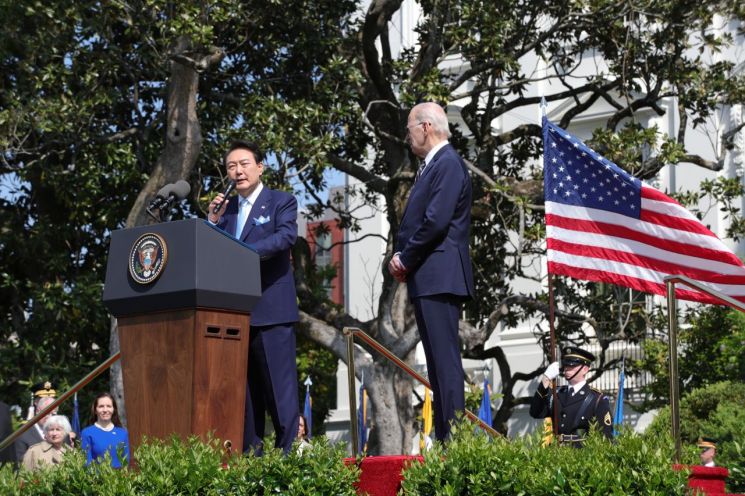
The Washington Declaration reflects the US government's intention to strengthen extended deterrence against North Korea and enhance the effectiveness of the 'nuclear umbrella' provided by the United States. This strategy aims to soothe the rising public opinion in South Korea favoring independent nuclear development while emphasizing that the US nuclear umbrella remains firm. President Yoon officially announced the establishment of the NCG, adding, "Now, the two countries will regularly consult on sharing information about nuclear and strategic weapons operation plans in response to North Korean threats and jointly plan and execute operations combining South Korea's advanced conventional forces with US nuclear forces."
Regarding the most contentious issue, the deployment of US strategic assets on the Korean Peninsula, President Yoon stated, "It will be conducted regularly and continuously." A senior official from the presidential office also added, "One of the strategic assets, nuclear submarines, have stealth capabilities making it difficult for adversaries to detect in advance, and they can immediately carry out nuclear retaliation in any contingency," and explained, "There is a plan to deploy such strategic assets very frequently and regularly on the Korean Peninsula."
Contrary to evaluations that the NCG mentioned by the two leaders on this day is merely symbolic to check North Korea, it is increasingly likely to become a bilateral consultative body where the US expands and shares response information with South Korea and organically coordinates extended deterrence operations. The NCG representatives have been designated at the deputy assistant secretary level by mutual agreement, and they agreed to hold regular meetings quarterly, totaling four times a year. The structure involves preparing in advance, conducting meetings, immediately reporting results to each leader, and then implementing them. Although specific dates have not been set, two to three meetings are scheduled within this year.
President Biden's determination to check North Korea's nuclear threat was confirmed several times. President Biden stated that "a nuclear attack by North Korea on the United States, its allies, or partners is unacceptable." He warned that if North Korea carries out a nuclear attack, it would "bring about the end of the regime," and explained, "Extended deterrence (enhancement) means that we will conduct more consultations regardless of the actions we take." Although the Biden administration has previously discussed strengthening extended deterrence with South Korea and warned of the 'end of the regime' in the event of a North Korean nuclear attack, this is the first time President Biden has directly addressed this.
Regarding the Washington Declaration, he explained, "It is about taking advanced measures in extended deterrence to respond to the increasing nuclear threat from North Korea," and added, "This means making every effort necessary to consult with allies when needed." However, he emphasized, "The foundation is to cooperate and consult closely with South Korea." This is also why President Biden mentioned, "We will not (permanently) redeploy nuclear weapons on the Korean Peninsula." Even with the establishment of the NCG, South Korea will not directly participate in decisions regarding the use of US nuclear weapons, as such decisions remain the authority of the US president. By formalizing the strengthening of extended deterrence, the US aims to support the Yoon administration while curbing South Korea's independent nuclear armament movement.
A senior official from the presidential office cautioned against interpretations, saying, "Since the two countries have established mechanisms for sharing information on US nuclear weapons operations and joint planning, our people may feel as if they are effectively sharing nuclear weapons with the United States." He further explained, "Although the Washington Declaration is phrased softly, the US has pledged that under no circumstances will it allow North Korea to use or attempt to use nuclear weapons without immediately eliminating the source of a preemptive strike."
© The Asia Business Daily(www.asiae.co.kr). All rights reserved.
![Clutching a Stolen Dior Bag, Saying "I Hate Being Poor but Real"... The Grotesque Con of a "Human Knockoff" [Slate]](https://cwcontent.asiae.co.kr/asiaresize/183/2026021902243444107_1771435474.jpg)
















