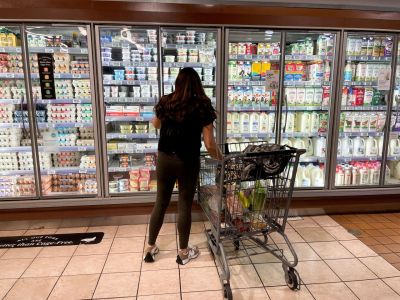
American consumers continue to open their wallets despite price increases on various products such as hamburgers, soft drinks, and diapers. Despite higher prices, customer traffic has persisted, leading to strong first-quarter performances for major retail companies like McDonald's, PepsiCo, and Kimberly-Clark. However, there are concerns within and outside the industry that the extent of price increases consumers can accept has now reached its limit.
According to the Wall Street Journal (WSJ) and others on the 25th (local time), McDonald's announced in its first-quarter earnings report that same-store sales increased by 12.6%. This far exceeded Wall Street's forecast of 8.2%. Total sales rose 4% year-over-year to $5.9 billion, surpassing market expectations. Net income for the same period also surged 63% to $1.8 billion.
This is attributed to more customers visiting stores despite price hikes on flagship products like hamburgers to offset increased costs due to inflation. The economic media CNBC reported, "Customer visits have increased for three consecutive quarters," adding, "Fast food chains like McDonald's tend to perform better during times of high economic uncertainty."
PepsiCo also recorded strong sales despite recently raising prices by more than 13%. The first-quarter sales released that day showed an increase of over 10% year-over-year to $17.85 billion. Consequently, PepsiCo raised its annual sales growth forecast for this year from 6% to 8%.
Kimberly-Clark, known for Huggies and Kleenex, showed growth exceeding sales and profit expectations despite raising product prices by more than 10% for two consecutive quarters. Nestl? SA, well known for Nescaf? and KitKat, experienced a decline in sales volume due to price increases of around 10%, but still performed better than market expectations. Procter & Gamble (P&G), which released its first-quarter results last week, also reported a 4% increase in sales despite implementing price hikes for two consecutive quarters.
Besides retail companies, American automaker General Motors (GM), which also released its first-quarter results that day, exceeded Wall Street expectations. First-quarter sales rose 11.1% year-over-year to $39.99 billion, and earnings per share were $2.21. Wall Street had previously forecasted $38.96 billion and $1.73, respectively. Notably, GM also raised its 2023 earnings forecast from $10.5?12.5 billion to $11?13 billion.
GM Chief Financial Officer Paul Jacobson explained that vehicle demand remains strong and consumers continue to spend. In the first quarter, American consumers spent an average of about $50,000 per vehicle, which is 1% lower than a year ago.
However, warnings about price increases have also emerged. Amid growing concerns about a recession and prolonged tightening by the Federal Reserve (Fed), there are indications that consumers' tolerance for inflation is gradually reaching its limit. AT&T stated in its earnings report last week that new wireless demand is declining due to layoffs and cost-cutting by companies. Verizon also reported a decrease in wireless subscribers, leading to reduced sales.
According to the U.S. Department of Commerce, American retail spending has declined for two consecutive months. Specifically, purchases of high-priced items such as vehicles, home appliances, and furniture have notably decreased. The day before, appliance manufacturer Whirlpool reported a 5% drop in first-quarter sales due to reduced demand for stoves and dishwashers amid sluggish home sales.
PepsiCo's Chief Financial Officer Hugh Johnston, whose company recorded better-than-expected results despite price increases, also said, "We are preparing for a mild recession this year." He added that a kind of "trade down" is being observed among some consumers, who are purchasing 2-liter PET bottles instead of single-use soda cans.
© The Asia Business Daily(www.asiae.co.kr). All rights reserved.
![Clutching a Stolen Dior Bag, Saying "I Hate Being Poor but Real"... The Grotesque Con of a "Human Knockoff" [Slate]](https://cwcontent.asiae.co.kr/asiaresize/183/2026021902243444107_1771435474.jpg)
















