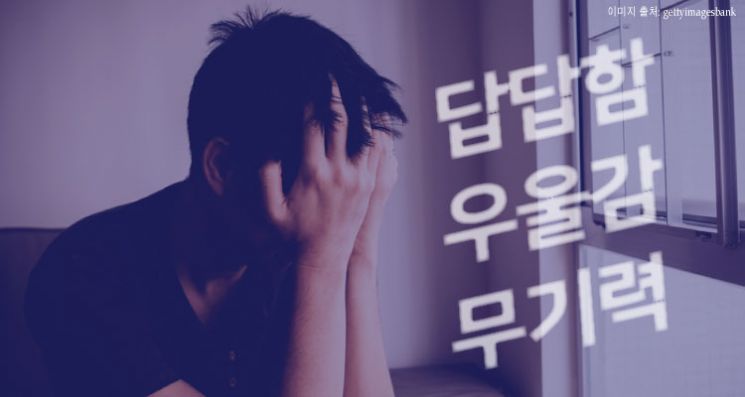
Mental health indicators, which were expected to improve with the return to normal life after COVID-19, have instead worsened. Experts view this as a sign of the tendency for suicide rates to rebound 2 to 3 years after a major disaster, emphasizing the need for extraordinary measures to prevent suicide.
According to the results of the "2022 Community Health Survey" released by the Korea Disease Control and Prevention Agency on the 25th, the "rate of experiencing depression" rose by 0.1 percentage points from the previous year to 6.8% last year. This means that one in every 15 people experienced depressive feelings severe enough to interfere with daily life for more than two weeks within a year. This marks a continuous increase for four years since 2018 (5.0%).
Until now, some believed that the depression indicators inevitably rose in 2021, the second year of COVID-19, due to social distancing and other factors, and expected improvement in 2022 with the phased return to normal life. However, the opposite result appeared. Regarding this, Professor Im Myeong-ho of Dankook University’s Department of Psychology said, “Psychological aftereffects from major disasters like COVID-19 occur with a certain time lag after the event,” adding, “Unfortunately, depression indicators may rise again this year.” The "stress perception rate," which measures those who feel "very much" or "a lot" of stress in daily life, fortunately dropped to 23.9% from 26.2% the previous year. However, about one in four people still experience significant stress, indicating a high level. The KDCA stated, “2022 was a year of returning to normal life,” and added, “We will conduct an in-depth analysis of the causes behind the indicators shown in the survey results.”
This year is supposed to be the year of overcoming COVID-19
This year is considered not only a year of returning to normal life but also a year of overcoming COVID-19. Given that mental health indicators have not significantly improved, there are growing concerns that suicide rates may rise in the future. South Korea’s suicide rate increased for two consecutive years from 24.3 per 100,000 in 2017 to 26.6 in 2018 and 26.9 in 2019, then decreased to 25.7 in 2020, but rose again to 26.0 in 2021, the second year of COVID-19. Professor Hong Jin-pyo of Samsung Seoul Hospital’s Department of Psychiatry explained, “At the beginning of COVID-19, many people experienced a similar ‘COVID Blue’ due to social isolation, but in the post-COVID period, as many things such as human relationships that were cut off during COVID begin again, individuals face various difficulties.” In terms of the quality of depression, the period after overcoming COVID-19 may be worse.
Concerns about the spread of the "Werther effect" (copycat suicides) among teenagers have also increased. On the 19th, news broke of the death of Moonbin (25), a member of a famous idol group, and between the 16th and 20th, three teenagers died consecutively in Gangnam-gu, Seoul, within five days. Due to COVID-19, interactions with friends and teachers were cut off for a while, while exposure to smartphones increased, leading many students to express anxiety caused by difficulties in classroom relationships. Professor Im Myeong-ho said, “Teenagers, who are in the stage of identity formation, are more sensitive and vulnerable to depression than adults,” and advised, “As the endemic phase has begun, the role of schools has become more important. It is necessary to resume gatherings that can activate interactions as before and strengthen mental health education.”
The Ministry of Health and Welfare announced the "5th Basic Plan for Suicide Prevention (2023?2027)" on the 14th, aiming to reduce the suicide rate by 30% by 2027. The plan includes shortening the free mental health checkups, which are currently available every 10 years, to every two years starting in 2025, and establishing "Life Respect Safe Villages" tailored to residents’ characteristics in all provinces and cities nationwide. Experts stated, “Since depression has increased despite the return to normal life and suicide rates may rise after overcoming COVID-19, the basic plan should be implemented, but good suicide prevention measures not included in the plan should also be prepared and executed.” A Ministry of Health and Welfare official said, “Even if a measure is not included in the basic suicide prevention plan, if it is necessary and urgent, it can be prepared through the annual implementation plan.”
© The Asia Business Daily(www.asiae.co.kr). All rights reserved.

















